Practice ・ 6 min
What gets people to the gym? A megastudy of 54 ideas
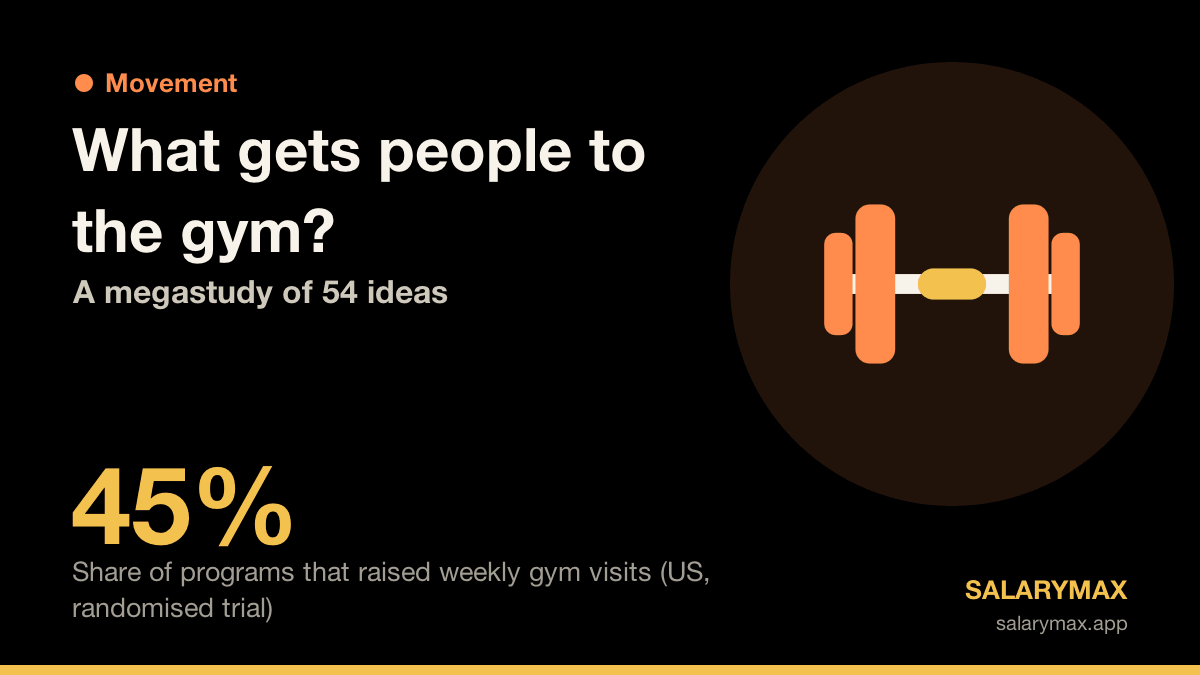
In a US test of 54 programs on 61,293 gym members, 45% raised weekly visits by 9–27%. A small reward for returning after a missed workout did best.
The evidence behind this article
- Randomised trial1
Includes studies built to test cause and effect (randomised trials or natural experiments).
1 sources・Countries studied: United States
How to read the kinds of evidence →What to do with this
The day after you skip a workout, make getting back your only goal, and set a small reward for the day you return. Schedule the time in advance.
What actually helps people keep going to the gym? A US “megastudy” tested 54 different approaches at once on more than 60,000 gym members. About half of the approaches increased gym visits, and the one with the biggest increase was a small reward for coming back after a missed workout. Neither experts nor the public could predict which approaches would work.
Key points
- In a US experiment that randomly assigned 61,293 members of a gym chain to 54 conditions (Milkman and colleagues, 2021), 45% of the 53 programs raised weekly gym visits by 9–27% over four weeks. People in the comparison condition went 1.48 times a week.
- The biggest increase came from giving points worth US$0.09 for returning to the gym after a missed workout: 0.40 more visits a week, or 27%. The authors note that the top estimates are probably inflated, because the best performers were picked from many.
- Only 8% of the programs still showed a clear difference in the four weeks after they ended. When members of the public, professors and practitioners predicted the results, the correlation with what actually happened was close to zero (r=0.02), and their predictions were on average 9.1 times too optimistic.
What is a megastudy that compares 54 ideas at once?
Most studies test one idea from one team in a sample that team recruited, which makes ideas hard to compare. So 30 scientists from 15 US universities each designed, in small teams, a four-week digital program to boost gym attendance, and all the programs were compared in the same population at the same time. This is what the authors call a megastudy.
The setting was 24 Hour Fitness, a large US gym chain. Members active between March 2018 and January 2019 were invited, and 61,293 people were randomly assigned to 54 conditions. The outcome was weekly gym visits counted from check-in records.
The comparison condition simply gave people points worth US$1.08 when they signed up. People in that condition went to the gym 1.48 times a week during the program. A basic program combined three things: planning the dates and times of workouts, text reminders at those times, and points worth about US$0.22 per visit. That alone raised visits by 0.14 a week, or 9%. The other conditions each added one more feature to this basic program.
Which programs increased gym visits?
The top performers were:
- Points worth US$0.09 for returning after a missed workout: 0.40 more visits a week, 27% more
- Raising the points per visit to US$1.75: 25% more
- Telling people that most Americans exercise and that the share is growing: 24% more
- Letting people choose whether points were framed as gains for going or losses for skipping: 19% more
What the top programs share is that they reward coming back after a break, tell people what others do, or let people choose. The amounts of money were all small. No program reduced gym visits.
The effects did not last long, though. Only 8% of the programs still showed a clear difference in the four weeks after they ended. About 2.5% would be expected by chance, so 8% is more than that, but most programs worked only while they were running.
Why did the experts’ predictions miss?
After the experiment, the team asked people who did not know the results to predict how well each program would do. They included 301 members of the public recruited online, 156 professors from US schools of public health, and 90 practitioners from companies that apply behavioural science.
Overall, the correlation between predicted and actual effects was close to zero (r=0.02). Neither professors nor practitioners could tell which programs would come out on top. They also overestimated the size of the effects, on average by 9.1 times. Among the 20 preregistered studies built into the megastudy, few produced results that matched the hypotheses set in advance.
How far does this megastudy go?
Because it was a large randomised experiment, we can say that each successful program caused more gym visits. But the participants were members of one US gym chain, the programs lasted four weeks, and the rewards were very small. The authors note that in-person coaching or larger incentives might have produced bigger effects.
The figures for the top programs are likely to be overstated because they were selected from many, so they need to be confirmed in follow-up studies. We did not find a similar large comparison study in Japan. The study also did not look at work or income.
A small step for today
- Decide in advance when you will exercise. In this experiment, even the basic program of planning and reminders increased visits.
- The day after you skip, make getting back your only goal. When you do, log “Moved for 5+ minutes” and give yourself a small reward you set beforehand.
- On days you make it to the gym, also log “Did strength training.” Count the days you came back rather than blaming yourself for the days you missed.
FAQ
What is the best way to keep going to the gym?
In a US experiment with 61,293 gym members, small points for returning after a missed workout raised weekly visits by 27%, the largest increase. Top estimates tend to be inflated, though, and only 8% of programs still made a difference after they ended.
Can experts predict which approaches will work?
In this experiment, the predictions of the public, professors and practitioners had almost no correlation with the actual results. They also overestimated the effects by 9.1 times on average, which shows that ideas need to be tested.
What should I do if I keep missing the gym?
In this experiment, the biggest increase came from rewarding people for returning after a missed workout. Rather than counting the days you missed, setting a small reward for the day you come back is one approach inspired by the research, though the study did not test rewards you set for yourself.
Sources
- [A10] Milkman et al. (2021) Megastudies improve the impact of applied behavioural science. Nature.
Studies describe average tendencies. This article is not a promise that a habit will lift your income, and it is not medical or investment advice. About these articles ・ Search & sources
Updated:
← All articles