Exercise and income: what the research says
Exercise, step counts, strength training, school sports, fitness. What surveys and trials in several countries have found about movement, work and pay.
20 articles
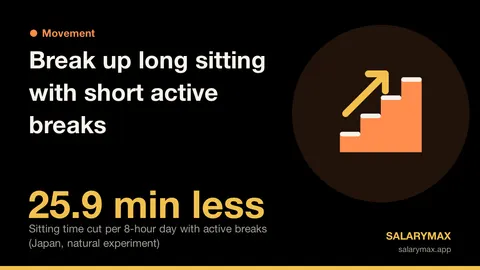 Break up long sitting with short active breaksIn a study of Tokyo offices, workplaces that added short active breaks cut sitting time by 25.9 minutes per 8-hour workday. What the study found, and its limits.
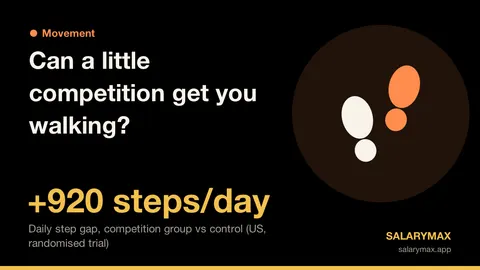 Can a little competition get you walking?In a US randomised trial of 602 adults, all three gamified approaches increased daily steps, and only the competition group kept a difference after the program ended.
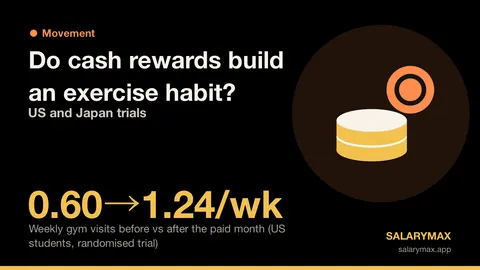 Do cash rewards build an exercise habit? US and Japan trialsIn a US experiment, students paid to use the gym for a month went from 0.60 to 1.24 weekly visits after pay ended. In trials of workers and in Japan, it faded.
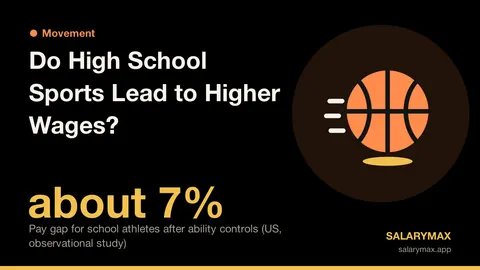 Do High School Sports Lead to Higher Wages?In US data, former high school athletes earned 14% to 19% more, about 7% after adjusting for family and ability. A Japanese study found no wage gain from school clubs.
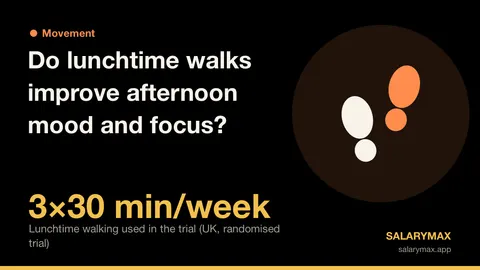 Do lunchtime walks improve afternoon mood and focus?In a UK randomised trial of 56 inactive staff, 30-minute lunchtime walks three times a week raised enthusiasm at work. In Finland, park walks went with better focus.
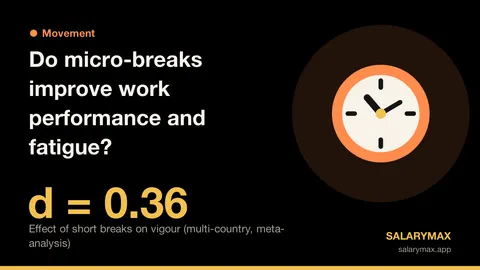 Do micro-breaks improve work performance and fatigue?A meta-analysis of 22 experimental samples (2,335 people) found breaks of 10 minutes or less slightly raised vigour and cut fatigue, with no clear effect on performance.
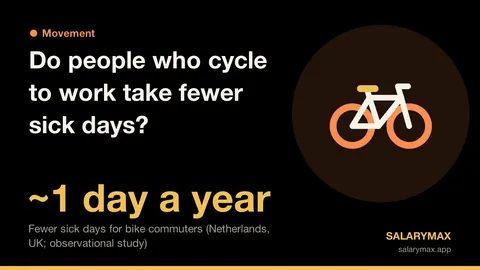 Do people who cycle to work take fewer sick days?A Dutch study of 1,236 employees found cycle commuters had just over one fewer sick day a year, and a UK study of 801 people, about one fewer. Both are observational.
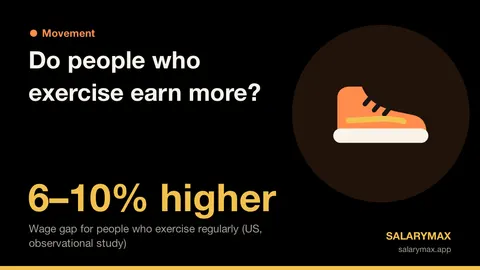 Do people who exercise earn more?Studies in the US and Germany find that people who exercise tend to earn more, with wages 6 to 10% higher in US data. These are observational data, not proof of cause.
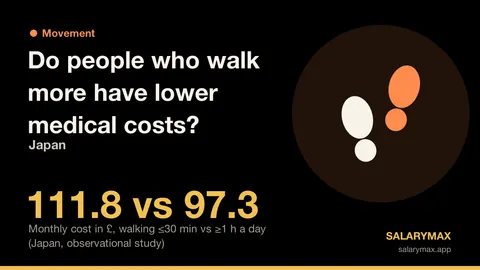 Do people who walk more have lower medical costs? JapanA Japanese study of 27,000 people aged 40 to 79 found that those walking an hour or more a day had lower monthly medical costs. But healthier people may simply walk more.
 Do workplace wellness programs cut costs? Two US trialsTwo US randomized trials found workplace wellness programs raised screening and self-reported exercise but did not change medical spending, sick days or job performance.
 Does exercising during work hours hurt productivity?In a randomised trial at six Swedish dental workplaces, moving 2.5 hours a week of work time to exercise did not cut patients treated. The trial was small: 177 women.
 Does temptation bundling help you keep exercising?In a US trial, gym-only audiobooks raised visits by 51% in week one, but the effect faded. A 6,792-person follow-up found a 10–14% higher chance of a weekly workout.
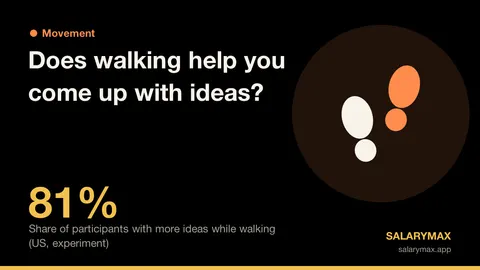 Does walking help you come up with ideas?In Stanford experiments, 81% of students came up with more ideas walking than sitting. A 2026 meta-analysis of 23 studies also found a large effect, mostly in students.
 Exercise and Long-Term Income: A Finnish Twin StudyA study of 5,042 male twins in Finland found that the more physically active twin in each pair tended to have higher income over 15 years. It was not a randomized trial.
 Fitness at 18 and Later Education and CareersA study of 1.2 million Swedish men found that those fitter at 18 scored higher on IQ tests and more often earned degrees and high-status jobs. Strength showed no link.
 Strength training two to three days a weekJapan's Physical Activity and Exercise Guide 2023 advises adults to do strength training two to three days a week. What it says and does not, and how to start at home.
 What changed when Japanese employees started exercisingA Japanese panel study of 6,576 full-time employees found that people who started exercising showed higher work engagement, but no significant change in presenteeism.
 What gets people to the gym? A megastudy of 54 ideasIn a US test of 54 programs on 61,293 gym members, 45% raised weekly visits by 9–27%. A small reward for returning after a missed workout did best.
 What the sports line on your CV signalsIn a Swedish field experiment, CVs listing a leisure sport had a callback rate about 2 percentage points higher. The researcher reads sport as a signal of sociability.
 Where the 8,000-steps target comes fromJapan's health ministry advises adults to take about 8,000 steps a day or more. In an analysis of 15 cohorts, people who walked more tended to have a lower risk of death.