Basics ・ 6 min
Do people who cycle to work take fewer sick days?
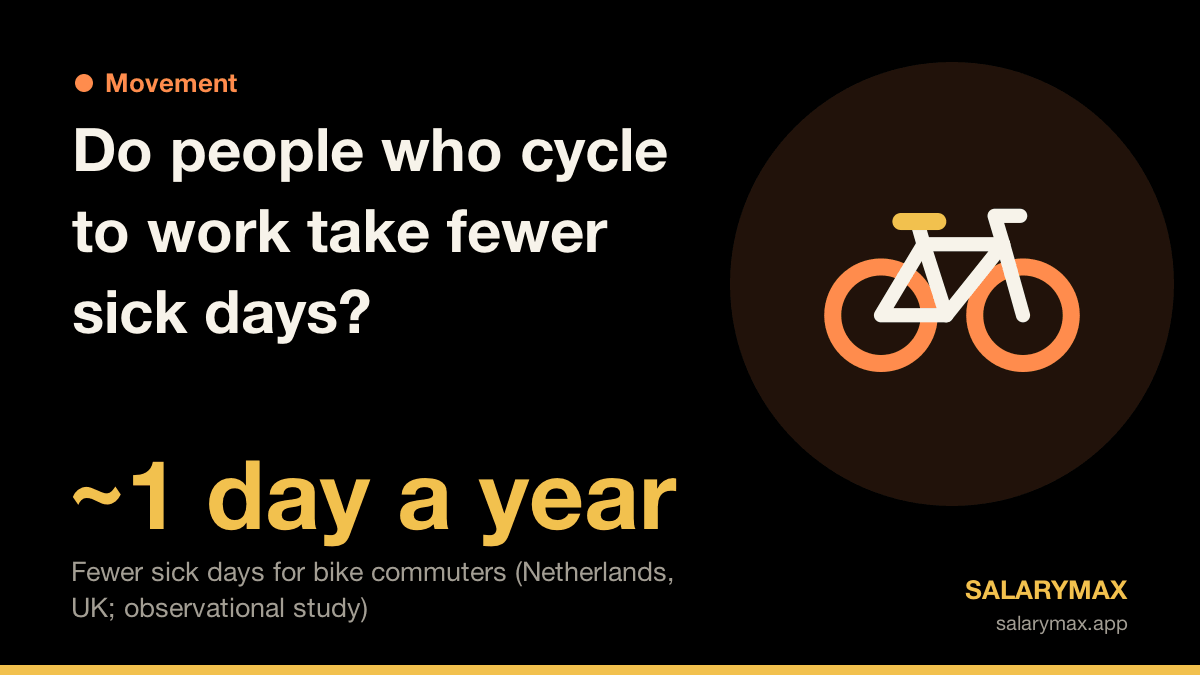
A Dutch study of 1,236 employees found cycle commuters had just over one fewer sick day a year, and a UK study of 801 people, about one fewer. Both are observational.
The evidence behind this article
- Adjusted observational3
- Observational1
Based on observational data. It shows that two things go together, not that one causes the other.
4 sources・Countries studied: Netherlands, United Kingdom, Japan
How to read the kinds of evidence →What to do with this
Turn part of your commute into movement, for example by getting off one stop early. If you want to cycle, first check your employer's rules and the safety of the route.
Do people who cycle to work call in sick less often? Studies from the Netherlands and the UK find that cycle commuters tend to take about one fewer sick day a year. Both studies are observational, so they do not show that taking up cycling will cut your sick days, and neither looked at income.
Key points
- A Dutch study of 1,236 employees used company absence records for one year. Employees who cycled to work had, on average, just over one day less sickness absence than those who did not, and people who cycled more often and farther tended to be absent less.
- A study that followed 801 people working in Cambridge, UK, from 2009 to 2012 found that those who kept cycling to work over a year reported about one fewer sick day per year. Walking to work showed no such association.
- We did not find a Japanese study of commuting and sick days. A survey of 331 male office workers in Japan found that those who walked or cycled to work for 20 minutes or more were more likely to rate their own work performance highly. All of these are correlations, and none measured income.
How many fewer sick days Dutch cycle commuters took
The Dutch study, by Hendriksen and colleagues, asked 1,236 employees about their cycling with a questionnaire and checked company absence records from May 2007 to April 2008. To compare similar people, the researchers used propensity scores, a statistical method that balances the differences between cyclists and non-cyclists.
Over the year, total sickness absence was on average more than one day shorter for cyclists than for non-cyclists. Most of this gap came from a simple pattern: a larger share of cyclists had no sickness absence at all.
The researchers also saw a dose-response pattern. Compared with people who cycled a short distance (5 km or less) three times a week, people who cycled more often and over longer distances were absent for fewer days on average.
Did UK commuters who kept cycling differ from those who started?
The UK study, by Mytton and colleagues, used the Commuting and Health in Cambridge study (2009 to 2012, 801 people) and followed the same people from year to year.
After adjusting for sociodemographic factors, physical activity and physical limitations, people who kept cycling to work over a one-year period reported lower sickness absence than people who did not cycle to work, equivalent to about one fewer day per year. They also had higher mental wellbeing scores. The sickness absence association held after accounting for how much sick leave people had taken at the start.
However, changes in cycle commuting, such as starting or stopping, were not significantly linked to changes in the health measures. Walking to work was not significantly linked to sickness absence or to wellbeing.
How to read research on cycling to work and sick days
In neither study were people assigned to cycle by lottery. People who are already healthier, or who live close to work and have more time, may be the ones who choose to cycle. The researchers adjusted for such differences, but they could not rule them out completely. The lack of a clear change among people who started cycling in the UK study is another reason for caution.
Both studies looked at sick days, not income or promotion. And both the Netherlands and Cambridge are places where cycling to work is relatively easy.
We did not find a Japanese study of active commuting and sick days. A related study by Tsuboi and colleagues surveyed 331 male office workers. Those who walked or cycled to work for 20 minutes or more (42.2%) were more likely to rate their work performance highly (odds ratio 2.43). It was a one-time survey. A Japanese online survey in 2021 of 1,551 commuters found that 41.4% commuted by car or motorbike, more often in rural areas, and 32.9% of them said they might be able to switch to walking, cycling or public transport. Korean research was outside the scope of this review.
A small step for today
You do not have to cycle the whole way. You can turn part of your commute into time spent moving. Safety comes first.
- Hit “Moved for 5+ minutes” on your commute: get off one stop early, or walk a little from where you park.
- When that feels easy, use the walk to and from work to move toward “Walked 8,000+ steps.”
- If you want to cycle, check your employer’s commuting rules and the safety of the route first.
FAQ
Does cycling to work mean fewer sick days?
In studies from the Netherlands and the UK, cycle commuters tended to take about one fewer sick day a year. The data are observational, so they do not show that starting to cycle will reduce your sick days.
Is walking to work linked to fewer sick days too?
The Cambridge study of 801 people found no significant link between walking to work and sickness absence. In a Japanese survey of male office workers, people who walked or cycled for 20 minutes or more rated their own work performance more highly.
Is cycling to work linked to higher income?
The studies here measured sick days and self-rated work performance, not income. They cannot tell us whether cycling to work is related to pay.
Sources
- [X-hendriksen-2010] Hendriksen, Simons, Garre & Hildebrandt (2010) The association between commuter cycling and sickness absence. Preventive Medicine.
- [X-mytton-2016] Mytton, Panter & Ogilvie (2016) Longitudinal associations of active commuting with wellbeing and sickness absence. Preventive Medicine.
- [X-tsuboi-2017] Tsuboi, Murata & Ono (2017) Is Active Commuting to Work Related to Work Performance Among Male Office Workers? Journal of Occupational and Environmental Medicine.
- [X-fukunishi-2024] Fukunishi et al. (2024) Commute mode — physical activity and the possibility of change to active commuting among Japanese workers: a descriptive study by region. Sangyo Eiseigaku Zasshi.
Studies describe average tendencies. This article is not a promise that a habit will lift your income, and it is not medical or investment advice. About these articles ・ Search & sources
Updated:
← All articles