Deep dive ・ 7 min
Do High School Sports Lead to Higher Wages?
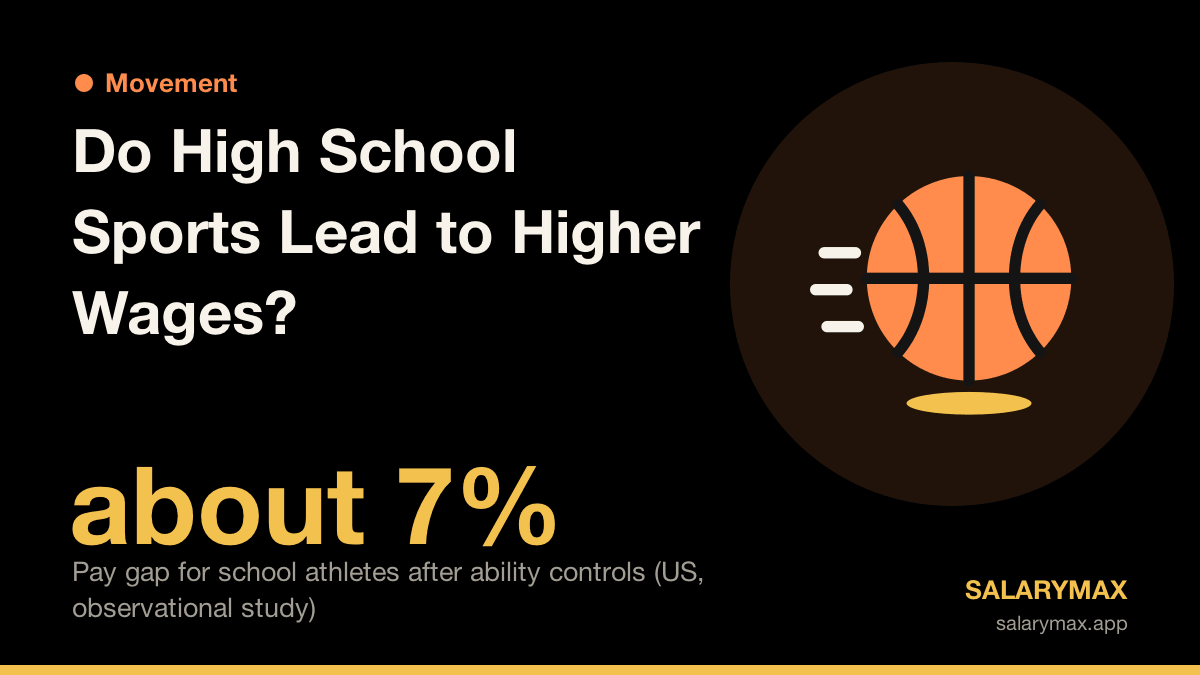
In US data, former high school athletes earned 14% to 19% more, about 7% after adjusting for family and ability. A Japanese study found no wage gain from school clubs.
The evidence behind this article
- Natural experiment2
- Adjusted observational2
Includes studies built to test cause and effect (randomised trials or natural experiments).
4 sources・Countries studied: United States, Japan
How to read the kinds of evidence →What to do with this
Do not judge yourself by whether you played school sports. Start by moving for at least five minutes in a way you enjoy.
Do people who played school sports earn more as adults? US surveys find that former high school athletes tend to have higher wages. But students with more ability or drive may be the ones who choose sports, and once that is accounted for, the gap shrinks or, in some studies, disappears.
Key points
- Using a US national youth survey (NLSY79), Stevenson (2010) found that in 1994, at an average age of 33, former high school athletes earned 14% (women) and 19% (men) more per hour. With family, school and ability considered, the gap shrank to about 7%. This is observational, not cause and effect.
- The same study used Title IX, a 1972 US law against sex discrimination in schools that sharply expanded girls’ sports. A 10-point rise in a state’s female sports participation rate raised women’s college attendance by 1 point and their labor force participation by 1 to 2 points. The effect on hourly wages was unclear.
- A Japanese study of 5,142 people aged 25 to 59 (Yasui and colleagues, 2021, not yet peer reviewed) found that junior high club members earned 11.5% more in a simple comparison, but an estimate using school policies on compulsory clubs showed no wage gain; wages were lower.
How much more do former US athletes earn in a simple comparison?
Barron and colleagues (2000) used two US data sets, the National Longitudinal Survey of Youth and a survey of the high school class of 1972. They found some evidence that sports directly affect wages and schooling, but much of the effect seemed to reflect differences in ability or in how much people value leisure.
Stevenson (2010) shows a similar pattern. Controlling only for demographics such as age and race, former athletes earned 14% more per hour among women and 19% more among men. Adding family background, such as parents’ education, and school characteristics cut the gap to 11% and 14%. Adding measures of ability, such as test scores and self-esteem, cut it to about 7%. The more evenly matched the comparison, the smaller the gap, suggesting that students who choose sports were different to begin with.
What happened to girls when a law expanded school sports?
No experiment assigns students to sports by lottery, so Stevenson turned to Title IX. To comply with the law, high schools rapidly added girls’ teams. Girls’ participation rose from 1 in 27 in 1972 to 1 in 4 by 1978, while boys’ stayed at about 1 in 2.
States where boys’ sports were already big had to add more places for girls. Using these state differences, a 10-point rise in a state’s female participation rate raised women’s college attendance by 1 point and their labor force participation by 1 to 2 points. More women also entered formerly male-dominated jobs, especially high-skill ones.
On hourly wages, though, the estimates swung widely, and the author writes that no firm conclusion can be drawn.
Does the athlete gap survive once selection is taken into account?
Ransom and Ransom (2018) used three US national longitudinal surveys to estimate a range for the effect of sports that allows for differences between athletes and non-athletes. They found no consistent evidence that former athletes are more likely to attend college, earn more or be in the labor force, though men who played were more likely to exercise regularly as adults.
In Japan, a 2019 online survey by Yasui and colleagues asked 5,142 people aged 25 to 59 about junior high clubs; 85% had joined one. Some public junior high schools require every student to join a club and take part, others leave it optional, and most people attend their district’s school. Using these policies, the 11.5% wage gap in a simple comparison disappeared; instead, club experience lowered wages by 39.8%. The clubs did raise ninth-grade test scores, cut lateness and absence in high school, and raised agreeableness.
How to read the research on school sports and wages
First, much of the wage gap seen in simple comparisons seems to reflect who chooses to play sports. No study shows that playing school sports raises wages.
Second, the Japanese numbers need care. The authors note that the estimate applies to students who joined only because their school required it, not to everyone who joined. It combines sports and non-sports clubs, no wage effect was found for women, and the paper is a discussion paper that has not yet been peer reviewed.
The US natural experiment showed that when girls gained the chance to play sports, more went to college and into work. Offering the chance and requiring students to take part are probably best seen as two different things.
A small step for today
Whether you played school sports says little about you now. The research shows average tendencies, mixed with differences in who chose to play. You can choose to be active as an adult, starting today.
- Start “Moved for 5+ minutes” with a kind of movement you enjoy.
- Keep up “Walked 8,000+ steps” by setting aside days to walk with someone.
- If your child is deciding about a club, talk it through with them and decide together.
FAQ
Do people who played sports in school earn more?
In US surveys, former athletes tended to have higher wages, but the gap shrank once family and ability were considered. Another US study found no consistent gap after allowing for who chooses to play.
Are Japanese school clubs linked to later wages?
In a Japanese study, junior high club members earned 11.5% more in a simple comparison, but an estimate based on school policies found no wage gain. The paper is not yet peer reviewed and combines sports and non-sports clubs.
Does playing a school sport help you get a job?
We found no study that tested this directly. In the US, states where girls’ sports grew more saw larger rises in women’s college attendance and employment, but the wage effect was unclear.
Sources
- [X-barron-2000] Barron, Ewing & Waddell (2000) The Effects of High School Athletic Participation on Education and Labor Market Outcomes. The Review of Economics and Statistics.
- [X-stevenson-2010] Stevenson (2010) Beyond the Classroom: Using Title IX to Measure the Return to High School Sports. The Review of Economics and Statistics.
- [X-ransom-2018] Ransom & Ransom (2018) Do high school sports build or reveal character? Bounding causal estimates of sports participation. Economics of Education Review.
- [X-yasui-2021] Yasui, Sano, Kume & Tsuru (2021) The effects of compulsory junior high school club activities on skills and outcomes (in Japanese). RIETI Discussion Paper.
Studies describe average tendencies. This article is not a promise that a habit will lift your income, and it is not medical or investment advice. About these articles ・ Search & sources
Updated:
← All articles