Practice ・ 6 min
Do cash rewards build an exercise habit? US and Japan trials
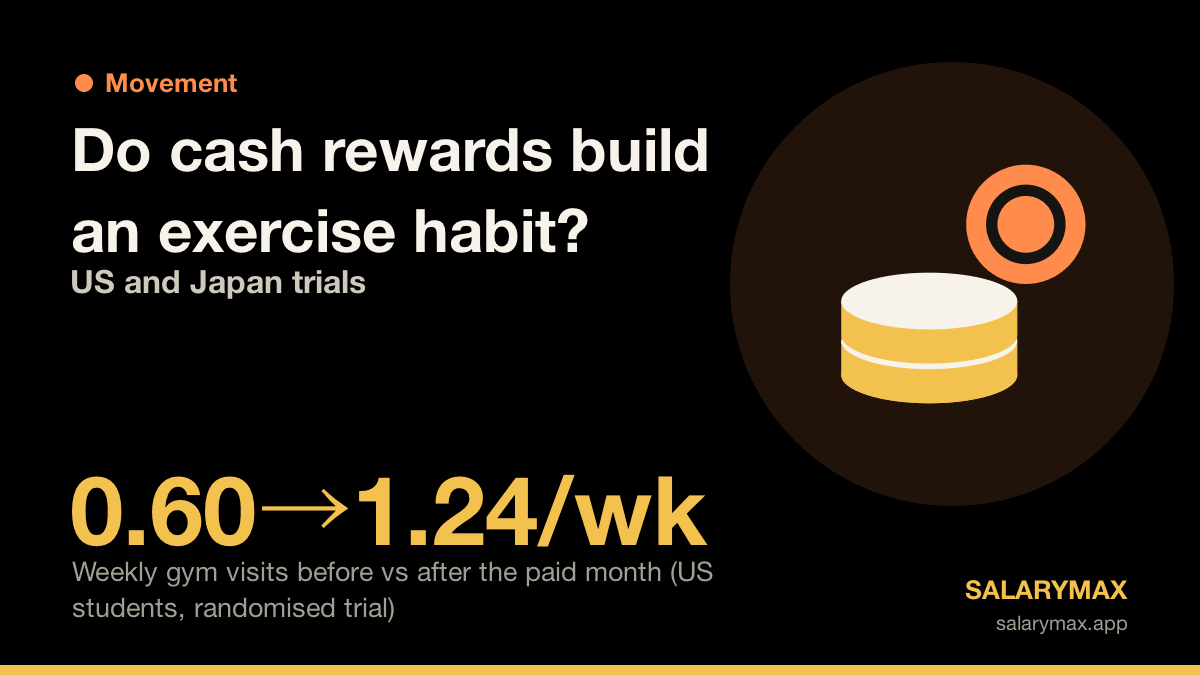
In a US experiment, students paid to use the gym for a month went from 0.60 to 1.24 weekly visits after pay ended. In trials of workers and in Japan, it faded.
The evidence behind this article
- Randomised trial3
- Research synthesis1
Includes studies built to test cause and effect (randomised trials or natural experiments).
4 sources・Countries studied: United States, Japan
How to read the kinds of evidence →What to do with this
When you start exercising, set a small reward for yourself for the first month only, and before it ends, write down a commitment to keep going.
If someone pays you to exercise, you will probably exercise. The real question is whether you keep going once the money stops. In US and Japanese trials, rewards increased exercise while they lasted, but whether the habit survived depended on who took part and how the program was designed.
Key points
- In a US randomised experiment, university students paid $100 to visit the gym at least eight times in a month went from 0.60 to 1.24 weekly visits in the seven weeks after the pay ended. The increase came from students who had not been going to the gym before.
- In a US experiment with about 1,000 employees of a large company, a $10-per-visit reward roughly doubled gym attendance, but one month after it ended only 25% of the increase remained. Workers who could also commit their own money to keep going kept a difference for much longer.
- In a randomised trial of 72 adults in Sendai, Japan, shopping points raised daily steps, but after the points stopped the difference from the control group was no longer clear.
Did students who were paid to go to the gym keep going?
The first study is by economists Gary Charness and Uri Gneezy (2009), who ran two experiments with US university students. Study 1 involved 120 students at the University of Chicago. Forty were a control group. The other 80 were paid $25 to visit the gym once in a week, and half of them were then offered another $100 to go at least eight more times over the next four weeks.
In the seven weeks after the payments ended, the eight-visit group went from 0.60 to 1.24 gym visits a week, a 107% increase. The control group went from 0.59 to 0.56, and the one-visit group from 0.70 to 0.76, so almost no change.
Study 2, with 168 students at the University of California, San Diego, found the eight-visit group going from 0.52 to 1.46 visits a week, with slight improvements in weight, waist size and pulse rate. Of the 49 people in that group who had not been regular gym users, 26 (53%) became regular. People who already went regularly did not go more often.
What lasted for workers after the rewards stopped?
Next, Heather Royer, Mark Stehr and Justin Sydnor (2015) studied about 1,000 employees of a Fortune 500 company in the US, randomly assigned to groups. According to the working-paper version of the study, the reward was $10 per visit to the company gym, up to three visits a week, for one month.
During the reward month, gym attendance roughly doubled. But one month after the reward ended, only 25% of the increase remained, and by the second month most of it was gone. Some change lasted only among people who had not been gym members before.
The twist was a commitment contract. Half of the rewarded group could pledge to keep going for the next two months with their own money at stake; if they failed, the money went to charity. Only 12% signed up, yet the group offered this option kept half of its reward-driven increase and went to the gym 50% more often than the control group. The final published paper reports that the difference was still detectable several years after the reward ended.
Did points raise daily steps in Japan?
In Japan, a Tohoku University team ran a randomised trial with 72 inactive adults in Sendai (Tanji and colleagues, 2020). During three weeks in which people earned shopping points for meeting a step target, daily steps rose by 1,650 in the reward group and by 514 in the control group. In the three weeks after the points stopped, the difference between the groups was no longer statistically clear.
A review of 14 Japanese studies (Aoki and Kawachi, 2026) found that points or gift certificates worth about 11 to 100 yen a day raised daily steps by 997 on average. Only one study looked at what happened after the rewards ended, and in that study the extra steps did not last.
How far does this evidence go on cash rewards and exercise?
The two US studies and the Sendai study were randomised experiments, so we can say rewards caused more exercise while they were in place. Of the 14 Japanese studies in the review, only 2 were randomised trials; the rest were mostly non-randomised comparisons. The change lasted afterwards only in some cases: the US student experiment and the workers who could make a commitment. The participants were US students, employees of one company and 72 people in Japan, and follow-up lasted months, except in the final version of the workplace study.
The effect also came from people who had not been exercising before. Money seems to help people over the first hurdle, while keeping a habit going takes something else. None of these studies measured income.
A small step for today
- If you are starting out, set a small reward for the first month only. Log “Moved for 5+ minutes” each day and count the days you did it.
- Before the reward ends, write down a commitment for the next two months. In the workplace study, that option kept the difference going for longer.
- If walking is your main activity, use “Walked 8,000+ steps” as your target. Keep logging after the reward is gone.
FAQ
Can cash rewards help you build an exercise habit?
Rewards increased exercise while they lasted, but whether the effect remained varied. It lasted in a US student experiment, but faded once rewards stopped in a workplace experiment and a Japanese step-count trial.
How can you keep exercising after a reward ends?
In the US workplace experiment, the group that could commit to continuing kept half of its increase. Starting with a reward and setting a commitment before it ends is one approach this research supports.
Do rewards work for people who already exercise?
In the US student experiments, people who already went to the gym regularly did not go more often. The effect came from people who had not been going before.
Sources
- [X-charness-gneezy-2009] Charness & Gneezy (2009) Incentives to Exercise. Econometrica.
- [X-royer-stehr-sydnor-2015] Royer, Stehr & Sydnor (2015) Incentives, Commitments, and Habit Formation in Exercise: Evidence from a Field Experiment with Workers at a Fortune-500 Company. American Economic Journal: Applied Economics.
- [X-tanji-2020] Tanji et al. (2020) Effect of a financial incentive (shopping point) on increasing the number of daily walking steps among community-dwelling adults in Japan: a randomised controlled trial. BMJ Open.
- [X-aoki-kawachi-2026] Aoki & Kawachi (2026) Financial Incentives to Promote Physical Activity in Japan: A Rapid Review. Journal of Primary Care & Community Health.
Studies describe average tendencies. This article is not a promise that a habit will lift your income, and it is not medical or investment advice. About these articles ・ Search & sources
Updated:
← All articles