Basics ・ 6 min
Do people who walk more have lower medical costs? Japan
A Japanese study of 27,000 people aged 40 to 79 found that those walking an hour or more a day had lower monthly medical costs. But healthier people may simply walk more.
The evidence behind this article
- Adjusted observational2
Based on observational data. It shows that two things go together, not that one causes the other.
2 sources・Countries studied: Japan
How to read the kinds of evidence →What to do with this
Record how long you walk each day for one week to learn your daily total. Then add one 10-minute walk to your commute or errands.
Does walking cut medical bills? In Japan’s Ohsaki Cohort Study, people who walked an hour or more a day did tend to have lower medical costs than those who walked 30 minutes or less. But this is an observational study, and the link may also run the other way: healthier people are able to walk more.
Key points
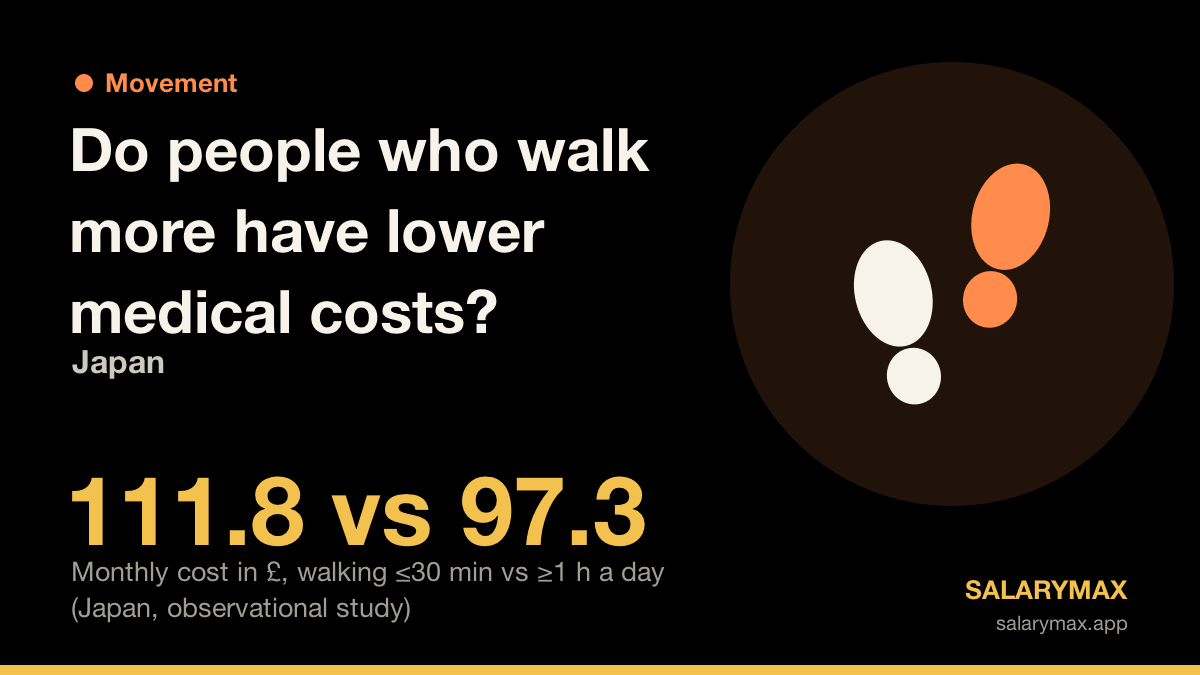
- A study that followed 27,431 people aged 40 to 79 with National Health Insurance in the Ohsaki area of Miyagi Prefecture for four years (Tsuji and colleagues 2003) found monthly medical costs per person of £111.80 for those walking 30 minutes or less a day and £97.30 for those walking an hour or more, after statistical adjustment.
- A 13-year follow-up of 27,738 people in the same area (Nagai and colleagues 2011) found that men who walked an hour or more a day had a life expectancy from age 40 that was 1.38 years longer and lifetime medical costs from age 40 that were 7.6% lower. For women the differences were not clear.
- Both are observational studies, not experiments in which walking was randomly assigned. People with physical limitations were excluded, but we cannot be sure the reverse link, that healthier people walk more, was fully removed.
How walking time and medical costs were linked in the Ohsaki cohort
The Ohsaki Cohort Study is run by a team at Tohoku University and follows residents of the area served by the Ohsaki Public Health Center in Miyagi Prefecture, northeastern Japan. In 1994, people aged 40 to 79 with National Health Insurance answered a lifestyle questionnaire.
The 2003 paper (Tsuji and colleagues 2003) included 27,431 of them who had no physical limitations or conditions that interfered with physical activity. Over four years, from January 1995 to December 1998, the researchers linked them to insurance claims records and tracked every hospital stay, outpatient visit and its cost.
The researchers split people into three groups by daily walking time and adjusted for other possible factors. Monthly medical costs per person were as follows. The paper reports costs converted into British pounds.
- Walking 30 minutes or less a day: £111.80
- 30 minutes to 1 hour: £108.10
- 1 hour or more: £97.30
People who walked longer tended to cost less.
Does living longer mean higher lifetime medical costs?
People who walk a lot may live longer and so build up more medical costs over a lifetime. The 2011 paper (Nagai and colleagues 2011) followed 27,738 people in the same area for 13 years to look at this. Costs were converted at a purchasing-power parity rate of £1 = ¥140.
Comparing men who walked an hour or more a day with those who walked less than an hour:
- Life expectancy from age 40 was 1.38 years longer (statistically significant).
- Lifetime medical costs from age 40 were 7.6% lower (statistically significant).
For women, life expectancy differed by 1.16 years and lifetime costs by 2.7%, but neither difference was statistically significant. The authors conclude that longer lives from a healthier lifestyle do not necessarily mean higher lifetime medical costs.
How to think about the reverse link: healthier people walk more
What this evidence supports is this: in an observational study of middle-aged and older adults in Miyagi, people who walked more tended to have lower medical costs. It does not show that walking reduces medical costs.
The biggest issue is the direction of cause. People with chronic illness or poor health both cost more to treat and walk less. So the data may show not that walking lowers costs, but that being healthy lets people walk more and also need less care. The researchers excluded people who reported physical limitations at the start and adjusted for other differences. Even so, unmeasured differences in health may remain.
There are other limits. Walking time came from a simple questionnaire, and walking pace or distance was not asked. The participants were National Health Insurance members in Miyagi in the 1990s, which leaves out people covered by employer health insurance. The results may not apply directly to today’s working-age people.
A small step for today
What the research reasonably supports is that gradually walking more is worth keeping up as one way of looking after your health. There is no need to think of it in terms of medical bills or income.
- Record how long you walk each day for one week to learn your daily total.
- Add one 10-minute walk to your commute or errands. On days you do, log “Moved for 5+ minutes”.
- Once you are used to it, aim for a few days a week when you log “Walked 8,000+ steps”.
If you have a chronic condition or walking causes pain, talk with your doctor about how much to walk.
FAQ
Do people who walk more have lower medical costs?
In a study that followed 27,431 people aged 40 to 79 in the Ohsaki area of Miyagi for four years, those who walked an hour or more a day tended to have lower monthly medical costs than those who walked 30 minutes or less (£97.30 versus £111.80). Because it is an observational study, it does not show that walking lowered costs. The reverse link, that healthier people walk more, is also possible.
Doesn’t living longer mean higher lifetime medical costs?
In the 13-year follow-up in the same area, men who walked an hour or more a day had a life expectancy 1.38 years longer and lifetime medical costs from age 40 that were 7.6% lower. For women the differences were not clear.
How many minutes a day should I walk?
In this study, medical costs were lowest among people who walked an hour or more a day. But walking time was self-reported, and pace and distance are unknown. Ask your doctor if you have a chronic condition.
Sources
- [X-tsuji-2003] Tsuji et al. (2003) Impact of walking upon medical care expenditure in Japan: the Ohsaki Cohort Study. International Journal of Epidemiology.
- [X-nagai-2011] Nagai et al. (2011) Impact of walking on life expectancy and lifetime medical expenditure: the Ohsaki Cohort Study. BMJ Open.
Studies describe average tendencies. This article is not a promise that a habit will lift your income, and it is not medical or investment advice. About these articles ・ Search & sources
Updated:
← All articles