Practice ・ 6 min
Do micro-breaks improve work performance and fatigue?
A meta-analysis of 22 experimental samples (2,335 people) found breaks of 10 minutes or less slightly raised vigour and cut fatigue, with no clear effect on performance.
The evidence behind this article
- Randomised trial1
- Research synthesis1
Includes studies built to test cause and effect (randomised trials or natural experiments).
2 sources・Countries studied: Japan, Several countries
How to read the kinds of evidence →What to do with this
Once an hour, at a natural pause, stand up and stretch for a minute or two. On days you feel worn out after hard thinking, try one break of 10 minutes or more.
Is stopping work for a few minutes slacking off, or a way to keep going? A review of 22 study samples found that breaks of 10 minutes or less had a small effect in raising vigour and reducing fatigue. Whether they improve work performance, however, was not clear.
Key points
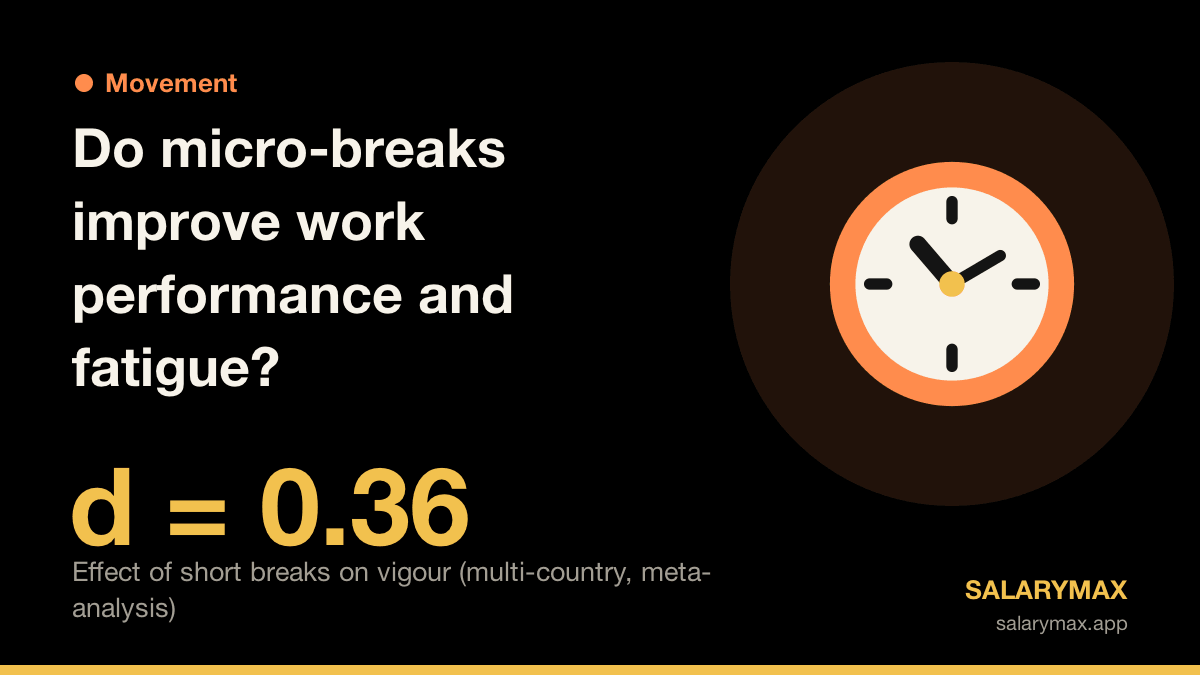
- A meta-analysis by a Romanian research team (Albulescu and colleagues 2022) pooled 22 experimental and quasi-experimental samples with 2,335 people. Breaks of 10 minutes or less, called micro-breaks, raised vigour (d = 0.36) and reduced fatigue (d = 0.35), both described by the authors as small effects.
- In the same analysis, the effect on overall performance was d = 0.16 and not statistically significant. After demanding mental tasks there was almost no effect, while after clerical or creative tasks there was some.
- Longer breaks were linked to larger performance gains, and recovering from very draining tasks may take more than 10 minutes. A Japanese workplace trial was included, but the number of studies was small and many experiments used students.
The meta-analysis of 22 studies on breaks of 10 minutes or less
This is a meta-analysis by a team at the West University of Timișoara in Romania (Albulescu and colleagues 2022). A meta-analysis combines many studies and recalculates the overall result. The team gathered experimental and quasi-experimental studies and used data from 22 samples in 19 papers, 2,335 people in total. The studies came from countries including the US, Australia, Brazil, China and Japan, and involved both employees and students.
Here a micro-break means a pause from a task of no longer than 10 minutes. What people did during the break varied: moving their body, relaxing, contact with nature, or switching to a different kind of mental activity.
The results are below. The letter d is an effect size, a standard way to express how large a difference is.
- Vigour, the feeling of having energy: d = 0.36 (9 studies, 913 people), a statistically significant difference.
- Fatigue: reduced by d = 0.35 (9 studies, 803 people), also significant.
- Overall performance: d = 0.16 (15 studies, 1,132 people), not statistically significant.
The authors summarise the effects on vigour and fatigue as statistically significant but small.
Performance depended on the task before the break and its length
When performance was split by the type of task done before the break, differences appeared.
- After demanding mental tasks, such as attention tests: d = -0.09, essentially no effect.
- After creative tasks: d = 0.38, a small effect.
- After clerical tasks: d = 0.56, but this is based on only two studies and should be read with caution.
Longer breaks were also linked to larger gains in performance. The authors suggest that recovering from very draining tasks may require breaks longer than 10 minutes. One way to read this is that a short break can lift your mood but may not be enough to fully restore the capacity needed for heavy mental work.
How to read the research on micro-breaks
What this evidence supports is this: in a pooled analysis of experiments and quasi-experiments, breaks of 10 minutes or less had a small effect in raising vigour and reducing fatigue. A clear effect on overall performance has not been shown.
There are limits. Each outcome rested on only 9 to 15 studies, too few to work out which break activity works best. Many experiments used convenience samples of students, whose situation differs from a workplace. Effects on pay or careers were not studied.
Japanese research is included. In one trial by a team at the University of Occupational and Environmental Health, workplaces with 59 white-collar workers were randomly assigned, and the exercise group did 10 minutes of short exercise during lunch breaks, three times a week for 10 weeks (Michishita and colleagues 2017). In those workplaces, scores for vigour and friendliness on a mood test rose. Its abstract reported gains in mood, relationships and activity, not in work performance.
Another article covers a Tokyo office study on breaking up long periods of sitting with short breaks. That study measured sitting time and activity levels.
A small step for today
What the research reasonably supports is pausing often so fatigue does not build up. It does not show that breaks make you perform better.
- Once an hour, at a natural pause, stand up and stretch for a minute or two. When you do, log “Stood up and moved once an hour”.
- On days when long stretches of hard thinking leave you worn out, try one break of 10 minutes or more. If you manage a short walk outside, log “Moved for 5+ minutes” as well.
- Do whatever you like during the break. This analysis could not tell which activity works best.
Making breaks compulsory can become a burden of its own. Counting only the breaks you do take is enough.
FAQ
Do short breaks make you more productive?
In a meta-analysis of 22 study samples, the effect of breaks of 10 minutes or less on overall performance was small (d = 0.16) and not statistically significant. There were effects after clerical and creative tasks, but almost none after demanding mental tasks. So we cannot say short breaks raise productivity.
Do micro-breaks work at all?
In the same analysis, micro-breaks raised vigour (d = 0.36) and reduced fatigue (d = 0.35). The authors describe both effects as small. The reading that fits the research is that they may help restore mood and energy.
How long should a break be?
In this analysis, longer breaks were linked to larger gains in performance. The authors suggest that recovering from very draining tasks may require more than 10 minutes. The ideal length is not yet known.
Sources
- [X-albulescu-2022] Albulescu et al. (2022) Give me a break! A systematic review and meta-analysis on the efficacy of micro-breaks for increasing well-being and performance. PLOS ONE.
- [X-michishita-2017] Michishita et al. (2017) The practice of active rest by workplace units improves personal relationships, mental health, and physical activity among workers. Journal of Occupational Health.
Studies describe average tendencies. This article is not a promise that a habit will lift your income, and it is not medical or investment advice. About these articles ・ Search & sources
Updated:
← All articles