Practice ・ 7 min
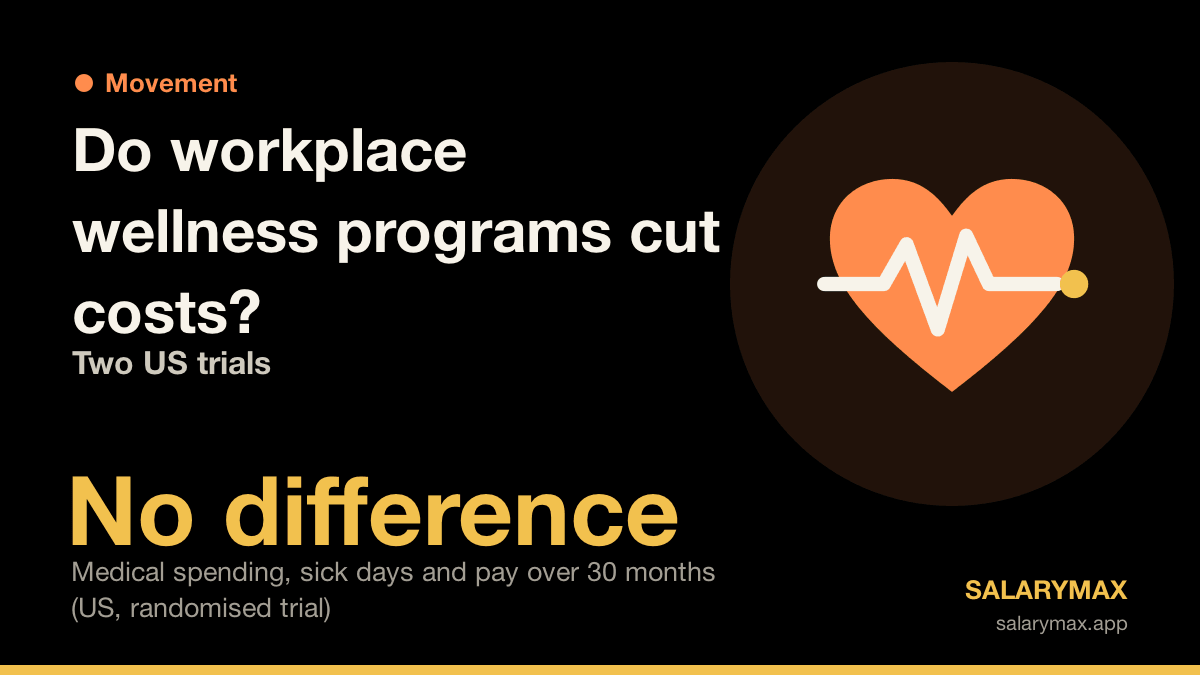
Do workplace wellness programs cut costs? Two US trials
Two US randomized trials found workplace wellness programs raised screening and self-reported exercise but did not change medical spending, sick days or job performance.
The evidence behind this article
- Randomised trial2
- Natural experiment2
Includes studies built to test cause and effect (randomised trials or natural experiments).
4 sources・Countries studied: United States, Japan
How to read the kinds of evidence →What to do with this
Make 'Moved for 5+ minutes' your daily baseline even when you miss a company class, and keep up health checks, talking to a doctor or nurse about results.
Do company wellness programs that encourage exercise and health checks reduce medical costs or sick days? Two large randomized trials in the United States looked for exactly that, and neither found clear effects on medical spending, absenteeism or job performance. Much of what earlier studies saw seems to reflect who signs up: healthier people.
Key points
- In a randomized controlled trial (RCT) at the University of Illinois, 4,834 employees were split by lottery into a group that could join a wellness program and a group that could not. Over up to 30 months, there were no significant differences in medical spending, sick leave, salary, promotion or gym visits.
- In the same trial, the employees who took part had already spent $1,384 less on medical care in the year before the program and were more active at the gym and in running events. Simply comparing participants with non-participants makes this difference look like an effect of the program.
- In a trial across 160 worksites of a large US warehouse retail company, the share of employees who said they exercised regularly rose by 8.3 percentage points after 18 months, but clinical measures such as blood pressure, medical spending, absenteeism and job performance did not differ.
What happened when wellness programs were tested by lottery
The first trial was run by economists Jones, Molitor and Reif at the University of Illinois at Urbana-Champaign. They invited 12,459 employees and 4,834 enrolled. By lottery, 3,300 were placed in the group that could join the program and 1,534 in a control group that could not.
The two-year program included an on-site health screening, an online health risk assessment and weekly wellness activities, with rewards of $50 to $650. In the first year, 56.0% of the treatment group finished both the screening and the assessment.
More people in the treatment group reported having had a health screening. But the researchers found no significant effects on medical spending, on job measures such as sick leave, salary and promotion, on gym visits, or on self-reported health. The picture was the same up to 30 months later. The authors report that their 95% confidence intervals rule out 84% of the medical spending and absenteeism effects reported in 112 earlier studies.
The second trial, by Song and Baicker, took place at a large US warehouse retail company. Twenty of 160 worksites (4,037 employees) were chosen by lottery, and registered dietitians ran eight modules on nutrition, physical activity, stress and related topics. The other 140 worksites (28,937 employees) received no program.
After 18 months, more employees at program sites said they exercised regularly (69.8% vs 61.9%, a difference of 8.3 percentage points) and that they were actively managing their weight (69.2% vs 54.7%, a difference of 13.6 points). Yet there were no differences in 10 clinical measures, including cholesterol and blood pressure, in 38 measures of medical spending and use, or in three employment outcomes: absenteeism, job tenure and job performance.
Why earlier studies made wellness programs look so effective
The key is who joins. In the Illinois trial, participants had spent $1,384 less on medical care than non-participants in the year before the program began, and they were already more likely to use the campus gym and enter running events. People who cared about their health were the ones who signed up.
Most earlier studies compared participants with non-participants. When the Illinois team made that same comparison in their own data, medical spending appeared to fall, by an amount close to earlier observational estimates. But that estimate was ruled out by the lottery-based comparison. Much of the apparent effect reflected the kind of people who join, not the program itself.
How to read these wellness program results, including for Japan
Both studies are randomized trials, so they are strong evidence. Still, they come from two US employers and cover 18 to 30 months. They cannot tell us what a longer or different program would do. The rise in exercise was also self-reported and was not matched by changes in clinical measures.
Japan has a national program called Specific Health Guidance. People aged 40 to 74 whose waist is 85 cm or more and who have a risk factor such as high blood pressure receive lifestyle counselling. A study comparing men just above and just below the waist cut-off (74,693 men) found weight was 0.29 kg lower after one year, but the difference faded by years three and four, and blood pressure and blood sugar did not change. A second study, of members of a health insurer for civil engineering and construction companies, found slightly fewer outpatient visit days but no difference in medical spending. We did not find any Japanese study of how company wellness programs affect job performance or pay, and Korean research was outside the scope of this review.
A small step for today
These results do not mean exercise is pointless. What matters is a routine you can keep.
- Make “Moved for 5+ minutes” your daily baseline. Stairs or a short walk count, even on days you miss a company class.
- When that feels easy, add “Walked 8,000+ steps,” using your commute or lunch break.
- Keep going to workplace health checks, and talk to a doctor or nurse about results and treatment. This article is not medical advice.
FAQ
Do workplace wellness programs lower health care costs?
In two US randomized trials, they did not significantly change medical spending. The Illinois trial followed employees for up to 30 months and the retail trial for 18 months, with the same result.
Do wellness programs reduce sick days?
These two trials found no significant difference in sick leave or absenteeism. Participants can look healthier because healthier people are more likely to join in the first place.
Is it still worth joining a workplace wellness program?
More people got health screenings, and more said they exercised regularly. Effects on medical costs and job performance were not confirmed, so it makes sense to join for your own health goals.
Sources
- [X-jones-molitor-reif-2019] Jones, Molitor & Reif (2019) What do Workplace Wellness Programs do? Evidence from the Illinois Workplace Wellness Study. The Quarterly Journal of Economics.
- [X-song-baicker-2019] Song & Baicker (2019) Effect of a Workplace Wellness Program on Employee Health and Economic Outcomes: A Randomized Clinical Trial. JAMA.
- [X-fukuma-2020] Fukuma, Iizuka, Ikenoue & Tsugawa (2020) Association of the National Health Guidance Intervention for Obesity and Cardiovascular Risks With Health Outcomes Among Japanese Men. JAMA Internal Medicine.
- [X-fukuma-2022] Fukuma, Mukaigawara, Iizuka & Tsugawa (2022) Impact of the national health guidance intervention for obesity and cardiovascular risks on healthcare utilisation and healthcare spending in working-age Japanese cohort: regression discontinuity design. BMJ Open.
Studies describe average tendencies. This article is not a promise that a habit will lift your income, and it is not medical or investment advice. About these articles ・ Search & sources
Updated:
← All articles