Basics ・ 6 min
Does walking help you come up with ideas?
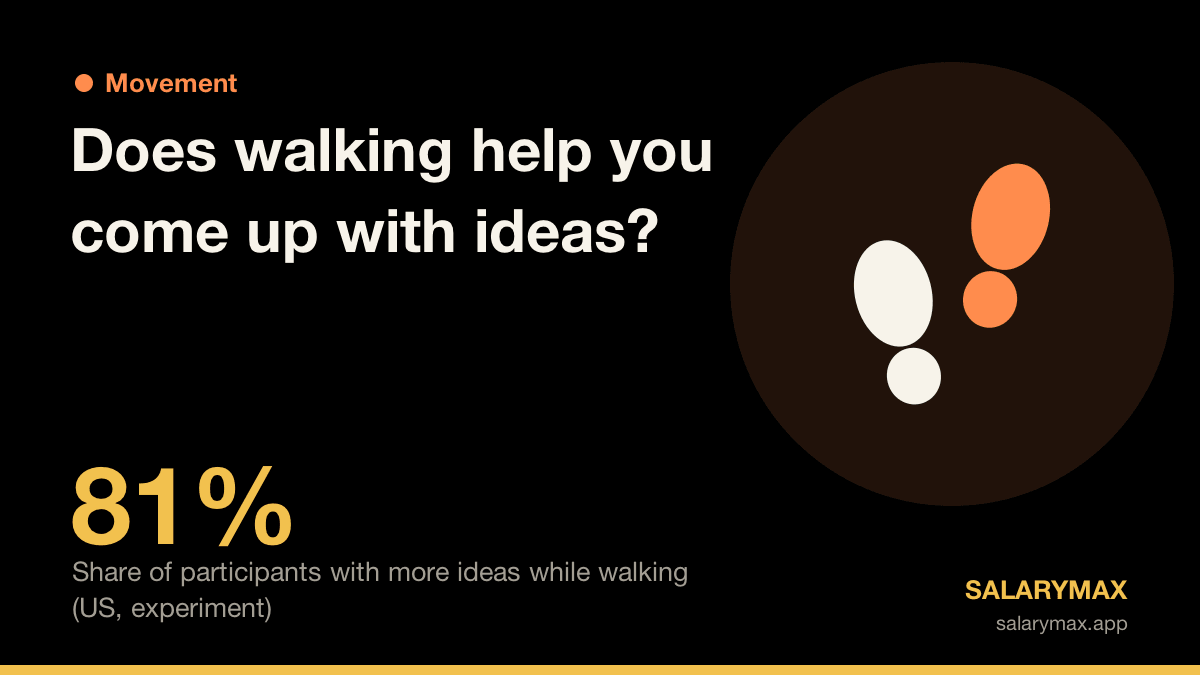
In Stanford experiments, 81% of students came up with more ideas walking than sitting. A 2026 meta-analysis of 23 studies also found a large effect, mostly in students.
The evidence behind this article
- Randomised trial2
- Research synthesis1
- Observational1
Includes studies built to test cause and effect (randomised trials or natural experiments).
4 sources・Countries studied: United States, Germany, Japan, Several countries
How to read the kinds of evidence →What to do with this
On a day you need fresh ideas, spend the first 10 minutes thinking on a walk, saying ideas aloud or noting them on your phone, then narrow them down at your desk.
Many people say their best ideas come on a walk. In US experiments, most people came up with more ideas while walking than while sitting, and a later review of many studies found the same direction. But walking helped with generating many ideas, not with narrowing down to one right answer.
Key points
- In experiments at Stanford University in the US (Oppezzo & Schwartz 2014), 48 students thought of uses for everyday objects while walking on a treadmill. For 81% of them, the number of novel, appropriate ideas was higher than when sitting, and the average increase was around 60%.
- A 2026 meta-analysis of 23 studies with 1,036 participants found that walking had a large effect on divergent thinking, the kind that generates many ideas (d = 0.93), rated as moderate-certainty evidence. The effect on convergent thinking, which finds one best answer, was unclear.
- Most studies were short experiments with university students, and results varied a lot. In German experiments, sitting freely without movement restrictions also boosted ideas, suggesting that not restricting the body may matter more than walking itself.
How much walking raised ideas in the Stanford experiments
The study consisted of four experiments run by researchers at Stanford University in the US (Oppezzo & Schwartz 2014). Participants were university and community college students. The main task was to list as many new uses as possible for an everyday object, known as the alternate uses test. Uses that were workable and not given by anyone else in the sample counted as creative ideas.
In the first experiment, 48 psychology undergraduates did the task first sitting and then walking on a treadmill facing a blank wall. For 81% of them, walking produced more creative ideas, and the average increase was around 60%. On a task with one correct answer (the remote associates test), performance dipped slightly while walking.
Because walking always came second, people might simply have got better with practice. So in the second experiment, 48 community college students were randomly assigned to sit then walk, walk then sit, or sit twice. Those who walked produced more ideas, and the boost lasted for a while after they sat back down. In the third and fourth experiments, walking outdoors around campus gave results in the same direction.
Later studies and the 2026 meta-analysis
A finding from one lab becomes more trustworthy when other studies confirm it. In 2026, a meta-analysis pooled the research on walking and creative thinking (Thabane and colleagues 2026). A meta-analysis combines many studies and recalculates the overall result. It covered 23 studies with 1,036 participants, mostly university students.
Walking had a large effect on divergent thinking (an effect size of d = 0.93, which the authors call large). Limited to randomised trials, the effect was 0.82, and the authors rated the certainty as moderate. For convergent thinking, the effect was 0.16, close to none, and the certainty was very low.
Results varied widely between studies, and the authors could not fully explain why. In German experiments (Murali & Händel 2022), restricting movement, by making people walk a set path or sit staring at a screen, shrank the effect of walking. Sitting freely, on the other hand, also widened people’s ideas. What matters may be not walking as such, but not restricting the body.
How to read the idea that walking sparks creativity
What this evidence supports is this: in short experiments, mostly with university students, people tend to produce more ideas while walking and shortly afterwards, and this has been found repeatedly. Whether it improves work results or earnings has not been studied.
In Japan, data from 40 university students showed that people who walked more in daily life tended to score higher on the novelty of their ideas (Chen and colleagues 2021). But this was a snapshot at one point in time, so it cannot show that walking made their ideas richer.
One more point: walking sometimes made it slightly harder to settle on one right answer. It seems sensible to separate time for generating ideas from time for narrowing them down.
A small step for today
What the research reasonably supports is trying to think on your feet when you want to widen your options.
- On a day you need ideas for a plan or a piece of writing, spend the first 10 minutes thinking on a walk. Say ideas aloud or note them on your phone.
- Do the narrowing down after you are back at your desk.
- On days you walk, log “Moved for 5+ minutes”. If a lunchtime walk and the rest of your day add up, log “Walked 8,000+ steps” too.
On days you cannot get out, simply moving a little without being locked into one posture is fine too.
FAQ
Does walking really help you come up with ideas?
In US experiments, 81% of people produced more ideas while walking than while sitting. A 2026 meta-analysis of 23 studies also found a large effect on divergent thinking, the kind that generates many ideas. However, most participants were university students and the experiments were short.
How long do you need to walk?
In the studies included in the meta-analysis, walks mostly lasted between 2 and 20 minutes. In the Stanford experiments, people walked at their natural pace, and the German experiments used free walking of about 4 minutes. The best length of walk is not yet known.
Has this research been replicated?
In the 2026 meta-analysis, a large effect remained when only randomised trials were included, and there was no sign of publication bias, the tendency for only positive results to be published. Results still varied a lot between studies, and one set of experiments suggests that freedom of movement may be what matters.
Sources
- [X-oppezzo-schwartz-2014] Oppezzo & Schwartz (2014) Give your ideas some legs: The positive effect of walking on creative thinking. Journal of Experimental Psychology: Learning, Memory, and Cognition.
- [X-thabane-2026] Thabane et al. (2026) The impact of walking on creative thinking: A systematic review and meta-analysis. PLOS One.
- [X-murali-handel-2022] Murali & Händel (2022) Motor restrictions impair divergent thinking during walking and during sitting. Psychological Research.
- [X-chen-2021] Chen et al. (2021) Regular Vigorous-Intensity Physical Activity and Walking Are Associated with Divergent but not Convergent Thinking in Japanese Young Adults. Brain Sciences.
Studies describe average tendencies. This article is not a promise that a habit will lift your income, and it is not medical or investment advice. About these articles ・ Search & sources
Updated:
← All articles