Deep dive ・ 6 min
Exercise and Long-Term Income: A Finnish Twin Study
A study of 5,042 male twins in Finland found that the more physically active twin in each pair tended to have higher income over 15 years. It was not a randomized trial.
The evidence behind this article
- Research synthesis1
- Adjusted observational4
Includes an analysis that pools many studies, which is less swayed by chance in any single one.
5 sources・Countries studied: Finland, United States, Japan
How to read the kinds of evidence →What to do with this
Start with five minutes of movement, such as walking one extra stop on your commute. Keeping it going over time matters more than doing a lot on any one day.
Surveys in the US and Germany find that people who exercise tend to earn more. But if people from healthier or better-off families are also more likely to exercise, the gap may not be about exercise at all. A Finnish study tried to shrink this problem by comparing twins with each other. Within twin pairs, the more physically active twin tended to have higher long-term income.
Key points
- In a study of 5,042 male twins in Finland (Hyytinen and Lahtonen, 2013), twin surveys from 1975, 1981 and 1990 were linked to register income for the 15 years from 1990 to 2004. Within twin pairs, the physically active twin tended to have higher income.
- Comparing twins holds constant hard-to-measure genetic and family factors. It cannot remove other differences between the two twins, and exercise was not assigned at random.
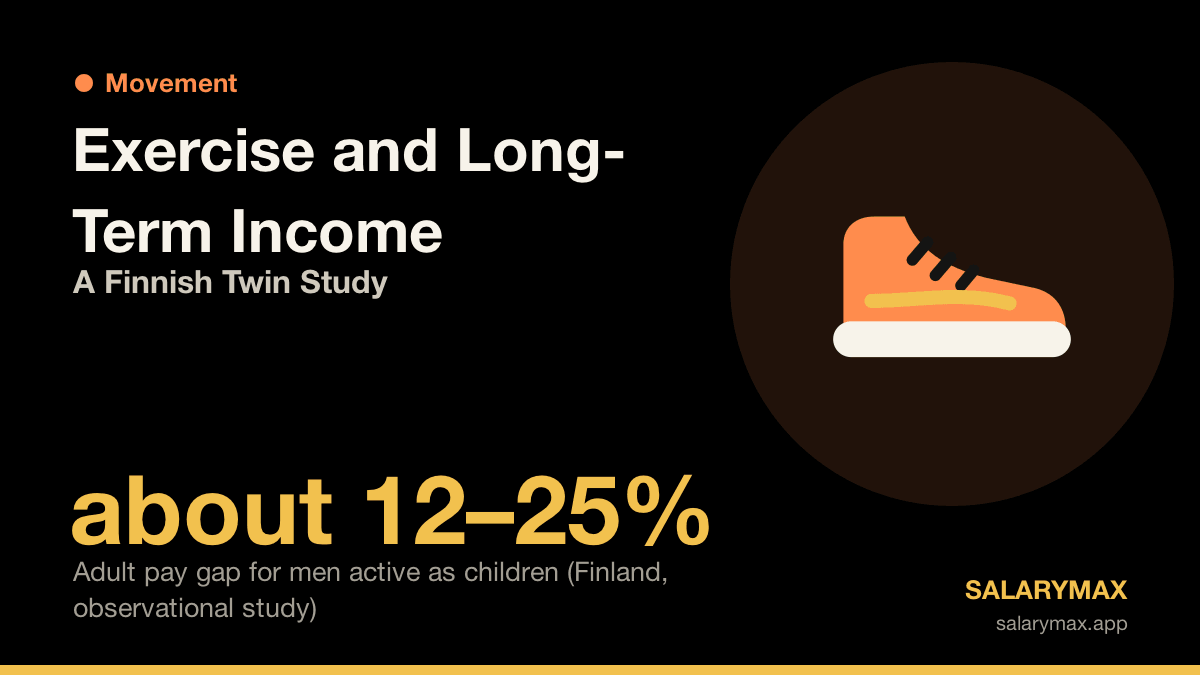
- In a separate Finnish study (Kari and colleagues, 2016), men who were more active in their free time at ages 9, 12 and 15 had average annual earnings about 12% to 25% higher over 10 years as adults. No link was found for women.
What a twin comparison holds constant
Ordinary surveys compare people who exercise with people who don’t. In a US national survey, people who exercised regularly earned 6% to 10% more (A1). The trouble is that this kind of comparison mixes in whatever else differs between the two groups, such as body type, family attitudes or the area people grew up in.
Twins grow up in the same home at the same time, and identical twins share nearly all their genes. So if you compare the more active twin with the less active one, much of the difference that comes from family and genes cancels out. Economists call this a within-twin comparison, and it has long been used in research on education and earnings, too.
How the Finnish twins differed over 15 years
Hyytinen and Lahtonen used 5,042 men from the Older Finnish Twin Cohort, a long-running study of adult twins in Finland. They linked answers from surveys in 1975, 1981 and 1990 to register data that connect employers and workers, covering income from 1990 to 2004. Income was measured over 15 years, covering most of the men’s prime working age.
Within twin pairs, the more active twin tended to have higher long-term income. The authors add that the gap is hard to explain only by better health or by staying in work more steadily. Instead, they suggest that traits and motivation may play a role, such as being more persistent when work gets hard or being more willing to enter competitive situations. This is the authors’ reasoning, not something the data tested directly.
Why even a twin study can’t say exercise raises income
First, differences between twins remain. Even twins raised together may differ in injuries, workplaces or personality. If such differences affect both exercise and income, the gap may not come from exercise.
Second, twins whose exercise habits differ sharply are rare. When researchers searched two Finnish twin cohorts for identical twins whose leisure-time activity had differed for many years, they found 17 pairs (Kujala and colleagues, 2022). In those pairs, the more active twin was fitter and had less body fat and less visceral fat, but income was not studied.
Third, the study covered Finnish men. As the Kari study shows, a link found for men may not appear for women. That study was not a twin study: it was an ordinary comparison that took into account family income, parents’ education and other factors, and activity levels were self-reported.
We found no Japanese study comparing exercise and income within twin pairs. A Japanese study that followed 6,576 full-time employees aged 35 to 54 found that starting to exercise did not significantly change productivity at work (presenteeism), but it did raise work engagement (A5).
A small step for today
The twin study shows a link between being on the active side and long-term income. It does not show that starting to exercise increases income. Still, staying active is also linked with better health and more engagement at work.
- Start with “Moved for 5+ minutes”. Walking one extra stop on your commute counts.
- Once that feels easy, aim for “Walked 8,000+ steps”. The research compared habits that lasted years, so keeping it going matters more than any single day.
- If you miss a day, simply pick it up again the next.
FAQ
Does exercising increase your income?
No study has shown that yet. In the Finnish twin study, the more active twin tended to have higher income over 15 years, but exercise was not assigned at random. It is an average tendency, not a prediction for any one person.
How is a twin study different from an ordinary survey?
Twins grow up in the same home, and identical twins share nearly all their genes. That lets researchers compare people with much of the family and genetic difference held constant. It still cannot remove other differences between the two twins.
Is childhood exercise linked to adult income?
In a Finnish study, men who were more active in their free time at ages 9, 12 and 15 had average annual earnings about 12% to 25% higher as adults. No link was found for women, and because the data were observational, the study does not show cause and effect.
Sources
- [X-hyytinen-lahtonen-2013] Hyytinen & Lahtonen (2013) The effect of physical activity on long-term income. Social Science & Medicine.
- [X-kujala-2022] Kujala et al. (2022) Physical activity and health: Findings from Finnish monozygotic twin pairs discordant for physical activity. Scandinavian Journal of Medicine & Science in Sports.
- [X-kari-2016] Kari et al. (2016) Childhood Physical Activity and Adulthood Earnings. Medicine & Science in Sports & Exercise.
- [A1] Kosteas (2012) The Effect of Exercise on Earnings: Evidence from the NLSY. Journal of Labor Research.
- [A5] Kashima, Takada, Matsuo & So (2026) The consequences of changes in exercise habits on work engagement and presenteeism. Scandinavian Journal of Work, Environment & Health.
Studies describe average tendencies. This article is not a promise that a habit will lift your income, and it is not medical or investment advice. About these articles ・ Search & sources
Updated:
← All articles