Practice ・ 6 min
What happens when you quit social media for weeks?
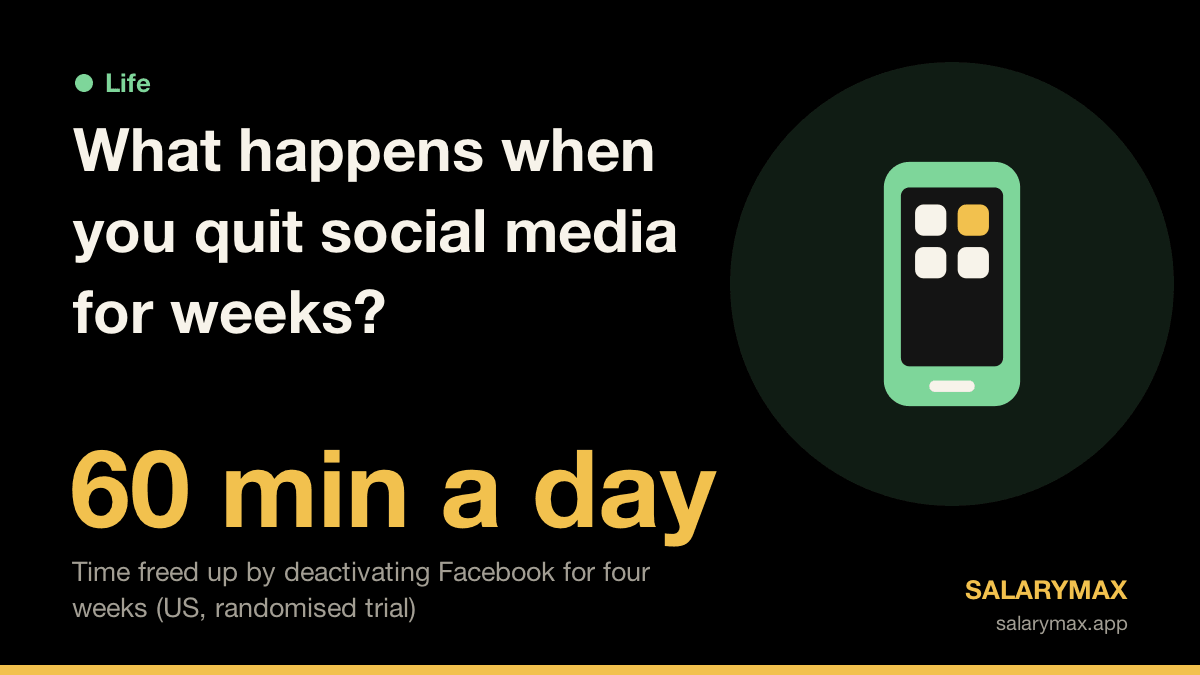
In a US randomised trial, people who quit Facebook for four weeks gained 60 minutes a day, saw family and friends more and felt slightly happier. Income was not measured.
The evidence behind this article
- Randomised trial2
Includes studies built to test cause and effect (randomised trials or natural experiments).
2 sources・Countries studied: United States
How to read the kinds of evidence →What to do with this
Pick one app you want to use less and set a daily limit with your phone's built-in tools. Decide in advance what you will do with the time it frees.
What changes when you step away from social media for a while? In a US randomised trial, people who deactivated Facebook for four weeks gained 60 minutes a day, spent more time with other people, and felt slightly happier. In another experiment, people paid to cut back kept using less even after the payments ended.
Key points
- In a US randomised trial of Facebook users (Allcott and colleagues, 2020), people who deactivated their accounts for the four weeks before the 2018 midterm election gained 60 minutes a day, spent less time on other social media and online, and spent more time watching TV alone and with family and friends.
- In the same trial, those who deactivated reported slightly higher happiness and life satisfaction and slightly less depression and anxiety, but they also knew less about the news. Several weeks after the experiment, their use of the Facebook app was still about 11 minutes (22%) lower.
- In a US experiment with about 2,000 people (Allcott and colleagues, 2022), paying people to cut back cut use by 56 minutes a day during three weeks, and use stayed 19 minutes lower in the three weeks after the payments ended. Neither study measured income or work performance.
How did time and mood change after four weeks off Facebook?
The first study is by US economists Hunt Allcott, Luca Braghieri, Sarah Eichmeyer and Matthew Gentzkow. Before the US midterm election in November 2018, they recruited 2,743 Facebook users through ads on Facebook. The 61% who said they would deactivate for four weeks for less than $102 were randomly split into two groups: one was paid to deactivate, and the other kept using Facebook as usual. More than 90% of the deactivation group complied.
Deactivating freed up 60 minutes a day. That time did not move to other social media or online activities, which actually declined too. What grew were offline activities, such as watching TV alone and spending time with family and friends.
On mood, people who deactivated reported slightly higher happiness and life satisfaction and slightly less depression and anxiety. The authors say the size was about 25–40% of the effect of psychological interventions such as self-help therapy, group training and individual therapy. But it was much smaller than correlational studies, which simply compare heavy and light users, would suggest.
There were costs, too. People who deactivated knew less about the news, and their political views became less polarised.
Did people keep using social media less afterwards?
After the experiment, the deactivation group still used Facebook differently. Several weeks later, their use of the Facebook app was about 11 minutes (22%) lower than the control group’s, and 5% still had their accounts deactivated nine weeks after the experiment ended. About 80% of the deactivation group agreed that deactivating had been good for them.
The second study is by Hunt Allcott, Matthew Gentzkow and Lena Song (2022). About 2,000 Android smartphone users in the US installed an app that recorded their screen time. The study focused on six apps: Facebook, Instagram, Twitter, Snapchat, web browsers and YouTube.
One randomly chosen group was paid $2.50 per hour of reduced use for three weeks. During that time, use of the six apps fell by 56 minutes a day (39%). In the three weeks after the payments ended, use was still 19 minutes lower, and in the three weeks after that, 12 minutes lower. Once social media use dropped, it tended to stay lower, consistent with habit formation.
Another randomly chosen group got a tool for setting daily limits on each app. Setting limits was optional, yet 78% of participants set limits that actually bound, and screen time fell by 22 minutes a day (16%) over 12 weeks. Meanwhile, people in the control group underestimated how much they would use these apps in the next period by 6.1 minutes a day on average.
How far does this evidence go on quitting social media?
Both were randomised experiments, so we can say that stopping or cutting back changed how people spent their time and improved their mood slightly. But the participants were US adults, and the first study involved deactivating only Facebook for four weeks before an election. In the second study, the well-being gains were mainly in concentration and avoiding distraction; changes in happiness and anxiety were not statistically clear.
Importantly, neither study measured income or work performance, so they do not show that quitting social media helps your career. We did not find similar experiments in Japan or Korea.
A small step for today
- Pick one app you want to use less and set a daily limit with your phone’s built-in tools. In the experiment, most people kept using their limits.
- Decide in advance what to do with the freed-up time. Choose one offline activity, such as a walk or time with family or friends.
- Before bed, log “Put the phone down an hour before bed.” Start trimming screen time from your evenings.
FAQ
Does quitting social media make you happier?
In a US randomised trial, people who deactivated Facebook for four weeks reported slightly higher happiness and life satisfaction and slightly less depression and anxiety. The effect was small, though, and they also knew less about the news.
How much time do you get back by quitting social media?
In the US trial, people who deactivated Facebook for four weeks gained 60 minutes a day. That time did not shift to other social media; instead, time with family and friends and other offline activities grew.
Does quitting social media improve your work or income?
We do not know, because these two studies did not measure income or work performance. What they show is that time use, mood and later use of social media changed.
Sources
- [X-allcott-2020] Allcott, Braghieri, Eichmeyer & Gentzkow (2020) The Welfare Effects of Social Media. American Economic Review.
- [X-allcott-gentzkow-song-2022] Allcott, Gentzkow & Song (2022) Digital Addiction. American Economic Review.
Studies describe average tendencies. This article is not a promise that a habit will lift your income, and it is not medical or investment advice. About these articles ・ Search & sources
Updated:
← All articles