Basics ・ 6 min
Does air pollution lower productivity at work? US and China
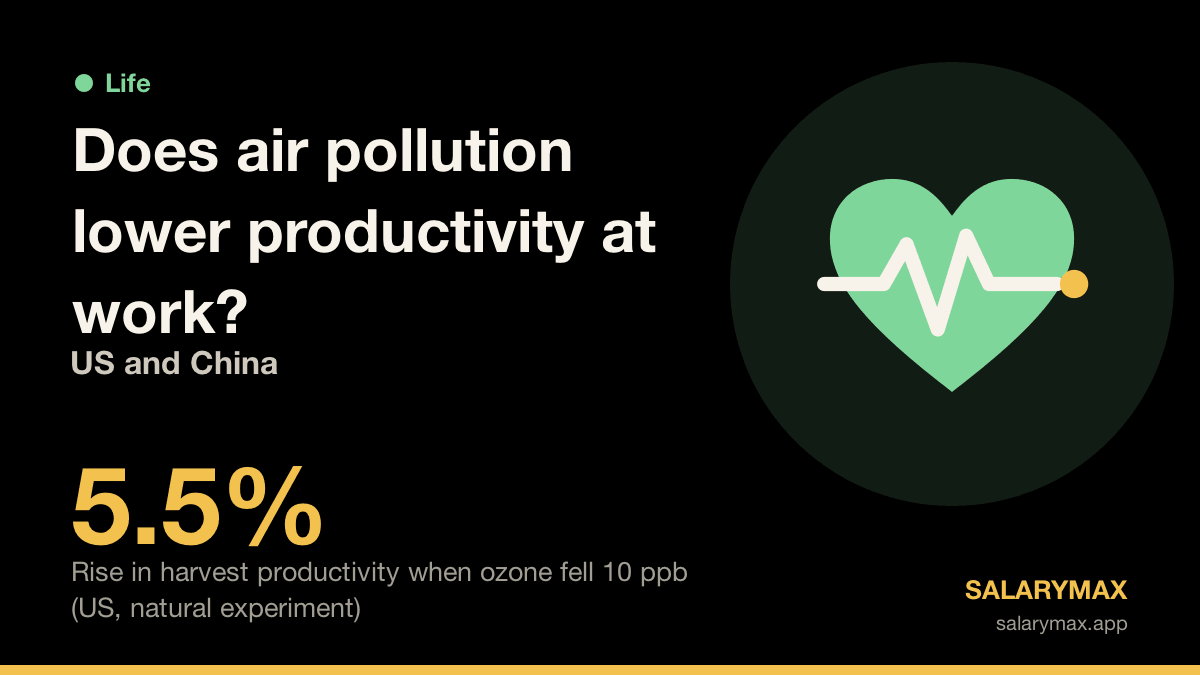
On a US farm, a 10 ppb fall in ozone raised harvest productivity by 5.5%. In China, call centre staff took fewer calls on polluted days. Both used natural daily swings.
The evidence behind this article
- Natural experiment2
Includes studies built to test cause and effect (randomised trials or natural experiments).
2 sources・Countries studied: United States, China
How to read the kinds of evidence →What to do with this
On days when the forecast says the air will be bad, don't pack your schedule too tightly. On slow days, note the air quality along with your progress.
Air pollution is usually discussed as a health issue. But does it also change how much work people get done? Studies of a farm in the United States and of call centres in China found that on days with dirtier air, workers got less done, and the effects appeared at levels of pollution that are common in big cities.
Key points
- A study using 2009 and 2010 records for about 1,600 piece-rate workers on a large California farm (Graff Zivin and Neidell, 2012) found that a 10 ppb drop in ozone raised harvest productivity by 5.5%. It used natural day-to-day changes in pollution, and ozone levels were well below the federal air quality standard.
- A study of call centres run by a large Chinese travel agency in Shanghai and Nantong from 2010 to 2012 (Chang and colleagues, 2019) found that workers handled fewer calls on more polluted days. Calls did not get longer; breaks did.
- In both studies, the effects appeared at levels of pollution commonly found in large cities. We did not find a Japanese study that used the same kind of design.
Did ozone levels change how much farm workers harvested in the US?
Joshua Graff Zivin and Matthew Neidell used the payroll records of a large farm in California’s Central Valley that grows blueberries and grapes. Workers are paid by how much they pick (piece rates), so each person’s daily harvest is recorded precisely. The data cover the 2009 and 2010 growing seasons and follow roughly 1,600 workers over 155 days.
The study looked at ozone, a main ingredient of smog. In this area, ozone depends heavily on pollution carried in from distant cities such as Los Angeles and San Francisco. Its daily level changes for reasons unrelated to how the farm is doing, so it works like a natural experiment.
A 10 ppb decrease in ozone (ppb means parts per billion, a unit of concentration) increased worker productivity by 5.5%. These ozone levels were well below the federal air quality standard. Ozone had little to do with whether people came to work or how many hours they worked. Workers went out to the fields and worked the same hours, but picked less on days with more ozone.
What fell at call centres in China on polluted days?
The effect is not limited to physical outdoor work. Tom Chang and colleagues studied call centres run by China’s largest travel agency, in Shanghai and Nantong, from January 2010 to December 2012. Workers take calls from customers across China and book their travel, and the number of calls each person handles is recorded every day.
Pollution was measured with China’s air pollution index (API), which during this period was driven mainly by particulate matter. In the working paper version of the study, a 10-point rise in the index reduced the number of calls a worker handled per day by 0.35% on average. Effects showed up clearly on every measure once the index went above 150.
The study also shows how output fell. The length of each call did not change; workers spent more time on breaks. The authors describe this as the first evidence that pollution lowers productivity in indoor, white-collar work, at levels commonly found in large cities in both developing and developed countries.
How to read the research on air pollution and productivity
Both studies rely on daily changes in pollution that workers cannot choose, so they come close to showing cause and effect. But each looks at one farm or one company. The size of the effect may differ for other jobs or other countries. The call centre figure of 0.35% comes from the working paper version.
We did not find a Japanese study of air pollution and worker productivity that used the same kind of design, and this article does not compare air quality in Japanese cities with the levels in these studies.
In short, studies that use natural daily changes in pollution show that dirtier air lowers worker productivity. The people studied, however, were farm workers in the US and call centre staff in China, so these are not figures for Japanese workplaces.
A small step for today
- When you do “Planned the day in the morning,” check the local air quality information along with the weather. On days with a bad forecast, avoid packing your schedule too tightly.
- Use “Set when and where to do tomorrow’s key task” to narrow tomorrow’s important work down to one task. Even on a day when you feel slower, you can start with what matters most.
- Add a word about the air or the weather when you log “Wrote one line on today’s progress.” It helps you avoid blaming yourself alone for a slow day.
FAQ
Does air pollution affect how productive people are at work?
In the US farm study, a 10 ppb drop in ozone raised harvest productivity by 5.5%. In the study of call centres in China, workers handled fewer calls on more polluted days. Both studies used natural day-to-day changes in pollution.
Does pollution matter if you work indoors?
The call centre work in China was indoors, and workers still handled fewer calls on more polluted days. The length of each call did not change, but breaks became longer. The study covered a single company, though.
If pollution is below the official standard, is there no effect?
Not necessarily. In the US farm study, ozone levels well below the federal standard were still linked with lower productivity. The Chinese study also reported effects at levels of pollution commonly found in large cities.
Sources
- [X-graff-zivin-neidell-2012] Graff Zivin & Neidell (2012) The Impact of Pollution on Worker Productivity. American Economic Review.
- [X-chang-2019] Chang, Graff Zivin, Gross & Neidell (2019) The Effect of Pollution on Worker Productivity: Evidence from Call Center Workers in China. American Economic Journal: Applied Economics.
Studies describe average tendencies. This article is not a promise that a habit will lift your income, and it is not medical or investment advice. About these articles ・ Search & sources
Updated:
← All articles