Basics ・ 6 min
Does heat lower work and learning? Studies from India and US
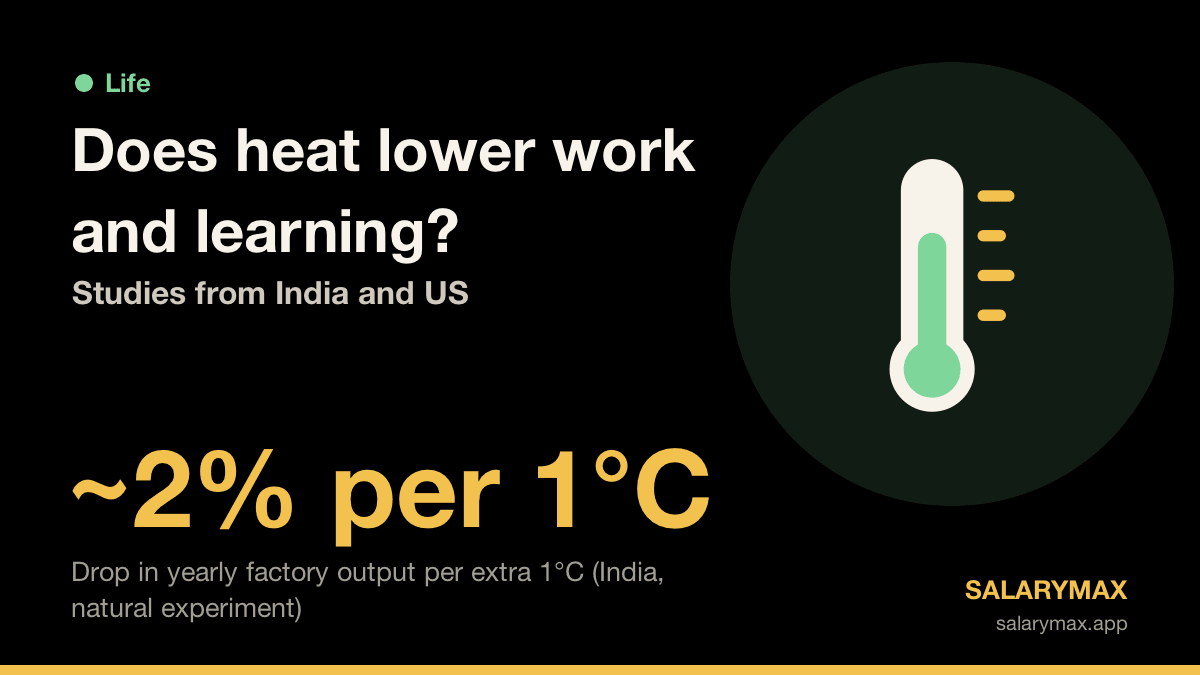
Indian factories produced about 2% less a year per extra degree Celsius. Among 10 million US students, hotter school years meant less learning without air conditioning.
The evidence behind this article
- Natural experiment2
Includes studies built to test cause and effect (randomised trials or natural experiments).
2 sources・Countries studied: India, United States
How to read the kinds of evidence →What to do with this
On hot days, move the work that needs the most focus to a cooler hour or an air-conditioned room, and choose that time and place the day before.
Many people feel they get less done in the summer. Studies of factories in India and of high school students in the United States suggest the feeling is real: on hotter days and in hotter school years, output and learning fell. Where people could stay cool with air conditioning, the losses were much smaller.
Key points
- A study of Indian manufacturing (Somanathan and colleagues, 2021) found that in a national panel of factories, annual plant output fell by about 2% for each degree Celsius of higher temperature. It used natural year-to-year changes in weather, and records from selected firms showed lower worker productivity and more absences on hot days.
- A US study of about 10 million students who took the national PSAT test at least twice (Park and colleagues, 2020) found that hot school days reduced learning. In schools without air conditioning, a school year that was 1°F warmer cut that year’s learning by about 1%.
- In both studies, losses from heat were smaller where there was air conditioning or climate control. We did not find a Japanese study that used the same kind of design.
How did hot days change output and attendance in Indian factories?
The economist E. Somanathan and colleagues studied Indian manufacturing in two steps. Neither factories nor workers can choose the weather, so differences in temperature from day to day and year to year work like a natural experiment.
First, they used detailed records from selected firms, matching each worker’s daily output and attendance to the temperature. On hot days, worker productivity fell and absenteeism rose. Where the workplace had climate control, the productivity losses were much smaller.
Second, they used a national panel that followed Indian factories year after year. In years that were one degree Celsius warmer, annual plant output was about 2% lower. The authors suggest the main reason is that heat lowers how much each worker adds to production.
Earlier research had shown that hotter years go along with lower economic output in developing countries. The authors say their estimates are large enough to explain those losses.
Did US students learn less in hotter school years?
R. Jisung Park and colleagues used the scores of about 10 million American students from the high school classes of 2001 to 2014 who took the PSAT at least twice (figure from the working paper version). They compared each student’s gain between the first and second test with how hot the school year in between had been. Because each student is compared with themselves, differences in starting ability or family background play a smaller role.
More hot school days in the years before the test meant smaller gains, and extreme heat was especially damaging. Temperatures on weekends and during the summer break made little difference. That pattern suggests heat disrupts the time spent learning in class.
The team also surveyed roughly 12,000 high schools about air conditioning. In schools without it, a school year that was 1°F warmer (a smaller step than one degree Celsius) reduced that year’s learning by about 1%. Where air conditioning was common, the pattern was consistent with it largely offsetting the effect of heat.
Hot school days hit minority students harder. The authors estimate that heat accounts for roughly 5% of the racial gap in achievement.
How to read the research on heat and performance
Both studies rely on changes in temperature that people cannot choose, so they come closer to showing cause and effect than a simple comparison of hot and cool places would.
The role of air conditioning deserves more caution. In the US study it comes from comparing schools with and without air conditioning, and the authors describe the result as a pattern consistent with an offsetting effect. Schools with air conditioning may differ in other ways too.
It also matters who was studied: factories in India and high school students in the United States. We cannot say whether offices or schools in Japan would see effects of the same size. We did not find a Japanese study that uses temperature changes to look at work or learning outcomes.
In short, studies that use natural changes in temperature show that heat reduces output at work and learning at school. But the people studied were Indian factory workers and American high school students, so these are not figures for Japanese workplaces.
A small step for today
- On the evening before a hot day, use “Set when and where to do tomorrow’s key task” to put the work that needs the most focus in the cool morning or in an air-conditioned room.
- When you do “Planned the day in the morning,” check the day’s high temperature as well, and save less demanding tasks for the hot afternoon.
- Add a word about the heat when you log “Wrote one line on today’s progress.” Over time you may see how your own work tracks the temperature.
FAQ
Does hot weather make people less productive at work?
In the study of Indian factories, worker productivity fell and absences rose on hot days. Across factories nationwide, annual output was about 2% lower in years that were one degree Celsius warmer. Workplaces with climate control saw much smaller losses.
Does summer heat affect school results?
In the US study of about 10 million students, temperatures on weekends and during the summer break had little link with test score gains. What mattered was heat on school days, which suggests heat lowers the quality of time spent learning.
Can air conditioning prevent the effect of heat?
In the US study, the effect of heat appeared to be largely offset in schools where air conditioning was common, and in Indian factories climate control greatly reduced productivity losses. The air conditioning result for schools comes from comparing schools, not from an experiment.
Sources
- [X-somanathan-2021] Somanathan, Somanathan, Sudarshan & Tewari (2021) The Impact of Temperature on Productivity and Labor Supply: Evidence from Indian Manufacturing. Journal of Political Economy.
- [X-park-2020] Park, Goodman, Hurwitz & Smith (2020) Heat and Learning. American Economic Journal: Economic Policy.
Studies describe average tendencies. This article is not a promise that a habit will lift your income, and it is not medical or investment advice. About these articles ・ Search & sources
Updated:
← All articles