Basics ・ 6 min
Locus of control and job search: a German study
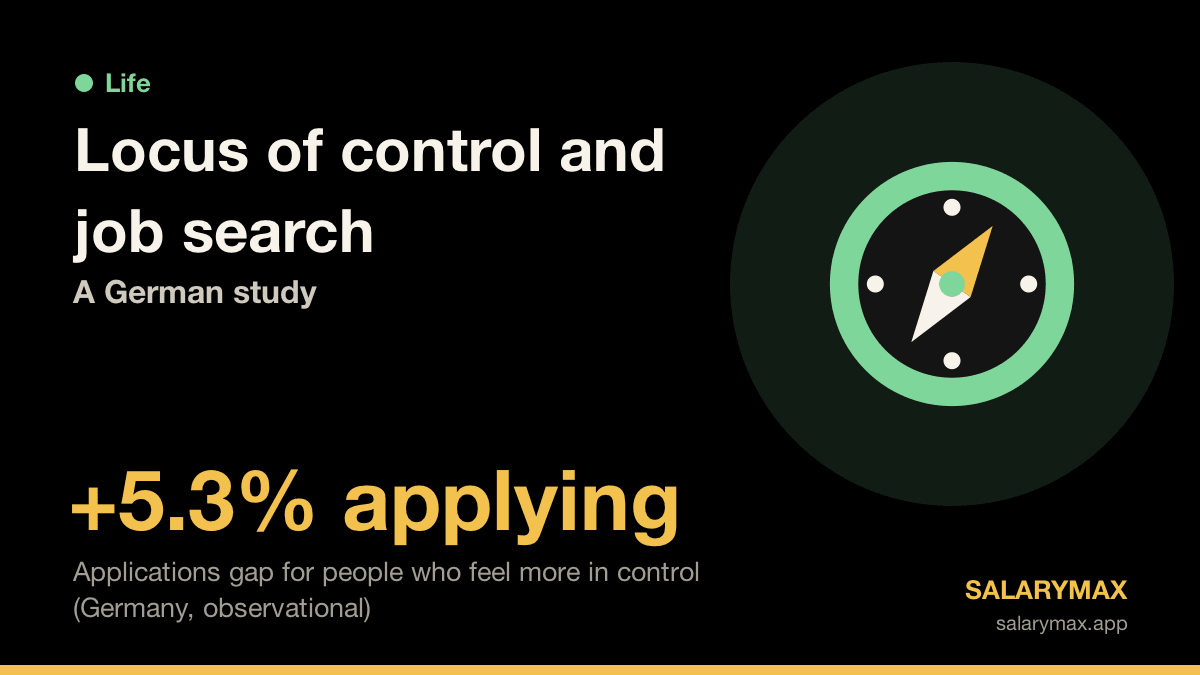
In a German study of about 8,000 newly unemployed people, those who felt life depends on their own actions applied more; those who credited luck set lower minimum pay.
The evidence behind this article
- Adjusted observational1
Based on observational data. It shows that two things go together, not that one causes the other.
1 sources・Countries studied: Germany
How to read the kinds of evidence →What to do with this
When job hunting, log applications and replies with Wrote one line on today's progress, and check market pay before setting your minimum, so effort and results show.
Do people who believe their own actions shape their lives look for work differently? A German study of about 8,000 people who had just lost their jobs found that those who felt this way sent more applications, while those who felt luck or others decide set a lower minimum wage they would accept. It is an observational study, so it does not mean that changing your outlook will find you a job.
Key points
- A study of people in Germany who became unemployed in late 2007 or early 2008, interviewed about two months into unemployment (Caliendo et al. 2015), found that those with a more internal locus of control, the belief that life depends on one’s own actions, tended to send more job applications. It is observational and does not show cause and effect.
- In the pre-publication version (2010), one standard deviation more internal control went with about 0.8 more applications (about 5.3%), and one standard deviation more external control went with a reservation wage, the lowest pay a person would accept, about 2.4% lower.
- The authors find that outlook shapes search through expectations that searching pays off. The paper does not follow whether people found jobs. We found no Japanese study on this question.
How was “life depends on me” measured, and who was studied?
Locus of control is a psychology concept. People with an internal locus of control see outcomes as driven by their own actions; those with an external locus of control see them as driven by luck, fate or other people.
The study draws on data built around roughly 17,000 people in Germany who became unemployed between late 2007 and early 2008. Everyone was interviewed about two months after losing their job, and the interviews were linked to official records of past jobs and wages. The analysis covers 7,896 people.
Outlook was measured with ten statements rated from 1 to 7, such as “How my life takes course is entirely dependent on me”, “What one achieves is, in the first instance, a question of destiny and luck” and “I have little control over things which happen in my life”.
How did applications and minimum acceptable pay differ?
The comparisons account for characteristics such as age, education, and past jobs and wages.
In the pre-publication version, people one standard deviation more internal sent about 0.8 more applications, or about 5.3% more. People one standard deviation more external had a reservation wage, the pay below which they would turn a job down, about 2.4% lower. When other personality traits were also taken into account, the gaps shrank, and the link between external control and the reservation wage was about 2.0%.
Matching people with similar characteristics pointed the same way. More applications were mainly linked to the “it depends on me” side, a lower minimum wage to the “it depends on luck” side.
Why would outlook show up in how people search?
The researchers also found that people with an internal locus of control were more likely to say that one extra application raised their chance of finding a job. In other words, the results fit the idea that they search differently because they expect searching to pay off, rather than because they are more able.
If ability were the reason, the authors argue, more able people would need to search less, so they would send fewer applications. Instead, people with more internal control applied more, which fits the expectations explanation better.
How should we read research on locus of control and job search?
First, this is observational research, and the authors describe their estimates as correlational. Interviewing everyone at the same point in their unemployment reduces the risk that search results changed people’s outlook, but does not remove it.
Second, consider who was studied: people who lost jobs in Germany in 2007 and 2008, under a benefit and hiring system unlike Japan’s. We found no Japanese study on locus of control and job search. The figures come from the pre-publication version and may differ in the published article.
Third, the paper looks at how people searched, not whether they found work sooner or at what pay. Outlook is also not purely a matter of personal effort. The honest summary is this: among unemployed people in Germany, those who felt in control tended to apply more, and those who credited luck tended to set lower minimum wages.
A small step for today
What the research supports is that expecting effort to pay off went together with searching more. Making the link between your actions and results easier to see is worth trying.
- Log the applications you send and the replies you get with “Wrote one line on today’s progress.” Your effort becomes visible.
- Put application time in your diary with “Set when and where to do tomorrow’s key task.”
- Before deciding the pay you will accept, use “Prepared for a negotiation” to look up market pay for the same job, so your minimum is based on information rather than mood.
FAQ
Do people who feel in control of their lives find jobs faster?
This paper did not analyse how quickly people found work. It found that they tended to send more applications. The authors cite earlier German studies reporting that people with more internal control were more likely to be re-employed and had shorter spells of unemployment.
What is locus of control?
It is a tendency to see what happens to you as driven either by your own actions or by luck and other people. In this study it was measured with ten statements, such as “How my life takes course is entirely dependent on me”, each rated from 1 to 7.
If I change my outlook, will my job search go better?
This study did not test that. It was not an experiment that tried to change people’s outlook, but an observational study of how outlook and search behaviour were related. The authors leave open whether policies could strengthen unemployed people’s sense of control.
Sources
- [X-caliendo-2015] Caliendo, Cobb-Clark & Uhlendorff (2015) Locus of Control and Job Search Strategies. The Review of Economics and Statistics.
Studies describe average tendencies. This article is not a promise that a habit will lift your income, and it is not medical or investment advice. About these articles ・ Search & sources
Updated:
← All articles