Basics ・ 7 min
Does Childhood Self-Control Predict Adult Income?
A New Zealand study of about 1,000 people followed to age 32 found that lower self-control in childhood went with lower adult income. It is observational, not destiny.
The evidence behind this article
- Adjusted observational3
Based on observational data. It shows that two things go together, not that one causes the other.
3 sources・Countries studied: New Zealand, United Kingdom, United States
How to read the kinds of evidence →What to do with this
Cut down on in-the-moment decisions: the night before, set when and where to do tomorrow's key task, and wait a night before buying something you want.
Do children who are good at waiting and holding back go on to earn more as adults? A New Zealand study that followed about 1,000 people from birth to age 32 found that those with lower self-control in childhood tended to have lower incomes and more money problems. It is observational, and the researchers treat self-control as something that can change.
Key points
- A study of 1,037 people born in Dunedin, New Zealand, in 1972–73 and followed to age 32 (Moffitt and colleagues, 2011) found that lower self-control at ages 3 to 11 went with lower income at 32, even after accounting for IQ and family social class. It is an observational study and does not show cause and effect.
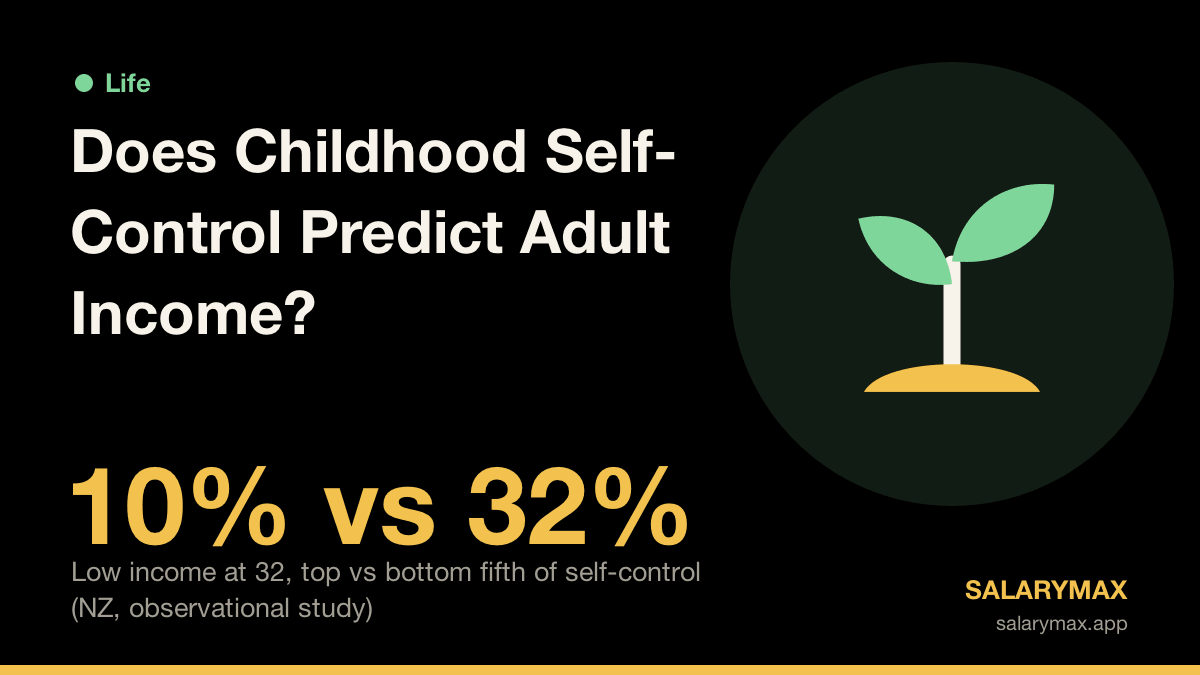
- In the same study, 10% of people in the top fifth for childhood self-control had an annual income under NZ$20,000 at 32, compared with 32% of people in the bottom fifth.
- A US study using a national survey of young people (NLSY79; Heckman and colleagues, 2006) found that cognitive skills and noncognitive skills, measured by a sense of control over one’s life and self-esteem, had about the same effect on wages.
How 1,000 New Zealanders differed at age 32
The Dunedin study followed all 1,037 children born in one city over a single year, from birth to age 32. 96% were still taking part at 32.
Self-control was measured at ages 3, 5, 7, 9 and 11 by combining ratings from research staff, teachers, parents and the children themselves into one score. It covered things like impulsive behavior, restlessness, lack of persistence and trouble paying attention.
By 32, people who had lower self-control as children tended to earn less, were less likely to save, and had fewer building blocks for the future, such as owning a home, investment funds or retirement plans. They also reported more trouble managing money and had more credit problems. Children with more self-control tended to come from better-off families and have higher IQs, but the link held after accounting for both.
The gap was not just at the extremes. Even without the fifth of children with the lowest self-control, more self-control still went with better outcomes.
Did the gap show up between siblings in the same home?
To remove family differences, the team also used a study of British twins. Comparing 509 same-sex fraternal twin pairs raised in the same homes, the twin with lower self-control at age 5 was more likely to do poorly in school and to start smoking by age 12. These twins had been followed only to 12, so their adult income is not yet known.
A US study points the same way. Using a national survey of people who were 14 to 21 in 1979, it found that noncognitive skills, measured by a sense of control over one’s life and a self-esteem scale, strongly affected whether people stayed in school, and were linked to wages even among people with the same schooling. Their effect on wages was about the same size as that of cognitive skills. The study also found that more years of schooling raised scores on these noncognitive measures.
Does the self-control research mean it is all set at birth?
No, for three reasons.
First, Moffitt and colleagues describe their own study as observational and correlational. It does not show that low self-control caused lower income. Second, the authors say self-control is shaped by both genes and environment and can change. People who moved up in self-control from childhood to young adulthood tended to have better outcomes at 32, although the authors note that natural change of this kind may not be the same as change produced by a program.
Third, a replication of the famous “marshmallow test” found a weaker link. A US study focused on children whose mothers had not finished college (Watts and colleagues, 2018) found that each extra minute a child waited at age 4 went with about one tenth of a standard deviation higher achievement at 15. That was about half the size of the original studies, and it shrank by about two thirds after accounting for family background, early cognitive ability and the home environment.
We also found no Japanese study that followed childhood self-control through to adult income.
A small step for today
Moffitt and colleagues argue that default settings, where healthy or saving choices happen unless you opt out, may help most the people with the least self-control. For adults, the lesson is to rely less on willpower and decide ahead of time.
- Use “Set when and where to do tomorrow’s key task” so you don’t have to decide in the moment.
- When something catches your eye, try “Waited a night before buying”. Moving the decision to the next day takes you out of the heat of the moment.
- Use “Planned the day in the morning” to write down, ahead of time, what you’ll do in the parts of the day when you tend to drift.
FAQ
If a child can’t wait or hold back, will they earn less as an adult?
No one’s future can be predicted from this. The New Zealand study found that people with lower childhood self-control tended to have lower incomes at 32, but that is an average across a group. Self-control can change, and people who moved up tended to have better outcomes.
Is self-control something you are born with?
Research treats self-control as shaped by genes and environment. In the US study, more years of schooling raised scores on noncognitive measures. It is not seen as fixed at birth.
Can the marshmallow test be trusted?
In a US replication, the link between waiting time at 4 and achievement at 15 was still there, but at about half the original size, and it shrank by about two thirds once family background and other factors were considered. Waiting time alone does not tell you a child’s future.
Sources
- [X-moffitt-2011] Moffitt et al. (2011) A gradient of childhood self-control predicts health, wealth, and public safety. Proceedings of the National Academy of Sciences.
- [X-heckman-2006] Heckman, Stixrud & Urzua (2006) The Effects of Cognitive and Noncognitive Abilities on Labor Market Outcomes and Social Behavior. Journal of Labor Economics.
- [X-watts-2018] Watts, Duncan & Quan (2018) Revisiting the Marshmallow Test: A Conceptual Replication Investigating Links Between Early Delay of Gratification and Later Outcomes. Psychological Science.
Studies describe average tendencies. This article is not a promise that a habit will lift your income, and it is not medical or investment advice. About these articles ・ Search & sources
Updated:
← All articles