Practice ・ 7 min
Do lottery winners stop working? Income and happiness
Swedish lottery studies find winners cut work earnings modestly, about equally by age, education and sex. Life satisfaction stayed higher for over a decade.
The evidence behind this article
- Natural experiment3
Includes studies built to test cause and effect (randomised trials or natural experiments).
3 sources・Countries studied: Sweden, United States
How to read the kinds of evidence →What to do with this
If extra money comes in, wait a night and write down how you would use it before deciding. Set aside a small amount first each month as a cushion.
Would a big lottery win mean quitting your job and living happily ever after? Studies from Sweden and the US find that winners earned less from work, but on average the drop was modest. Life satisfaction stayed higher for more than a decade, while the effect on everyday happiness and mental health was much smaller.
Key points
- A 2017 study of Swedish lottery winners found that winning modestly reduced earnings from work. The drop started right away, lasted, and was about the same across age, education and sex. It is a natural experiment based on prizes set by chance.
- A study that surveyed 3,362 Swedish lottery players 5 to 22 years after a lottery event found that large-prize winners had higher life satisfaction for more than a decade, with no sign of fading. The effects on happiness and mental health were much smaller.
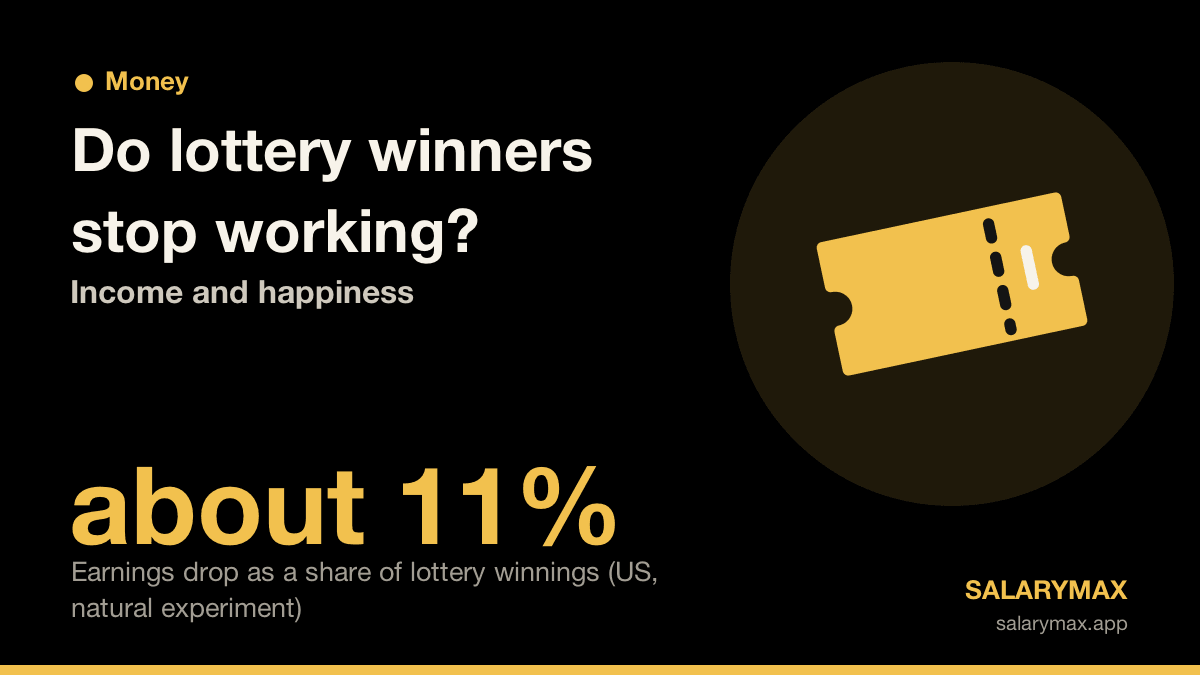
- A survey of Massachusetts lottery players from the mid-1980s found that earnings from work fell by about 11% of the lottery income. We did not find a study of this kind from Japan or Korea.
Why do researchers study lottery winners?
Measuring how money changes people is hard, because higher earners often differ in other ways too, such as health or drive.
So researchers turn to lotteries. Among people who bought the same number of tickets, who wins and how much is down to chance. Comparing winners with non-winners, or with those who won different amounts, makes it easier to isolate the effect of the money itself. Using a chance event in place of a planned experiment is called a “natural experiment.”
This article does not encourage buying lottery tickets. For researchers, lotteries are simply a way to see what happens when wealth rises by chance.
How much did winners change the way they work?
In the US, Guido Imbens, Donald Rubin and Bruce Sacerdote surveyed people who had played the Massachusetts lottery in the mid-1980s (published 2001). Large prizes were paid out every year over 20 years. Assuming that, among winners, the size of the prize was random, they found that earnings from work fell by about 11% of the lottery income. The effect was larger for people aged 55 to 65. By the time winners had received about half their prize, they had saved about 16% of it.
In Sweden, David Cesarini and colleagues followed winners of prize-linked savings accounts, a monthly subscription lottery and a scratch-card lottery using official register data (2017). They compared people who held the same number of tickets. The main findings were:
- Winning a prize reduced earnings from work modestly.
- The drop began immediately and persisted.
- It was about the same across age, education and sex.
- Winners themselves cut their earnings more than their spouses did.
Using a model, the authors calculated that lifetime earnings from work would fall by about 17% of the lottery income for someone who won at age 20, and by about 4% for someone who won at age 60.
Ten years or more after winning, how happy were they?
Erik Lindqvist and colleagues surveyed Swedish lottery players and matched comparison players in 2016, 5 to 22 years after a lottery event (2020). The study covered 3,362 people and a total prize pool of $277 million, and the analysis plan was registered in advance.
Large-prize winners were more satisfied with their lives overall, and the gap lasted for more than ten years with no sign of fading. The main driver was satisfaction with their finances. The effects on how happy people felt and on mental health were clearly smaller than the effect on life satisfaction.
The effect is modest. An after-tax prize of $100,000 was estimated to raise life satisfaction by 0.037 standard deviations, where a standard deviation is a rough measure of how much people typically differ from one another.
How to read lottery research
- These designs come close to showing cause and effect. Because chance decides who wins, they make it easier to see the effect of extra money. But the people studied are lottery players, who do not represent everyone.
- Countries and periods are limited. Most of the evidence is from Sweden, and the US study uses data from the 1980s. We did not find studies using the same method on lottery winners in Japan or Korea.
- Keep life evaluation and daily mood apart. What rose was mainly satisfaction with life and with finances.
- These are averages, not predictions. Individual choices vary widely.
A small step for today
On average, extra money led to only a modest drop in earnings, and life satisfaction rose mainly through satisfaction with finances. You can build some of that security gradually, without a ticket.
- Use “Paid myself first” to set aside a small amount each month.
- If unexpected money arrives, use “Waited a night before buying” and list your options first.
- Once a year, ask yourself what you would change if a lump sum arrived. If the answer is “worry less about money,” that is a cue to review how you save now.
FAQ
Do lottery winners quit their jobs?
In the Swedish research, winners’ earnings from work fell only modestly on average, and the drop was about the same across age, education and sex. In the US study, earnings fell by about 11% of the lottery income. These are averages, so they do not mean that no one stopped working.
Does winning the lottery make you happier?
In the Swedish research, large-prize winners had higher life satisfaction for more than a decade. The effects on happiness and mental health were much smaller, and the rise in life satisfaction came mainly from satisfaction with finances.
Why do researchers use lotteries?
Among people with the same number of tickets, chance decides who wins and how much, so comparing them isolates the effect of the money itself. The research is not a reason to buy tickets.
Sources
- [X-cesarini-2017] Cesarini, Lindqvist, Notowidigdo & Östling (2017) The Effect of Wealth on Individual and Household Labor Supply: Evidence from Swedish Lotteries. American Economic Review.
- [X-lindqvist-2020] Lindqvist, Östling & Cesarini (2020) Long-Run Effects of Lottery Wealth on Psychological Well-Being. The Review of Economic Studies.
- [X-imbens-2001] Imbens, Rubin & Sacerdote (2001) Estimating the Effect of Unearned Income on Labor Earnings, Savings, and Consumption: Evidence from a Survey of Lottery Players. American Economic Review.
Studies describe average tendencies. This article is not a promise that a habit will lift your income, and it is not medical or investment advice. About these articles ・ Search & sources
Updated:
← All articles