Basics ・ 6 min
Why do we spend more right after payday?
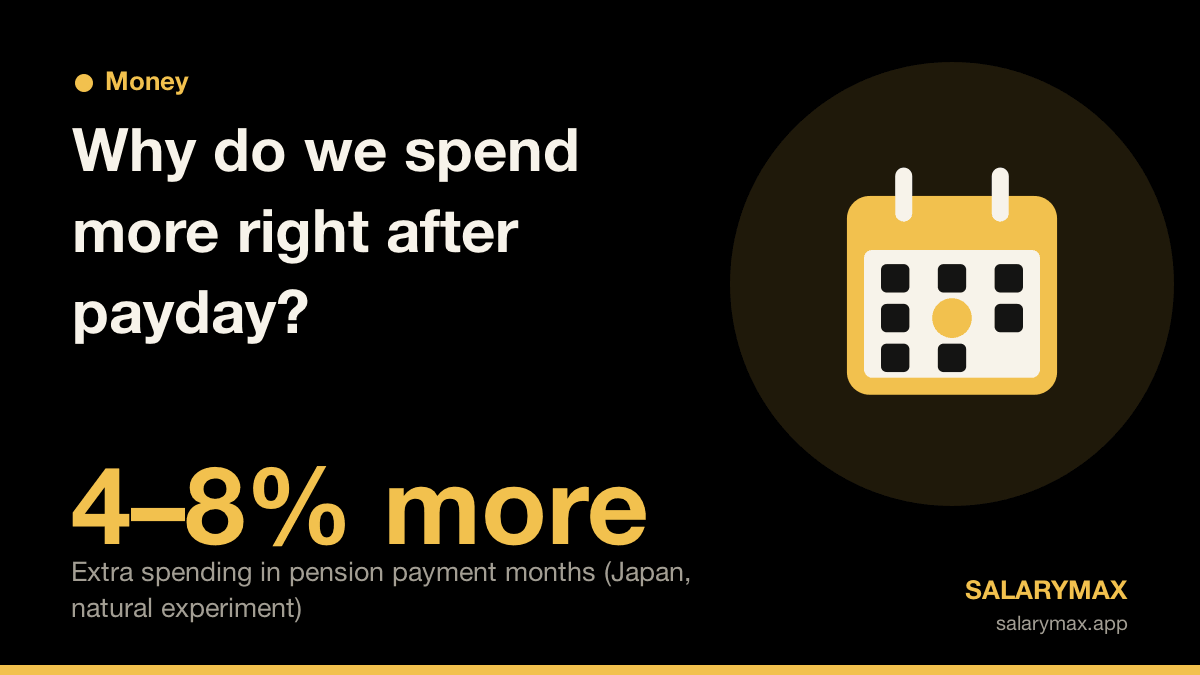
When Japan paid pensions every three months, older couples spent 4–8% more in payment months. In the US, food-stamp households ate 10–15% fewer calories by month end.
The evidence behind this article
- Randomised trial1
- Natural experiment3
Includes studies built to test cause and effect (randomised trials or natural experiments).
4 sources・Countries studied: Japan, United States
How to read the kinds of evidence →What to do with this
On your next payday, move your savings amount before you spend anything. Then track spending week by week to see the shape of your own monthly cycle.
Spending loosens after payday and tightens at month end. This cycle shows up in data from several countries, even when people know exactly when money will arrive.
Key points
- A study using Japan’s household expenditure survey found that, while public pensions were paid every three months (until February 1990), older couples aged 65 and over spent 4–8% more in payment months. After payments became every two months, this swing was at least 75% smaller, though the authors did not claim this as a proven cause.
- In US household spending diaries from 1986 to 1996, households that relied on pensions for at least 70% of their income spent 21% more on eating out in the week after their check arrived. Among food-stamp households, calorie intake fell by 10–15% over the 30 days after receiving benefits.
- In the Japanese study, households had substantial savings, so a shortage of cash could not explain the pattern. These studies use the design of public programmes and do not predict individual behaviour.
How did spending move when Japanese pensions were paid every three months?
Until February 1990, Japan’s public pensions were paid four times a year, in February, May, August and November. After that, payments came every two months. Melvin Stephens and Takashi Unayama used this to study how payment gaps show up in spending (2011).
Using Japan’s Family Income and Expenditure Survey from March 1986 to February 1994, they focused on two-person married households headed by a man aged 65 or older who was not working. For most of these households, pensions made up more than 90% of income, and each payment was about a quarter of annual income.
Since dates and amounts were known in advance, standard theory says spending should not jump in payment months. Yet in the working-paper version, when pensions were paid every three months, spending on non-durables, such as food and other things used up quickly, rose by 4–8% in payment months. After the switch to every two months, that rise shrank by at least 75%.
These households were not short of money: the median household held net financial assets worth four times its annual income, and high- and low-income households responded in similar ways. The authors concluded that neither a lack of cash nor precautionary saving explained the pattern. A 1989 newspaper report quoted in the paper said most pensioners wanted monthly payments, like a salary, to make spending easier to plan.
How did US spending move after payment days?
At the time, US Social Security checks arrived on the third of each month. Melvin Stephens (2003) used a government diary survey from 1986 to 1996, in which households recorded every purchase for two weeks. Because start dates were set at random, he could compare households whose diary covered the check’s arrival with those whose diary did not.
Across all recipients the effect was small, but households relying on Social Security for at least 70% of their income showed a clear cycle. In the working-paper version, spending on food away from home rose by 21% in the week after the check arrived, and spending on items consumed immediately rose by about 16%. The biggest jump came on arrival day. Stephens noted that these responses did not imply large losses in well-being.
Jesse Shapiro (2005) studied food records of US food-stamp households from 1989 to 1991. Daily calorie intake fell by 10–15% over the 30 days after benefits arrived. Survey answers also showed growing hardship as the month went on. Shapiro read this as a strong preference for consuming now.
What can these payday cycles tell us?
A fair reading is that, on average, spending tends to rise and fall with the timing of income. These studies use the design of real programmes; none of them assigned payment dates by lottery.
- Before payday, people lean towards “now”. In a US study that randomly surveyed 3,821 low-income adults before or after payday, the before-payday group was more likely to choose money now over money later. The authors linked this to having little cash on hand. Thinking-test scores did not differ.
- There may be more than one reason. Japanese pensioners had a cycle despite ample savings; the US study pointed to a shortage of cash.
- We found no study of salary paydays among Japanese workers. The Japanese evidence comes from older pensioner couples, using data from 1986 to 1994.
- Shorter gaps between payments may reduce the swing, though the Japanese authors did not claim this as a proven cause.
Unlike research on people who strongly favour the present and carry more card debt, here it is the timing of income itself that shapes spending.
A small step for today
If spending rises right after payday, payday is a natural moment to set money aside first.
- On payday, move a fixed amount before spending anything. Linking “Paid myself first” to your payday makes you less exposed to the cycle.
- Review “Tracked spending” in weekly blocks starting from payday. You will see the shape of your own monthly cycle.
- For a big purchase right after payday, try “Waited a night before buying”.
FAQ
Is it normal to overspend right after payday?
It is a common average pattern. In the US, pension-reliant households spent 21% more on eating out in the week after their check arrived, and in Japan older couples spent 4–8% more in pension months. This does not predict any one person’s behaviour.
Does running short at the end of the month mean I am bad at planning?
Not necessarily. In the Japanese study, older households with substantial savings still spent more in payment months. A newspaper report at the time said monthly payments made spending easier to plan. The research points to the effect of how income arrives, not to anyone’s character.
Would being paid twice a month reduce overspending?
This is not clear. In Japan, after pensions changed from every three months to every two, the rise in spending in payment months shrank by at least 75%. The authors themselves, though, did not claim this as a proven cause.
Sources
- [X-stephens-unayama-2011] Stephens & Unayama (2011) The Consumption Response to Seasonal Income: Evidence from Japanese Public Pension Benefits. American Economic Journal: Applied Economics.
- [X-stephens-2003] Stephens (2003) “3rd of tha Month”: Do Social Security Recipients Smooth Consumption Between Checks? American Economic Review.
- [X-shapiro-2005] Shapiro (2005) Is there a daily discount rate? Evidence from the food stamp nutrition cycle. Journal of Public Economics.
- [X-carvalho-meier-wang-2016] Carvalho, Meier & Wang (2016) Poverty and Economic Decision-Making: Evidence from Changes in Financial Resources at Payday. American Economic Review.
Studies describe average tendencies. This article is not a promise that a habit will lift your income, and it is not medical or investment advice. About these articles ・ Search & sources
Updated:
← All articles