Practice ・ 6 min
Why carry credit card debt while holding savings?
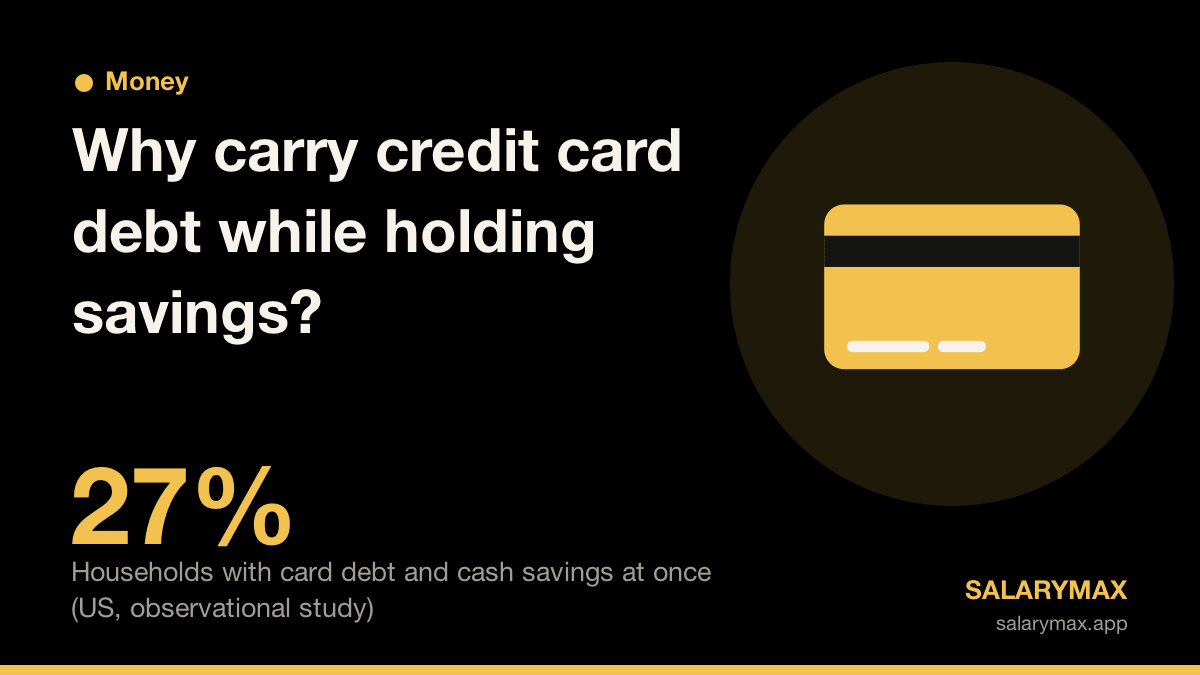
In the 2001 US Survey of Consumer Finances, 27% of households carried card debt while holding sizeable cash. A US study found debt rose by 10–14% of any limit increase.
The evidence behind this article
- Adjusted observational1
- Observational1
- Estimate1
- Official guideline1
Based on observational data. It shows that two things go together, not that one causes the other.
4 sources・Countries studied: United States, Japan
How to read the kinds of evidence →What to do with this
Check your card statement for any balance carried over and the fees charged, and treat a higher credit limit as borrowing room, not extra money.
Some people keep money in the bank yet leave a credit card balance unpaid from month to month. In the US this is common enough that economists call it the “credit card debt puzzle”. This article looks at that puzzle and at a study showing that when card limits went up, borrowing went up too.
Key points
- In the 2001 US Survey of Consumer Finances (SCF), 27% of households were carrying significant credit card debt while also holding sizeable amounts of low-return liquid assets. Economists call this the “credit card debt puzzle”.
- A US study using thousands of card accounts from several issuers, linked to credit bureau data, found that debt rose right away when credit limits went up. On average, debt rose by 10–14% of the limit increase. The response was larger for people near their limit, but it was clear even for people well below it.
- In Japan’s 2022 Financial Literacy Survey of 30,000 people aged 18 to 79, 49.6% correctly picked out as false the statement that “revolving payments carry fees but installment payments do not”.
What is the puzzle of holding savings and card debt at once?
According to a study by Irina Telyukova, 27% of households in the 2001 SCF were carrying significant card debt while also holding sizeable low-return liquid assets, such as bank deposits. On simple arithmetic, using the savings to pay off the card would cut the interest they pay. Because more than a quarter of households did not do so, the pattern has been called a puzzle.
Telyukova proposed one reason: people keep money in the bank because they expect to need it in situations where a card cannot be used. If an expense that cannot go on a card comes up suddenly, money already spent on paying down the card is not available. A household model built on this idea (a set of equations that reproduces household behavior) accounted for 44% to 56% of the households in the puzzle group. In other words, behavior that looks inconsistent may partly reflect a wish to keep cash on hand as a buffer.
What happened to borrowing when card limits went up?
David Gross and Nicholas Souleles used a panel of thousands of credit card accounts from several card issuers, along with matching credit bureau data. They looked at how borrowing changed when credit limits and interest rates changed.
When limits went up, debt rose right away. On average, debt rose by 10% to 14% of the increase in the limit, or about $10 to $14 for every extra $100 of limit. The rise was much larger for people who started near their limit, and it was still significant for people who started well below it. The authors say this fits models of precautionary saving, in which people like to keep some spare room as a cushion.
Borrowing also responded to interest rates. When the rate on an account changed, debt changed too, with a long-run elasticity (a measure of how strongly borrowing reacts) of about −1.3. Less than half of this reflected people moving balances between cards; most of it was a change in total borrowing. The response was larger when rates fell than when they rose.
How to apply the credit card debt puzzle to your own finances
- The data are from the US. The limit study uses card account records, and the puzzle figure comes from a 2001 household survey. We found no study of this puzzle in Japan.
- The model offers a possible reason, not the whole answer. Telyukova’s model accounted for about half of the puzzle households, not all of them.
- There are other explanations. A study of lower-income people in the US found that those with a stronger pull toward the present (present bias) carried more revolving card debt. That link is correlational. We cover it in the article “Why sleep on a purchase”.
- In Japan, understanding how the products work is also an issue. The share who answered the installment fee question correctly was 49.6% in 2022, almost the same as 49.5% in 2019. The survey’s explanation states that installment payments also carry fees (interest).
- Whether to put all of your savings toward the card depends on how much you need as a buffer for sudden costs, and that differs from person to person.
A small step for today
- Check your card statement for any balance carried into later months and the fees or interest charged, and log it with “Tracked spending”.
- If you are told your credit limit has gone up, treat it as more borrowing room, not more money. If it worries you, ask the card company whether you can lower it.
- Set aside money for sudden expenses with “Paid myself first”, so that you need to lean on the card less often.
FAQ
Is it strange to have savings and a revolving card balance at the same time?
No, it is not unusual. In the 2001 US survey, 27% of households carried card debt while also holding sizeable liquid assets. Research explains part of this by a wish to keep money for situations where a card cannot be used.
Does a higher credit limit lead to more borrowing?
In the study of US card accounts, debt rose right away when limits went up, on average by 10–14% of the increase. The rise was larger for people near their limit and still present for those well below it. This is an average pattern, not a prediction for each person.
Are installment payments free of fees?
Not necessarily. The explanation in Japan’s Financial Literacy Survey states that installment payments also carry fees (interest). In the 2022 survey, 49.6% answered this point correctly.
Sources
- [X-gross-souleles-2002] Gross & Souleles (2002) Do Liquidity Constraints and Interest Rates Matter for Consumer Behavior? Evidence from Credit Card Data. The Quarterly Journal of Economics.
- [X-telyukova-2013] Telyukova (2013) Household Need for Liquidity and the Credit Card Debt Puzzle. The Review of Economic Studies.
- [D10] Meier & Sprenger (2010) Present-Biased Preferences and Credit Card Borrowing. American Economic Journal: Applied Economics.
- [D4] Central Council for Financial Services Information (2022) Financial Literacy Survey 2022.
Studies describe average tendencies. This article is not a promise that a habit will lift your income, and it is not medical or investment advice. About these articles ・ Search & sources
Updated:
← All articles