Basics ・ 6 min
Emergency savings: could you find $2,000 in 30 days?
In a 2009 US survey, 27.9% said they certainly could not raise $2,000 in 30 days and 22.2% probably could not. In Japan in 2022, 57.0% had three months of costs saved.
The evidence behind this article
- Observational1
- Official guideline1
Based on observational data. It shows that two things go together, not that one causes the other.
2 sources・Countries studied: United States, United Kingdom, Canada, France, Germany, Italy, Netherlands, Portugal, Japan
How to read the kinds of evidence →What to do with this
When you are paid, move even a small amount for sudden costs into a separate account first, and track spending to learn what a month of living costs.
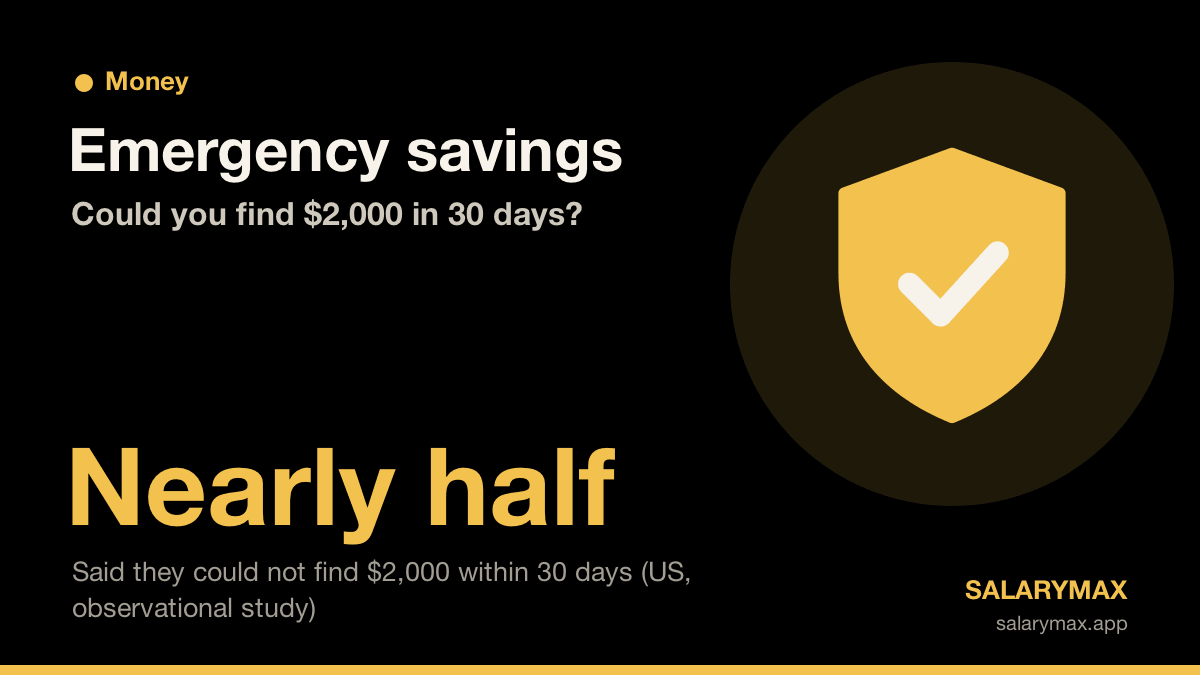
A car repair or a broken appliance can arrive at any time. When a US study asked people whether they could come up with $2,000 within 30 days, nearly half said no. In a Japanese survey, 57.0% said they had three months of living costs set aside. Here is what the research found and how to read the numbers.
Key points
- In a 2009 US internet survey of 2,148 people aged 18 to 65, 27.9% said they certainly could not come up with $2,000 within 30 days if an unexpected need arose, and 22.2% said they probably could not. Together that is nearly half (excluding people who answered “don’t know”).
- In the same study, people who said they could cope most often named using savings (62%), followed by relying on family or friends (34%) and ordinary borrowing (31%).
- In Japan’s 2022 Financial Literacy Survey of 30,000 people aged 18 to 79, 57.0% said they had three months of living costs set aside for events such as illness or job loss, up slightly from 54.4% in 2019.
How many people could not find $2,000 in 30 days?
Annamaria Lusardi, Daniel Schneider and Peter Tufano used an internet survey carried out between June and September 2009. In the US, 2,148 people aged 18 to 65 took part. The survey was run shortly after the global financial crisis.
The question asked whether people could come up with $2,000 if an unexpected need arose within the next month. The amount was chosen to match a cost like a major car repair.
The answers were: certainly able 24.9%, probably able 25.1%, probably unable 22.2%, and certainly unable 27.9%. Taken together, the “unable” answers come to nearly half. The authors call these households “financially fragile”.
People with higher incomes were more likely to say they could cope, but the problem was not limited to low-income households. Nearly a quarter of households earning between $100,000 and $150,000 said they could not raise the money. People with less education, no financial education, families with children, people who had lost a lot of wealth, and the unemployed were more likely to say they could not cope.
How did people plan to cover a sudden expense?
Among those who said they could cope, the most common method was drawing on savings (62%). Next came relying on family and friends (34%), ordinary borrowing (31%), and selling possessions (19%). The authors see a “pecking order”: savings first, then other methods if savings are not enough. They also argue that to understand how families cope, we need to look beyond savings to family help and borrowing.
The study asked a similar question in seven other countries, using $2,000 in the US and Canada, £1,500 in the UK, and €1,500 elsewhere. The share who said they probably or certainly could not raise the money was 50% or more in the US, the UK and Germany, 46% in Portugal, 37% in France, 28% in Canada, 27.9% in the Netherlands, and 20% in Italy. Japan was not included.
Japan’s “three months of living costs” figure and how to read the research
- The Japanese figure comes from a different question. The Financial Literacy Survey asks whether people have three months of living costs set aside in case of illness, job loss, a downturn or similar events. In 2022, 57.0% said yes, 28.3% said no, and 14.7% said they did not know. Because the question differs from the US one, the two cannot be compared directly.
- “Three months” is the survey’s yardstick, not the right answer. The sources for this article do not say how many months is enough. The amount you need depends on how stable your income is and on your family situation.
- The US figures are self-reports. They show what people expected, not what they did when an expense actually came. The authors also note that an internet survey may under-represent the people most at risk.
- This is correlational research. It shows who is more fragile, but it does not show cause and effect, for example that financial education would reduce fragility.
A small step for today
- Move money for sudden expenses into a separate account as soon as you are paid. A small amount is fine. This is the app habit “Paid myself first”.
- Use “Tracked spending” to get a sense of your monthly living costs. Then you can count how many months your cash on hand would cover.
- When large amounts go out every month, there is less room to absorb a sudden cost. Use “Reviewed one fixed cost” to build a little more room over time.
FAQ
How many months of expenses should an emergency fund cover?
The sources for this article cannot settle how many months is right. Japan’s Financial Literacy Survey uses three months of living costs as its yardstick, and 57.0% had that much set aside in 2022. The amount you need depends on your income stability and family situation.
How many people are not prepared for a sudden expense?
In the 2009 US survey, nearly half said they certainly or probably could not come up with $2,000 within 30 days. In Japan’s 2022 survey, 28.3% said they did not have three months of living costs set aside, and 14.7% did not know.
What do people do when a sudden expense comes up?
In the US study, the method people who could cope named most often was using savings (62%). Relying on family or friends (34%), ordinary borrowing (31%), and selling possessions (19%) were also common. The authors see an order in which savings come first.
Sources
- [X-lusardi-schneider-tufano-2011] Lusardi, Schneider & Tufano (2011) Financially Fragile Households: Evidence and Implications. Brookings Papers on Economic Activity.
- [D4] Central Council for Financial Services Information (2022) Financial Literacy Survey 2022.
Studies describe average tendencies. This article is not a promise that a habit will lift your income, and it is not medical or investment advice. About these articles ・ Search & sources
Updated:
← All articles