Practice ・ 6 min
Low insurance deductibles: paying too much for small risks
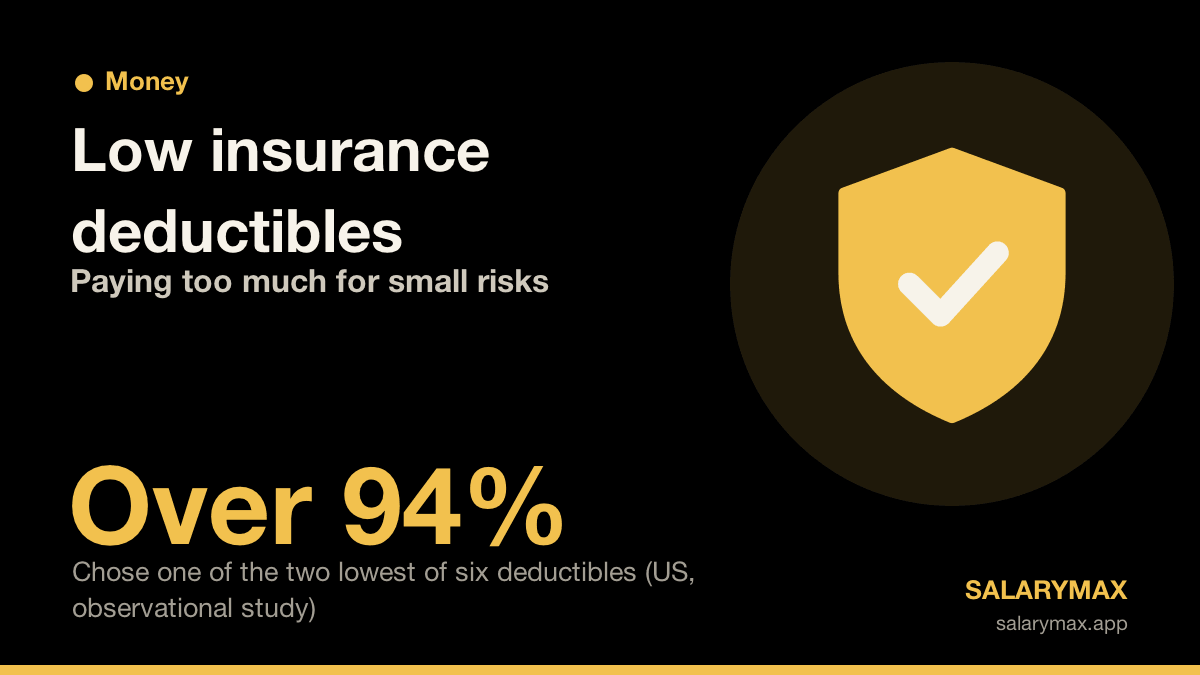
In a US study, most home insurance buyers paid well above expected savings for low deductibles. In a flood insurance working paper, over 94% picked one of the two lowest.
The evidence behind this article
- Observational1
- Estimate2
Based on observational data. It shows that two things go together, not that one causes the other.
3 sources・Countries studied: United States
How to read the kinds of evidence →What to do with this
At renewal, get quotes with different deductibles, note how much the yearly premium changes, and check whether your savings could cover the higher deductible.
Choosing a lower deductible, the part of a loss you pay yourself, means paying less when something goes wrong, but a higher premium every year. A study of US home insurance found that most customers chose low deductibles and paid far more for them than the out-of-pocket costs they could expect to save. This article walks through that study and related research. It does not recommend any insurance product, and it does not suggest cancelling a policy.
Key points
- A study of the deductibles that US home insurance customers actually chose found that most picked low deductibles. The extra premium was well above the expected value (the average amount you could expect) of the out-of-pocket costs it saved.
- A study of more than 100,000 US flood insurance contracts found that over 94% of households chose one of the two lowest deductibles out of six options. That study is a working paper that has not been peer reviewed.
- Another US study of insurance choices concluded that this pattern is largely explained by “probability distortion”: treating unlikely events as more likely than they are. We did not find research from Japan.
Did the extra premium for a low deductible match the savings?
A deductible is the part of a loss you pay yourself before insurance pays. A higher deductible means you cover small losses yourself, and in return your yearly premium is lower.
Justin Sydnor used data on the deductibles that customers of a US home insurer actually chose. He compared the extra premium people paid to get a lower deductible with the expected amount that lower deductible would save them.
Most customers chose low deductibles, at a cost well above the expected value. When Sydnor fitted these choices to the standard economic model of risk aversion, the implied level of caution was implausibly large. In other words, people paid more to avoid small losses than ordinary caution can easily explain.
Flood insurance: most households chose low deductibles too
Benjamin Collier and colleagues studied more than 100,000 contracts in the US public flood insurance programme. In each contract, households make a small-stakes choice, the deductible, and a large-stakes choice, the coverage limit.
For the deductible, over 94% of households chose one of the two lowest of six options. Again, the standard model could explain these choices only if households were extremely risk averse. This paper is a National Bureau of Economic Research working paper, not a peer-reviewed final version.
Why pay so much to avoid small losses? How people weigh small chances
Why does this happen? Levon Barseghyan and colleagues used deductible choices for auto and home insurance at a large US insurer to estimate a model of how people choose. They found that probability distortion, especially a strong overweighting of small probabilities, played an important role in explaining the caution seen in deductible choices. Neither loss aversion alone nor disappointment aversion alone could explain it.
The flood insurance study reached a similar view: once probability distortions were allowed in the model, it explained most households’ choices, and households acted as if small probabilities were larger than they are.
What can deductible research tell us?
This evidence supports one statement: in US insurance contract data, many people chose low deductibles that were expensive relative to their expected value.
- These are records of choices, interpreted with models. They do not show that any one person’s choice was a mistake. How much peace of mind is worth is a personal judgement.
- This is about small losses. The research looks at the choice of deductible, a relatively small amount. It does not mean that protection against large losses is unnecessary.
- It is about the US. The studies cover US home, auto and flood insurance, and how insurance works and is priced differs by country. We did not find a Japanese study of how people choose deductibles.
A small step for today
Whether to buy insurance, and how much cover to have, is up to you. These steps simply help you check whether you are paying too much for a low deductible.
- At renewal, ask for quotes with different deductibles and write down how much the yearly premium changes. It counts as one round of the app habit “Reviewed one fixed cost”.
- Put that premium difference next to the difference in deductible (how much more you would pay yourself), and think about how often you are likely to claim.
- If you raise the deductible, check that you could pay it from savings. Building a cushion with “Paid myself first” widens your options.
FAQ
Is a lower insurance deductible always better?
Not necessarily. In the US home insurance study, most people chose low deductibles and paid premiums well above the expected value of the out-of-pocket costs saved. That is an average pattern; whether it pays for you depends on how likely you are to claim and on your savings.
Why do people tend to choose low deductibles?
A study of US insurance choices found that a large part of the pattern is explained by probability distortion, treating unlikely events as more likely than they are. It concluded that loss aversion alone could not explain the choices.
Does the same apply to insurance in Japan?
We did not find a Japanese study of how people choose deductibles. These results come from US home, auto and flood insurance, and insurance rules and pricing differ by country, so they may not apply directly.
Sources
- [X-sydnor-2010] Sydnor (2010) (Over)insuring Modest Risks. American Economic Journal: Applied Economics.
- [X-barseghyan-2013] Barseghyan, Molinari, O’Donoghue & Teitelbaum (2013) The Nature of Risk Preferences: Evidence from Insurance Choices. American Economic Review.
- [X-collier-2017] Collier, Schwartz, Kunreuther & Michel-Kerjan (2017) Risk Preferences in Small and Large Stakes: Evidence from Insurance Contract Decisions. NBER Working Paper.
Studies describe average tendencies. This article is not a promise that a habit will lift your income, and it is not medical or investment advice. About these articles ・ Search & sources
Updated:
← All articles