Practice ・ 6 min
Pay transparency: what changes when salaries become visible?
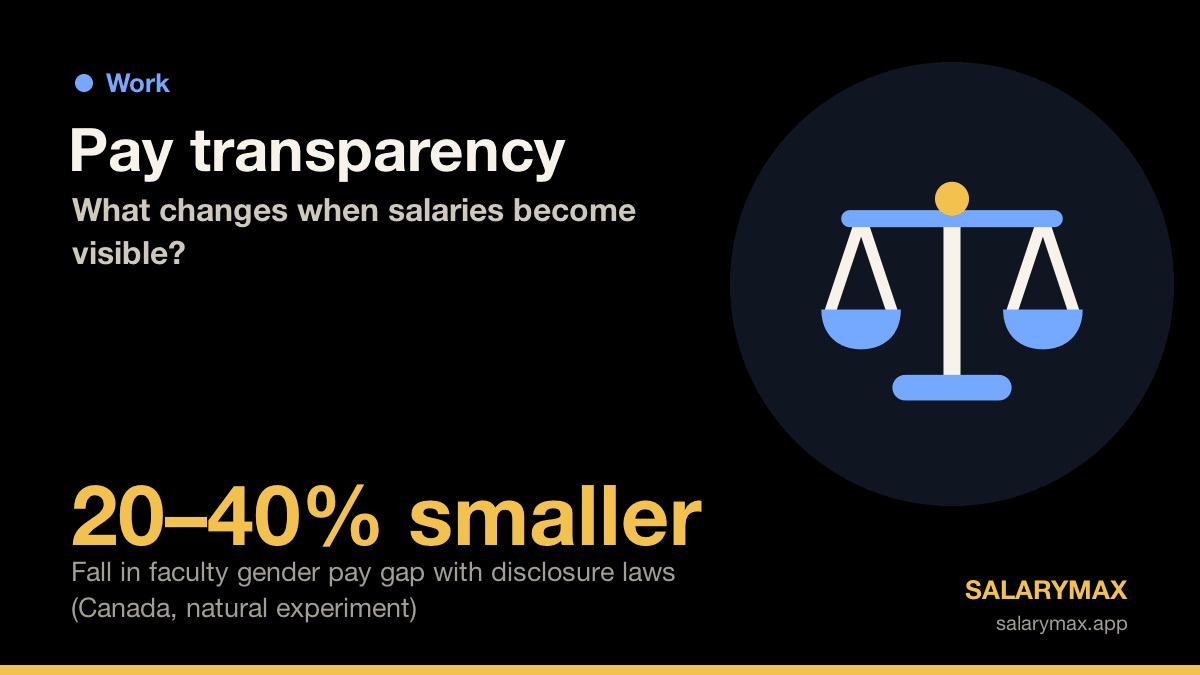
Canadian laws making university faculty salaries public cut the gender pay gap by about 20–40%. In a Southeast Asian bank experiment, learning a boss's pay raised hours.
The evidence behind this article
- Randomised trial2
- Natural experiment1
Includes studies built to test cause and effect (randomised trials or natural experiments).
3 sources・Countries studied: Canada, United States
How to read the kinds of evidence →What to do with this
Check one source of pay data for your role, such as pay ranges in job ads or official wage statistics. Write down your guess first to see how far off it was.
What happens when people can see what others are paid? At Canadian universities, making salaries public narrowed the pay gap between men and women. In an experiment at a bank in Southeast Asia, learning a manager’s pay and learning a peer’s pay moved employees’ effort in opposite directions.
Key points
- A study of Canadian provincial laws requiring public disclosure of university faculty salaries (Baker and colleagues, 2023) found that the laws reduced the gender pay gap by about 20–40%. It uses differences in when and to whom the laws applied, so it can be read as close to cause and effect.
- In an experiment with 2,060 employees of a large bank in Southeast Asia (Cullen & Perez-Truglia 2022), employees underestimated their managers’ average salary by 14.1% on average. Learning that managers earned 10% more than they thought increased their hours worked over the next 90 days by 1.5%.
- In the same experiment, learning that peers earned 10% more than they thought reduced hours worked by 9.4%. In a University of California experiment (Card and colleagues, 2012), staff paid below the median who were told about a public salary website reported lower satisfaction and were more likely to look for a new job.
How did salary disclosure change the gender pay gap?
Several Canadian provinces have laws requiring public sector bodies to publish the salaries of people paid above a set amount. In 1996, British Columbia, Manitoba and Ontario were the first, requiring universities to report each employee earning more than $50,000, $50,000 and $100,000 respectively.
Michael Baker, Yosh Halberstam, Kory Kroft, Alexandre Mas and Derek Messacar used Statistics Canada records covering almost all full-time university faculty. Within the same province, departments where someone earned above the threshold were affected by the law, while lower-paying departments were not. Using this difference and the different timing across provinces, they found that the laws reduced the gender pay gap by about 20–40%.
The effect was larger in unionised workplaces and among full professors. In some specifications, the gap narrowed mainly because men’s salaries grew more slowly, rather than because women’s pay rose.
How did learning a boss’s or a peer’s pay change effort?
Zoë Cullen and Ricardo Perez-Truglia worked with a large commercial bank in Southeast Asia and 2,060 of its employees. First they asked staff to guess the average salaries of their managers and peers, and compared the answers with company records. Guesses about manager pay were off by 28% on average and too low by 14.1% overall. Guesses about peer pay were off by 11.5%, with no overall bias.
Next, a randomly chosen group was shown the true average salaries, and the researchers tracked later effort using building entry records and email data. Learning that managers earned 10% more than expected increased hours worked by 1.5%. Learning that peers earned 10% more reduced hours worked by 9.4%.
The motivating effect of manager pay appeared for positions a few promotions away, which employees could realistically aspire to. For positions out of reach, the effect was close to zero.
A University of California experiment also shows how peer pay matters. Staff who were randomly told about a website listing university salaries, and whose pay was below the median for their unit and occupation, reported lower pay and job satisfaction and a higher chance of looking for a new job. Those paid above the median were unaffected.
What to keep in mind when reading pay transparency research
The Canadian study uses differences in how the laws applied, and the bank and University of California studies are experiments that shared information at random. All three are designed to get close to cause and effect, but they cover narrow groups: university faculty, one bank in Southeast Asia and university staff. The bank study’s authors also note that results may differ in workplaces with fewer chances for promotion.
A smaller gender gap is not the same as everyone being paid more. We have not found any study in Japan on the effects of making pay public.
A small step for today
Many people misjudge what others are paid, and accurate numbers changed their behaviour. Preparing to negotiate can start by checking your own assumptions against real figures.
- Count it as “Prepared for a negotiation” when you check one source of pay information for your role, such as the pay range in job ads, official wage statistics or your employer’s pay grades. Write down your guess first so you can see how far off it was.
- Use “Wrote one line on today’s progress” to note what the role you are aiming for requires. In the bank experiment, effort rose when people learned the pay of positions they could reach.
- If you lead a team, think about how much of the way pay is set you could explain.
FAQ
Does making salaries public close the gender pay gap?
At Canadian universities, disclosure laws reduced the gender pay gap by about 20–40%. However, this was among university faculty, and we have not found a study testing the same question in Japan.
Does knowing a coworker’s salary lower motivation?
In the bank experiment, learning that peers earned 10% more than expected reduced hours worked by 9.4%. At the University of California, staff paid below the median became less satisfied and more likely to look for another job.
Is there any point in knowing what your boss earns?
In the bank experiment, learning that managers earned 10% more than expected increased hours worked by 1.5%. The effect appeared for positions reachable through promotion and was close to zero for positions out of reach.
Sources
- [X-baker-2023] Baker, Halberstam, Kroft, Mas & Messacar (2023) Pay Transparency and the Gender Gap. American Economic Journal: Applied Economics.
- [X-cullen-perez-truglia-2022] Cullen & Perez-Truglia (2022) How Much Does Your Boss Make? The Effects of Salary Comparisons. Journal of Political Economy.
- [X-card-2012] Card, Mas, Moretti & Saez (2012) Inequality at Work: The Effect of Peer Salaries on Job Satisfaction. American Economic Review.
Studies describe average tendencies. This article is not a promise that a habit will lift your income, and it is not medical or investment advice. About these articles ・ Search & sources
Updated:
← All articles