Basics ・ 6 min
Does changing jobs raise pay? US research and Japan data
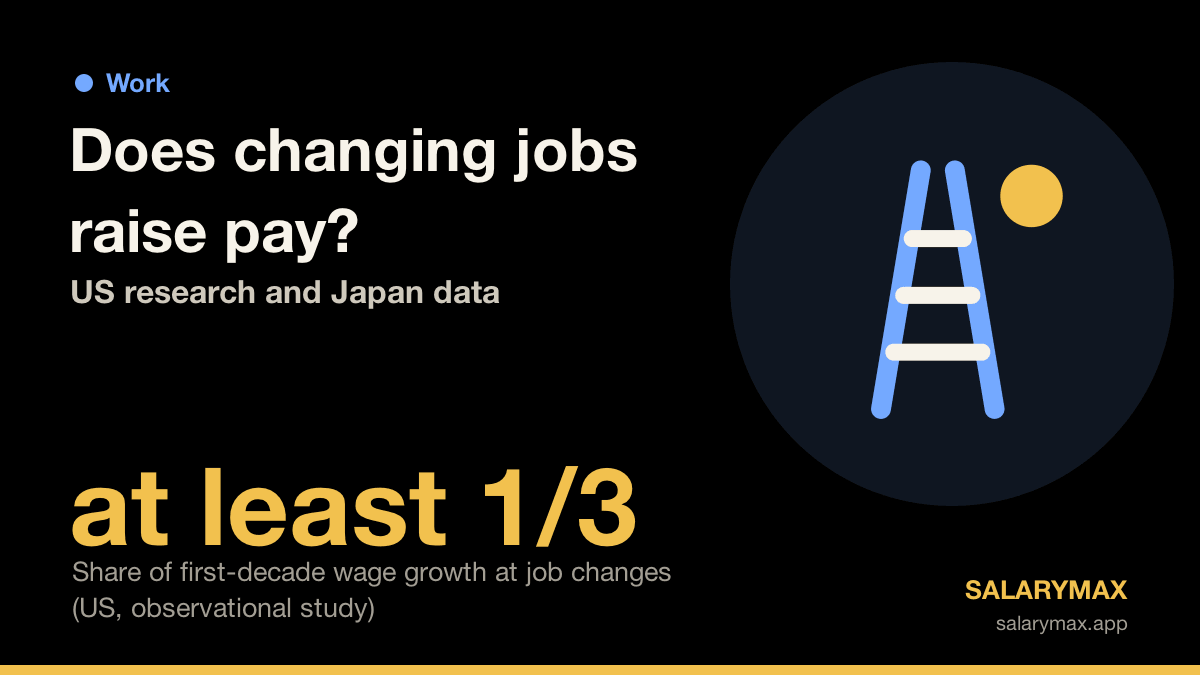
A US study of young men found at least a third of wage growth in their first 10 years came at job changes. In Japan in 2025, 40.8% of job changers got more, 31.0% less.
The evidence behind this article
- Adjusted observational1
- Observational1
Based on observational data. It shows that two things go together, not that one causes the other.
2 sources・Countries studied: United States, Japan
How to read the kinds of evidence →What to do with this
Look at one job ad for your kind of work to see the pay range, and note in one line what you handled and how it went, with the date.
Does switching jobs pay off? A long-running US study of young men found that at least a third of their wage growth in the first ten years of work happened at the moment they changed jobs. Yet Japan’s official statistics show that about three in ten people who change jobs end up earning less. Here is how to read both.
Key points
- A US study based on Social Security earnings records (Topel & Ward 1992) found that young men typically worked for about seven employers in their first ten years, and that wage gains at job changes accounted for at least a third of their wage growth over that period. It is an analysis of observational data, so it does not show that changing jobs causes higher pay.
- In Japan’s Survey on Employment Trends by the Ministry of Health, Labour and Welfare, 40.8% of people who changed jobs in 2025 were paid more than in their previous job, 31.0% were paid less, and 25.5% saw no change.
- In the same Japanese data, 55.2% of job changers aged 20–24 were paid more, while 54.3% of those aged 60–64 were paid less, so the direction differs sharply by age.
How much did pay change each time young US men switched jobs?
Robert Topel and Michael Ward used a large data set built from US Social Security records, the Longitudinal Employee-Employer Data (LEED). From records covering 1957 to 1972, they selected roughly 10,000 white men born after 1938 and followed their employers and earnings every three months for up to 15 years from the start of their careers.
Three findings stand out.
First, young workers change jobs a lot. In the first ten years, a typical worker held jobs with about seven employers, which is roughly two-thirds of all the jobs he would hold over his whole career.
Second, wage growth and job changes are closely linked. At least a third of wage growth in the first decade of work was explained by the pay rises that came with changing jobs. In the working paper version of the study, a typical job change came with a rise of about 12% in quarterly wages, compared with growth of about 1.75% per quarter while staying with the same employer.
Third, pay was the main factor in deciding whether to move. Workers moved when they found a better offer and stayed once they found a good match. The authors see this seemingly haphazard job-hopping as an important step toward the stable jobs of a mature career.
Did job changers in Japan earn more or less?
Japan’s Ministry of Health, Labour and Welfare runs the Survey on Employment Trends, an official survey of 14,840 sampled workplaces with five or more regular employees. In the 2025 results, 40.8% of people who joined a new employer after leaving another job were paid more than before, 31.0% were paid less, and 25.5% saw no change. A rise of 10% or more applied to 28.2%, and a fall of 10% or more to 21.9%.
Age makes a big difference. Among people aged 20–24, 55.2% were paid more and 17.5% were paid less. Among those aged 50–54, only 29.4% were paid more while 42.0% were paid less, and among those aged 60–64, 54.3% were paid less.
What to keep in mind when reading job-switching research
Neither source is an experiment where people were randomly told to switch or stay. As the US study shows, people move when they find a better offer, and those who never got one may simply have stayed. So we cannot say that changing jobs caused the higher pay.
It also matters whose careers these are. The US study covers young white men in the 1950s to 1970s. The results may not carry over to women, to today’s labour market, or to Japan’s employment system.
The Japanese figures are shares of people whose pay went up or down. They do not compare job changers with what would have happened had they stayed, and they count only people still working at their new workplace at the time of the survey. In this article we use Japan’s official statistics; we have not covered Japanese studies that follow the same people over many years to track job changes and wage growth.
A small step for today
Whether or not you plan to move, you can collect evidence of what your work is worth.
- Use “Wrote one line on today’s progress” to note what you worked on and what came of it, with dates. It helps in a job search and in pay talks where you are now.
- Count it as “Prepared for a negotiation” when you look at one job ad in your field and note the pay range. In the US study, pay was the main reason people decided to move.
- Use “Studied for 30 minutes” to build skills that other employers would also value.
FAQ
Will changing jobs increase my salary?
It depends on the person, and research cannot promise it. In Japan’s 2025 data, 40.8% of job changers were paid more, 31.0% were paid less and 25.5% saw no change. The US study also describes an average pattern among people who chose to move.
Is it bad to change jobs many times when you are young?
This research cannot tell whether the number of moves itself helps or hurts. Among young US men, holding about seven jobs in the first ten years was typical, and the study describes repeated moves as part of settling into a long-lasting job.
Up to what age does changing jobs tend to raise pay?
In Japan’s 2025 data, the share of job changers who were paid more fell as age rose. It was 55.2% for people aged 20–24, and from age 50–54 onward more people were paid less than more. These figures shift from year to year.
Sources
- [X-topel-ward-1992] Topel & Ward (1992) Job Mobility and the Careers of Young Men. The Quarterly Journal of Economics.
- [X-mhlw-2026] Ministry of Health, Labour and Welfare, Japan (2026) Survey on Employment Trends 2025: Summary of Results.
Studies describe average tendencies. This article is not a promise that a habit will lift your income, and it is not medical or investment advice. About these articles ・ Search & sources
Updated:
← All articles