Basics ・ 6 min
Do productive coworkers make you faster? Peer effects
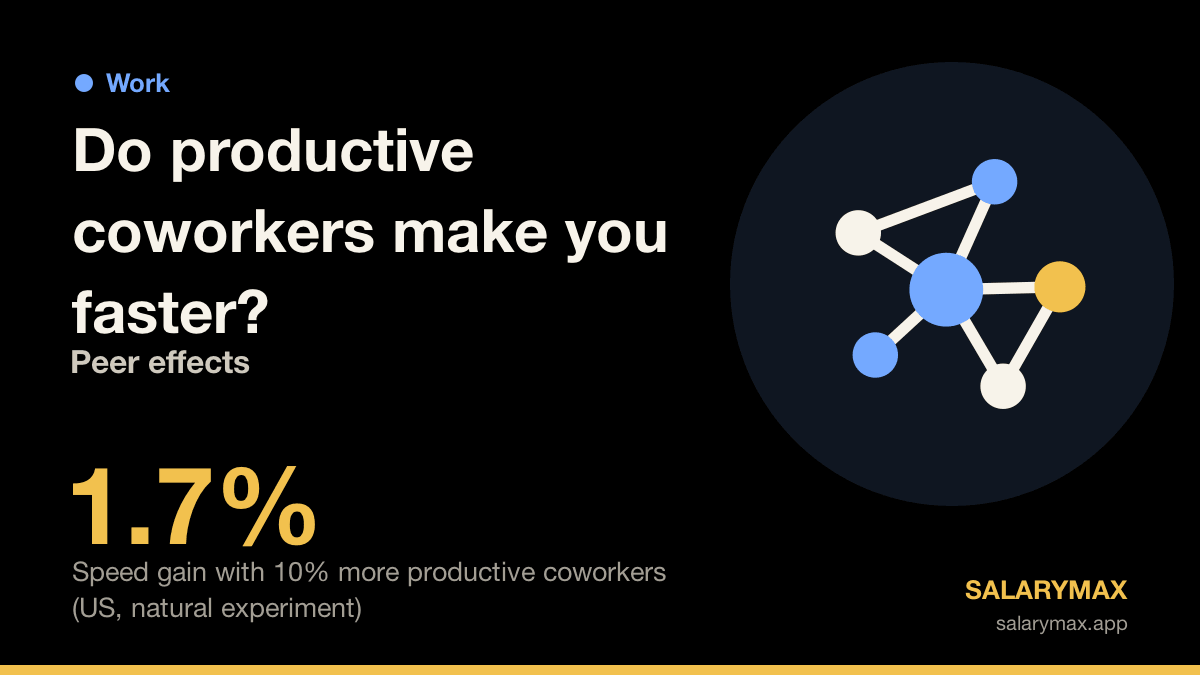
In a US supermarket study, when same-shift coworkers were 10% more productive, cashiers worked 1.7% faster. Across a German city, the same gap meant just 0.1% higher pay.
The evidence behind this article
- Natural experiment2
- Adjusted observational1
Includes studies built to test cause and effect (randomised trials or natural experiments).
3 sources・Countries studied: United States, Germany, Japan
How to read the kinds of evidence →What to do with this
This week, pick one way an experienced colleague works and try copying it. Write one line on what you tried and what you noticed.
Does working next to someone very good change how you work? At checkout counters in US supermarkets, cashiers sped up when a fast colleague joined the shift. Economists call this kind of influence a peer effect. But across a whole German city, the effect on wages was small on average.
Key points
- In records from 370 cashiers at six US supermarkets (Mas and Moretti, 2009), a 10% increase in the average productivity of coworkers on the same shift went with a 1.7% increase in a cashier’s own speed. Only cashiers who were within sight of the faster colleague responded.
- In German social security records for the Munich area from 1989 to 2005 (Cornelissen and colleagues, 2017), coworkers in the same firm and occupation who were 10% better went with only 0.1% higher wages on average. In highly repetitive jobs, the figure was larger, at 0.6–0.9%.
- In a fully remote Japanese company (Ishikura, 2026), the average productivity of teammates made no difference, but teams of highly experienced members had about 12.2% higher productivity, and about 26.2% higher for the newest staff.
What happened at supermarket checkouts when a fast cashier arrived?
Alexandre Mas and Enrico Moretti used two years of checkout data, between 2003 and 2006, from six stores of a supermarket chain in one metropolitan area in the western United States. They followed 370 cashiers and measured each person’s speed every ten minutes as items scanned per second.
Workers had a lot of freedom to choose their shifts, and managers did not place fast cashiers at busy times. As a result, the timing of who started or ended a shift during the day was close to random. Using that kind of chance variation is called a natural experiment.
When the average productivity of coworkers on the shift was 10% higher, a cashier’s own speed was 1.7% higher. Most of the gain came from cashiers who were slower to begin with.
Only cashiers who could be seen by the newly arrived fast worker sped up. Being able to see a fast worker, without being seen in return, made no difference. The authors interpret this as social pressure: people work harder when colleagues can watch. These cashiers were paid a fixed hourly wage, so working faster did not raise their pay.
How large were coworker effects across a German city and in a Japanese remote company?
Thomas Cornelissen, Christian Dustmann and Uta Schönberg used social security records for every worker aged 16 to 65 in Munich and its surrounding districts from 1989 to 2005. They defined peers as people in the same occupation at the same workplace and used statistical controls for differences between individual workers and firms.
On average, the effect was small. Peers who were 10% better went with only 0.1% higher wages, roughly 10 to 15 times smaller than the supermarket result. The effect was also small in high-skilled jobs. In jobs built on simple, repeated tasks, however, 10% better peers went with 0.6–0.9% higher wages. Again, the authors point to social pressure.
In Japan, Hideaki Ishikura studied a company whose staff have worked fully remotely since it was founded, using records from April 2022 to March 2023 (977 employee-months). New hires were assigned to teams in a way that was close to random. Teammates’ average productivity had no effect. But on teams of highly experienced members, productivity, measured as the number of clients handled per month, was about 12.2% higher, and about 26.2% higher for the newest employees. The effect was not related to how much the team communicated. The paper discloses that the author side includes a former director of the company.
How far does peer-effect research go?
This evidence supports one claim: coworker effects tend to show up where work is visible to others, and for people with little experience. The supermarket and Japanese studies use chance variation, so they come close to showing cause, but each covers one company and one kind of work. The German study, which covers a whole city with statistical controls, finds that the effect is small on average.
Higher productivity also does not necessarily mean higher pay. The supermarket cashiers were on a fixed wage. Korean research was outside the scope of this review.
A small step for today
What the research supports is that working alongside experienced colleagues can help, especially early on.
- During “Studied for 30 minutes,” pick one way an experienced colleague does their work and try copying it.
- Use “Wrote one line on today’s progress” to note what you tried and what you noticed.
- When you join a new team, look for chances to work on the same tasks as experienced people. In the Japanese study, the gap was largest for the newest staff.
FAQ
Will working with high performers make me more productive?
At US supermarket checkouts, a 10% increase in coworkers’ productivity went with a 1.7% increase in a cashier’s own speed. But across a German city, the same gap meant only 0.1% higher wages on average. The effect varies a lot with the job and the workplace.
Why do coworkers affect how we work?
The US and German studies point mainly to social pressure from being watched. In the supermarket, only cashiers within sight of the fast worker sped up. In the Japanese remote company, experienced teammates were linked to higher productivity regardless of how much the team communicated.
Will moving to a workplace with stronger colleagues raise my pay?
The research does not show that. In the German study, peers who were 10% better went with only 0.1% higher wages on average. The research describes average tendencies, not a prediction for any one person.
Sources
- [X-mas-moretti-2009] Mas & Moretti (2009) Peers at Work. American Economic Review.
- [X-cornelissen-2017] Cornelissen, Dustmann & Schönberg (2017) Peer Effects in the Workplace. American Economic Review.
- [X-ishikura-2026] Ishikura (2026) Experienced teammates increase productivity in remote work: Evidence from a full remote work company in Japan. PLOS One.
Studies describe average tendencies. This article is not a promise that a habit will lift your income, and it is not medical or investment advice. About these articles ・ Search & sources
Updated:
← All articles