Basics ・ 6 min
Graduating in a recession: what happens to your earnings?
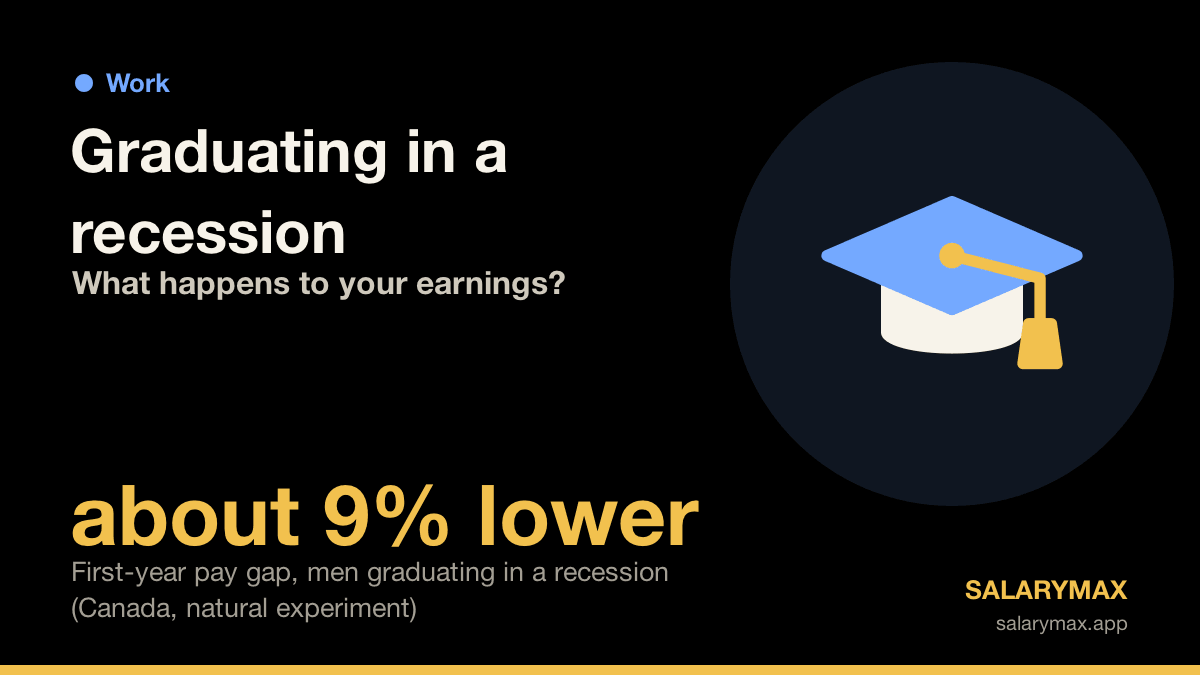
Canadian men who left college in a typical recession earned about 9% less at first, and the gap took about 10 years to fade. In Japan, less-educated men were hit longer.
The evidence behind this article
- Natural experiment2
- Adjusted observational2
Includes studies built to test cause and effect (randomised trials or natural experiments).
4 sources・Countries studied: Canada, Japan, United States, South Korea
How to read the kinds of evidence →What to do with this
You cannot choose when you graduate, so spend 30 minutes on a skill other employers would value, and write one line on what you did and what came of it.
What happens to your career if you leave school in a bad year? Studies from Canada, the United States, Japan and South Korea find that people who graduate into a weak economy tend to earn less for years afterward. Because nobody chooses the year they graduate, researchers treat this as the effect of timing and luck, not of effort.
Key points
- A Canadian study using administrative data on college graduates (Oreopoulos and colleagues, 2012) found that men who graduated in a typical recession, with unemployment 5 percentage points higher, earned about 9% less in their first year; the gap halved within 5 years and had mostly faded after about 10 years (estimates from the working paper version).
- A study comparing Japan and the United States (Genda and colleagues, 2010) found that a high unemployment rate at graduation had a long-lasting effect on less-educated Japanese men, but only a temporary effect on the same group in the US.
- A US study of white men who finished college between 1979 and 1989, using the NLSY survey (Kahn 2010), found that the wage penalty from graduating into a bad economy lasted for the whole period studied.
How much less, and for how long, did recession graduates earn?
In Canada, Philip Oreopoulos, Till von Wachter and Andrew Heisz linked university records with tax and payroll records to follow the earnings of men who graduated from college between 1976 and 1995. Graduating in a typical recession, when unemployment is 5 percentage points higher, meant annual earnings about 9% lower in the first year. The gap halved within 5 years and had mostly disappeared after about 10.
The effect was not the same for everyone. For the group with the lowest predicted earnings based on their background at graduation, earnings were about 15% lower in the first year and still about 7.5% lower ten years later.
The study also shows how people caught up. Recession graduates often started at lower-paying employers, then gradually closed the gap by moving to better ones. Graduates with more advantages made those moves faster.
In the United States, Lisa Kahn followed white men who graduated from college between 1979 and 1989 in the National Longitudinal Survey of Youth (NLSY). Those who graduated into a worse economy had lower wages, and the penalty lasted for the whole period she studied. In her own summary of the work, people who graduated into a large downturn still earned around 10% less 17 years later than those who graduated in the best times.
What happened in Japan’s “employment ice age” and Korea’s financial crisis?
Yuji Genda, Ayako Kondo and Souichi Ohta compared men in Japan’s Labour Force Survey with a similar US survey. For less-educated Japanese men, a high unemployment rate at graduation had effects that lasted for many years. For the same group in the US, the effect was temporary.
The authors point to Japan’s system of hiring new graduates directly through schools, and to rules that make dismissals difficult. Missing the first chance to become a regular, permanent employee was hard to make up for later.
In South Korea, a study compared people who graduated from college before, during and after the 1997–1998 Asian financial crisis (Choi and colleagues, 2020). Using the Korean Labor and Income Panel Study, it found that men who graduated during the crisis saw large and lasting reductions in employment, earnings, marriage, having children and building assets.
How to read research on graduation timing and earnings
Nobody chooses the state of the economy in the year they graduate. That is why researchers treat these results as close to cause and effect. Some people do delay graduation to avoid a bad year, so the Canadian and US studies also adjust for that.
These are still average patterns, and the Canadian, US and Japanese studies focus mainly on men. The results may not apply with the same size to women or to people with other levels of education.
Most importantly, lower earnings after graduating in a recession are not a sign of too little effort. People with similar backgrounds ended up with different earnings simply because of the year they left school.
A small step for today
You cannot choose your timing, but you can prepare a little each day to move and to cope.
- Use “Studied for 30 minutes” to add skills that other employers would also value.
- Use “Wrote one line on today’s progress” to record what you did and what came of it. It gives you material to explain your work when you change employers.
- Use “Paid myself first” to build savings, even small amounts, as a cushion for hard times in the economy.
FAQ
If I graduated during the employment ice age, will my income always stay lower?
It depends. In Canada the average gap mostly faded after about 10 years, but for the group with the lowest predicted earnings it was still about 7.5% ten years on. In Japan, the effect lasted a long time for less-educated men.
Is low pay after graduating in a recession a matter of not trying hard enough?
Research does not support that view. The differences come from the economy in the year of graduation, which people cannot choose, and similar people earned different amounts depending on when they left school.
How did recession graduates catch up?
In the Canadian study, graduates who started at lower-paying employers gradually caught up by moving to better ones.
Sources
- [X-oreopoulos-2012] Oreopoulos, von Wachter & Heisz (2012) The Short- and Long-Term Career Effects of Graduating in a Recession. American Economic Journal: Applied Economics.
- [X-genda-2010] Genda, Kondo & Ohta (2010) Long-Term Effects of a Recession at Labor Market Entry in Japan and the United States. Journal of Human Resources.
- [X-kahn-2010] Kahn (2010) The long-term labor market consequences of graduating from college in a bad economy. Labour Economics.
- [X-choi-2020] Choi, Choi & Son (2020) The long-term effects of labor market entry in a recession: Evidence from the Asian financial crisis. Labour Economics.
Studies describe average tendencies. This article is not a promise that a habit will lift your income, and it is not medical or investment advice. About these articles ・ Search & sources
Updated:
← All articles