Basics ・ 7 min
Do big cities pay more? Wage evidence from Spain and the US
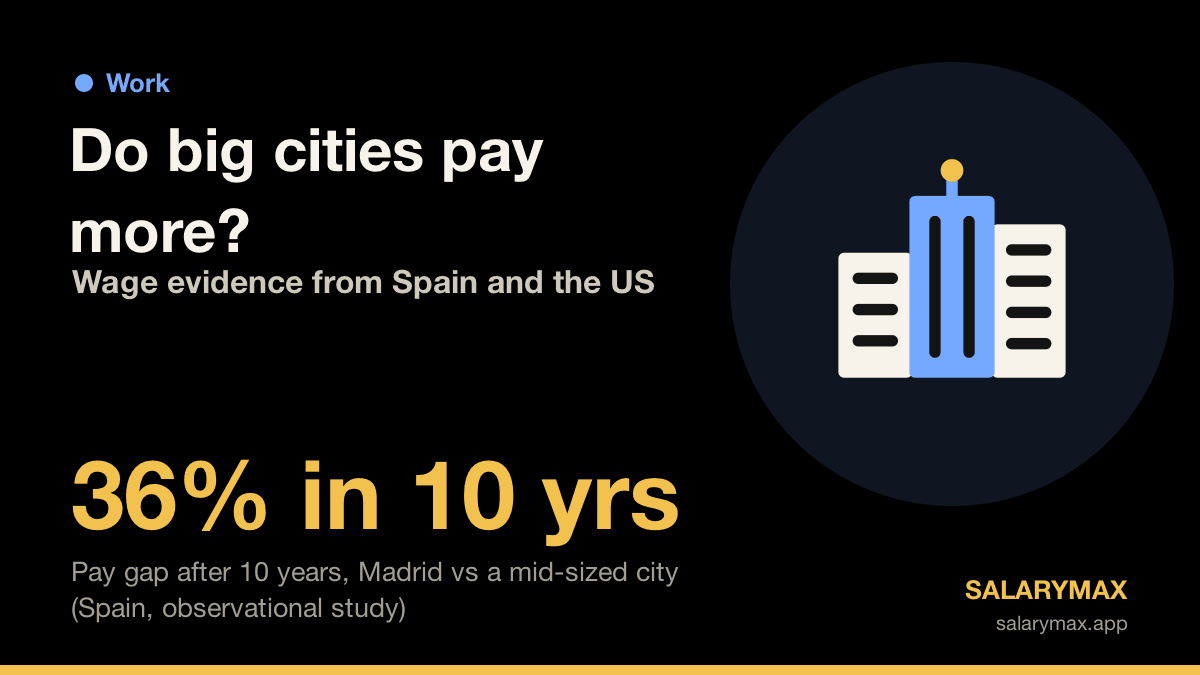
Spanish data on 157,000 men show similar workers earned 9% more in Madrid than in a mid-sized city at first, 36% more after 10 years. Observational; before living costs.
The evidence behind this article
- Adjusted observational3
- Observational1
- Estimate1
Based on observational data. It shows that two things go together, not that one causes the other.
5 sources・Countries studied: Spain, United States, Japan
How to read the kinds of evidence →What to do with this
When you compare jobs or places to live, write the monthly fixed costs such as rent and the experience you could build next to the headline salary.
People often say that big cities pay more. A study from Spain suggests this is not mainly because more able people move there, but because big-city experience is worth more, and workers keep that value after they leave. Big cities also cost more to live in, so headline pay alone does not settle the question.
Key points
- A study that followed about 157,000 men in Spanish administrative records from 2004 to 2009 (De la Roca and Puga, 2017) found that, comparing workers with the same characteristics, pay in Madrid was about 9% higher than in the mid-sized city of Santiago at first and 36% higher after 10 years. It is an observational study and does not account for living costs.
- In the same study, workers who spent 5 years in Madrid and then moved to Santiago kept 14.5% higher earnings from the experience they had built. About half of the big-city premium came from working there and about half built up as experience.
- Japanese statistics for 2025 show average pay of 418.3 thousand yen in Tokyo against 340.6 thousand yen nationally, but Tokyo also had the highest price level, 104.2 with the national average at 100, driven mostly by housing.
How much more did workers earn in Spain’s big cities?
Jorge De la Roca and Diego Puga used Spanish administrative data that link social security, tax and census records for a random 4% of the population. They followed about 157,000 men born in 1962 or later who worked at some point between 2004 and 2009, tracking each change of employer and city.
On a simple average, men working in Madrid earned 31,000 euros a year, 46% more than in Santiago de Compostela, the median-sized city. That raw gap also mixes in differences in education, occupation and ability.
So the researchers also used the changes in pay when the same person moved between cities, removing differences in underlying ability. Comparing workers with the same characteristics, pay in Madrid started about 9% higher, and the gap widened each year to 36% after 10 years.
Did the value of big-city experience last after people left?
Workers who spent 5 years in Madrid and then moved to Santiago saw their pay fall by 8.6% when they moved, close to the size of the original gap between the two cities. But they kept the 14.5% higher earnings that came from experience built in Madrid. That advantage shrank slightly over time, but a substantial gap remained.
Over about 7 years, roughly half of the big-city premium came from working there at the time and half from experience that built up. More able workers tended to gain more from it.
Edward Glaeser and David Maré, using US surveys that follow men over time (the PSID and NLSY), reached a similar conclusion. The urban wage premium could not be explained by ability differences alone, and most of it built up over time as workers gained skills in cities.
How much higher are wages and prices in Tokyo?
Japan’s Basic Survey on Wage Structure for 2025 shows that average scheduled monthly pay in June (excluding overtime) was 340.6 thousand yen nationally. Only four prefectures were above that, Tokyo, Kanagawa, Aichi and Osaka, and Tokyo was highest at 418.3 thousand yen.
The Statistics Bureau’s 2025 regional price index puts Tokyo at 104.2 with the national average at 100, the highest for 13 years in a row. Housing was the biggest factor pushing Tokyo’s prices up.
A discussion paper from Japan’s Research Institute of Economy, Trade and Industry (Kondo, 2017, not peer reviewed) found in manufacturing data that the usual measure of the urban premium also picks up differences such as firm size. Counting only the part that runs through firm productivity, the link between city size and pay was smaller than in earlier international studies.
How to read the research on big-city wages
The Spanish and US studies follow the same people over time and use statistics to remove ability differences, but they are observational. Nobody was assigned to a city by lottery, and the samples are mainly men.
Living costs matter too. The Spanish study compares headline wages, and the authors note that higher housing prices in big cities tend to offset higher pay, so the gap in real terms may not be large. The Tokyo figures measure wages and prices separately, so you cannot simply subtract one from the other.
What this evidence supports is that in Spain and the US, people who worked in big cities tended to build more valuable experience, and they kept that value after moving. This article does not cover a Japanese study that follows the same people across cities over time.
A small step for today
- Use “Studied for 30 minutes” to write down one skill you are building in your current job. In the research, the gap came from experience built up at work.
- Use “Wrote one line on today’s progress” to record what you worked on and what came of it. It becomes a record of experience you can take anywhere.
- If you are thinking of moving to a different city, count it as “Reviewed one fixed cost” when you write down the difference in rent and other monthly fixed costs and put it next to the headline salary.
FAQ
Do you earn more if you work in Tokyo?
In Japan’s 2025 statistics, average pay in Tokyo was 418.3 thousand yen, higher than the national 340.6 thousand yen. But Tokyo also had the highest prices, driven mostly by housing. The Spanish study is observational too, so it does not mean that moving to a big city raises anyone’s pay.
Does big-city experience still help if you move to a smaller city?
In the Spanish study, workers who spent 5 years in Madrid and then moved to a mid-sized city kept 14.5% higher earnings from their big-city experience. These are average tendencies, not a forecast for any one person.
Do higher big-city salaries disappear into living costs?
It depends. The authors of the Spanish study note that higher housing prices in big cities tend to offset higher headline pay. In Japan, too, Tokyo had the highest price level, pushed up mainly by housing.
Sources
- [X-de-la-roca-puga-2017] De la Roca & Puga (2017) Learning by Working in Big Cities. The Review of Economic Studies.
- [X-glaeser-mare-2001] Glaeser & Maré (2001) Cities and Skills. Journal of Labor Economics.
- [X-mhlw-chingin-2026] 厚生労働省 (2026) 令和7年賃金構造基本統計調査 結果の概況.
- [X-stat-chiikisa-2026] 総務省統計局 (2026) 消費者物価地域差指数-小売物価統計調査(構造編)2025年(令和7年)結果-.
- [X-kondo-2017] Kondo (2017) Urban Wage Premium Revisited: Evidence from Japanese matched employer-employee data. RIETI Discussion Paper.
Studies describe average tendencies. This article is not a promise that a habit will lift your income, and it is not medical or investment advice. About these articles ・ Search & sources
Updated:
← All articles