Basics ・ 7 min
Does your employer change your pay? Germany and US evidence
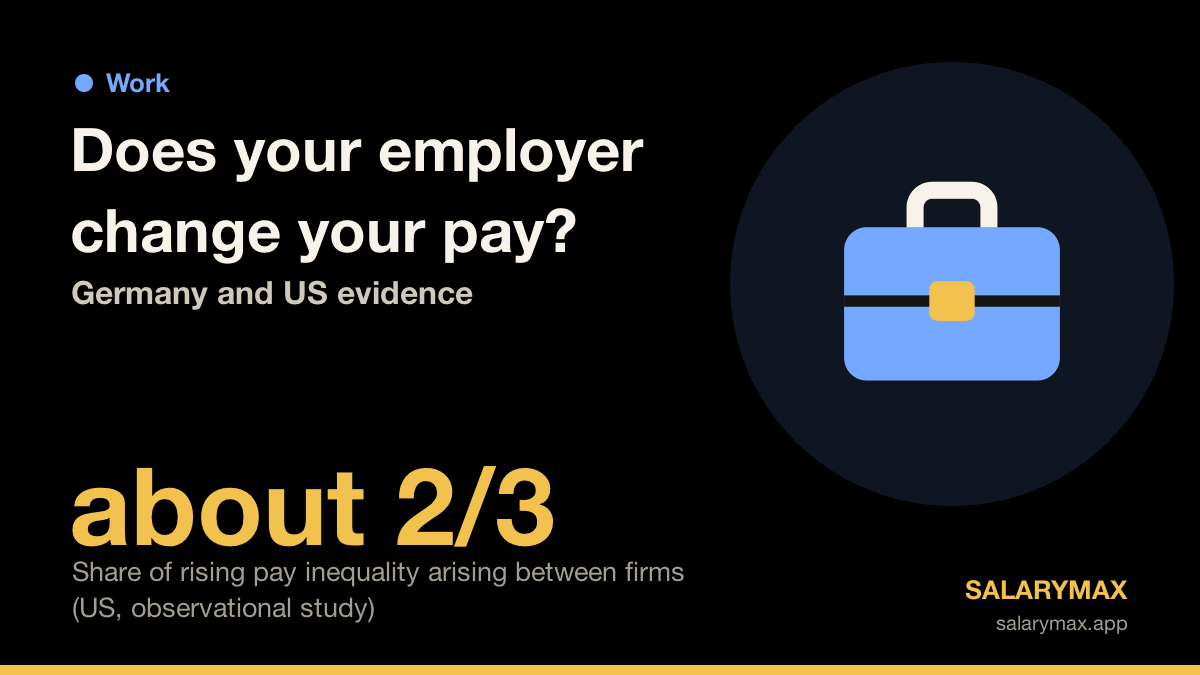
In US data, two-thirds of rising earnings inequality arose between firms, mostly from who works where. West German men who moved to higher-paying workplaces gained.
The evidence behind this article
- Adjusted observational3
- Observational1
Based on observational data. It shows that two things go together, not that one causes the other.
4 sources・Countries studied: Germany, United States, Japan
How to read the kinds of evidence →What to do with this
When you compare job ads, look beyond the typical pay for the role and note what one specific company pays for the same job.
Do people with the same skills earn different amounts depending on which company they work for? A study using large German administrative records found that workplaces differ in the pay premium they offer, and that people’s wages moved up or down by roughly that difference when they changed workplace. A US study, however, found that the main reason gaps between companies grew was a change in who works where.
Key points
- A study of West German social insurance records for full-time men from 1985 to 2009 (Card, Heining and Kline, 2013) found that people who moved from the lowest-paying to the highest-paying group of workplaces gained 36 log points on average in 2002 to 2009, and those who moved the other way lost 48. It is observational, and the figures come from the working paper version.
- A study of US administrative data linking employers and workers from 1978 to 2013 (Song and colleagues, 2019) found that two-thirds of the rise in earnings inequality happened between firms. Most of that came from changes in which workers are at which firms, not from firms paying the same kind of worker more.
- Japanese statistics for 2025 show average monthly pay of 385.1 thousand yen at firms with 1,000 or more employees and 305.6 thousand yen at firms with 10 to 99. That gap also reflects differences in the workers, such as age and years of service.
How did changing workplaces change the same person’s pay in West Germany?
David Card and colleagues used West German social insurance records for men working full time. They split 1985 to 2009 into four periods and studied the wages of about 17 million workers in each (working paper version).
Their method splits each wage into a part that belongs to the person and a part that belongs to the workplace, measuring each workplace’s pay premium from what happens to people’s wages when they move. It explained nearly all of the rise in West German wage inequality.
When workplaces were sorted into four groups by their premium, people who moved from the lowest group to the highest gained about 23 log points on average in 1985 to 1991 and 36 log points in 2002 to 2009. People who moved the other way lost 22 and 48 log points. Log points measure pay gaps on a logarithmic scale. For small gaps they are close to percentages, but for large gaps the number is smaller than the percentage.
Gains and losses were roughly the same size, and people who moved between workplaces with similar premiums gained almost nothing. Wages also did not dip temporarily in the year before a move.
Why did pay gaps between US companies grow?
Jae Song and colleagues used a massive US database that links companies and workers, covering 1978 to 2013. Of the rise in earnings inequality over that time, one-third happened within firms and two-thirds between firms.
But once the mix of workers was taken into account, the spread of firm-specific pay premiums had not grown. Instead, high-wage workers became more likely to work at high-wage firms, and high-wage workers became more likely to work alongside each other. These two changes contributed roughly equal amounts.
What do we know about pay gaps between companies in Japan?
A discussion paper from the Research Institute of Economy, Trade and Industry (Kambayashi, Tanaka and Yamaguchi, 2024, not peer reviewed) found that among full-time men from 1995 to 2013, pay gaps between firms widened and drove the overall rise in inequality, while gaps within firms did not change.
Japan’s Basic Survey on Wage Structure for 2025 shows average scheduled monthly pay in June of 385.1 thousand yen at large firms (1,000 or more employees), 326.2 thousand yen at medium firms (100 to 999) and 305.6 thousand yen at small firms (10 to 99). With large firms set at 100, small firms come to 79.4. Average years of service, though, were 14.1 at large firms and 11.5 at small ones, so the workers differ too.
How to read the research on employers and pay
None of these studies assigned people to employers by lottery; all are observational. The German study checks that gains and losses are about the same size and that wages do not drop before a move, and reads this as evidence that workplace pay premiums are real. But as the US study shows, much of the gap between companies also reflects who works there.
What this evidence supports is that in German administrative records, workplaces differed in their pay premiums, and movers’ wages tended to shift by about that difference. It does not mean that moving to a higher-paying company gets you the full gap in average pay. The German mover figures come from the working paper version, and the Japanese study is a discussion paper that has not been peer reviewed.
A small step for today
- Count it as “Prepared for a negotiation” when you look at one job ad in your field and note the pay range by company. You will see differences between employers, not just the typical pay for the role.
- Use “Wrote one line on today’s progress” to record what you worked on and what came of it. It helps when you compare employers and when you talk about pay where you are now.
- Use “Studied for 30 minutes” to build skills that any company would value.
FAQ
Will moving to a large company raise my salary?
Not necessarily. In Japan’s 2025 statistics, average pay was 385.1 thousand yen at large firms and 305.6 thousand yen at small firms, but that gap also reflects differences in workers, such as age and years of service. The German study, too, describes average tendencies in observational data.
Why do companies pay different amounts for the same job?
In the German study, workplaces differed in their pay premiums, and workplaces with higher premiums were more likely to survive. The authors say this cannot be explained simply as compensation for harder jobs (working paper version). In the US, differences in who works at each firm also mattered a great deal.
If I move to a higher-paying company, do I get the whole difference?
Not always. In the US study, the main reason gaps between companies grew was that high-wage workers increasingly worked at the same firms. Differences in average pay between companies include differences in who works there.
Sources
- [X-card-heining-kline-2013] Card, Heining & Kline (2013) Workplace Heterogeneity and the Rise of West German Wage Inequality. The Quarterly Journal of Economics.
- [X-song-2019] Song, Price, Guvenen, Bloom & von Wachter (2019) Firming Up Inequality. The Quarterly Journal of Economics.
- [X-kambayashi-2024] Kambayashi, Tanaka & Yamaguchi (2024) Rise in Wage Inequality between Firms: Evidence from Japan 1995-2013. RIETI Discussion Paper.
- [X-mhlw-chingin-2026] 厚生労働省 (2026) 令和7年賃金構造基本統計調査 結果の概況.
Studies describe average tendencies. This article is not a promise that a habit will lift your income, and it is not medical or investment advice. About these articles ・ Search & sources
Updated:
← All articles