Basics ・ 6 min
Generative AI at Work: How Productivity Changed in Studies
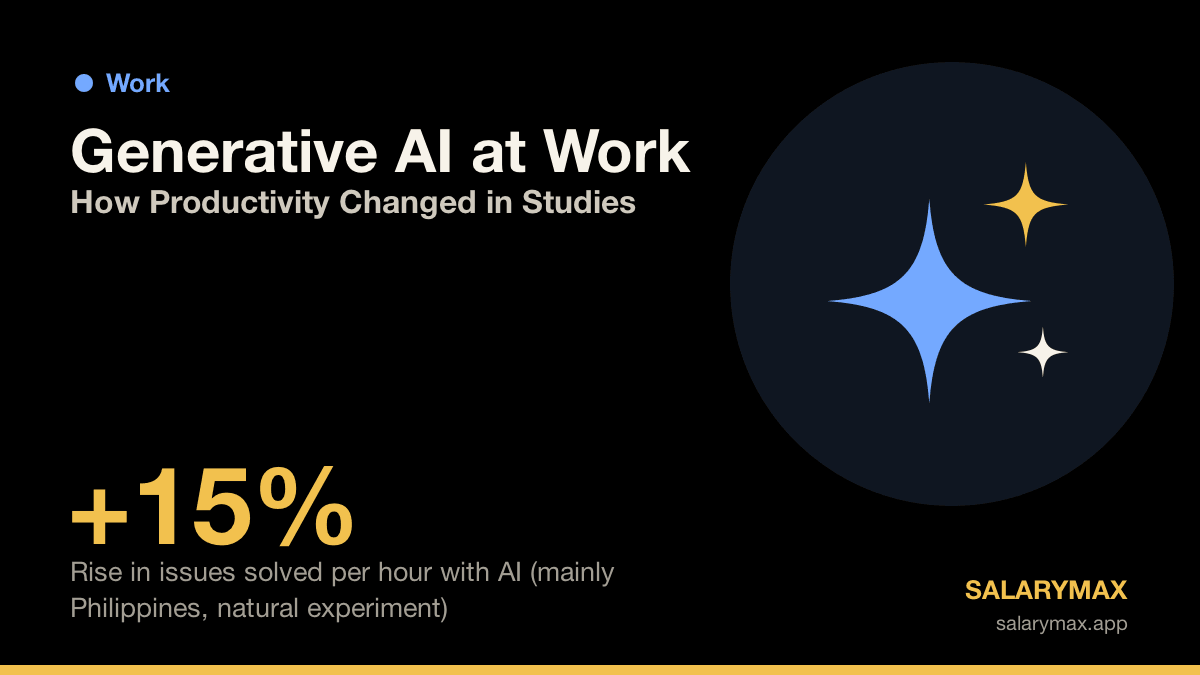
In a study of 5,172 support agents, generative AI raised issues solved per hour by 15%, most for newer staff; a writing test cut time by 40%. Effects on pay are unknown.
The evidence behind this article
- Randomised trial1
- Natural experiment1
- Observational1
Includes studies built to test cause and effect (randomised trials or natural experiments).
3 sources・Countries studied: United States, Philippines, Japan
How to read the kinds of evidence →What to do with this
Try generative AI on one routine task, such as drafting an email, and note how long it took. Check your company's rules first, and reread what it produces.
How does using generative AI at work change productivity? A study of real customer-support work and an experiment with writing tasks both found that people worked faster, and the gains were biggest for less experienced or lower-scoring workers. What happens to pay, however, is still unknown.
Key points
- In a study of 5,172 customer-support agents at a large firm (89% based outside the US, mainly in the Philippines), access to a generative AI conversational assistant raised the number of issues resolved per hour by 15% on average. The analysis used the fact that agents got access at different times.
- In the same study, less experienced and lower-skilled agents resolved 30% more issues per hour and improved in both speed and quality. The most experienced and skilled agents saw small gains in speed and small declines in quality.
- In a randomized experiment with 453 college-educated professionals (Noy & Zhang 2023), those given ChatGPT took 40% less time on writing tasks and their work was rated 18% higher in quality. Neither study measured effects on wages.
Whose productivity rose in customer support?
Erik Brynjolfsson of Stanford and his co-authors studied data on 5,172 customer-support agents at a Fortune 500 company that sells business-process software. Most of the agents (89%) worked outside the US, mainly in the Philippines. A conversational assistant built on generative AI was rolled out mainly in fall 2020 and winter 2021, reaching different agents at different times. The researchers used this staggered timing to compare agents before and after they got access, a quasi-experimental design.
On average, issues resolved per hour rose by 15%. The gains were largest among less experienced and lower-skilled agents, who resolved 30% more issues per hour and improved in both speed and quality. The most experienced and skilled agents got slightly faster, but the quality of their work fell slightly.
The study also reports evidence that AI assistance helped agents learn and improved English fluency, especially among agents outside the US. Customers were more polite and less likely to ask for a manager. Fewer agents quit, mainly because newer agents stayed on.
How did time and quality change in a writing experiment?
Shakked Noy and Whitney Zhang of MIT ran a preregistered online experiment with 453 college-educated professionals. Participants did writing tasks matched to their occupations, such as marketing, grant writing, consulting, data analysis, human resources and management, with bonuses for good work. Half were randomly chosen to have access to ChatGPT.
Those with ChatGPT took 40% less time on average, and their work was rated 18% higher in quality by professionals in the same fields. People who scored lower on the first task gained more, so differences between workers shrank. Two weeks later, participants who had been given ChatGPT were twice as likely to report using it in their real jobs, and 1.6 times as likely two months later.
A Japanese survey and how to read the research on generative AI
In Japan, Morikawa (2024) at the Research Institute of Economy, Trade and Industry surveyed 13,150 workers online in September 2023 (a discussion paper that has not been peer reviewed). Only 5.8% used AI, including generative AI, in their work. Those users said, on average, that AI made their work 21.8% more efficient. That is a self-assessment, not a measurement. Workers who used AI at work earned 45.6% more per year than those who did not, but after accounting for sex, age, education, occupation and other factors the gap shrank to 12.4%. This suggests that people who were already better paid were more likely to use AI.
Keep these points in mind:
- The support study covers one job at one company, and the writing tasks took about 20 to 30 minutes. The same gains may not carry over to other kinds of work.
- Higher productivity does not automatically mean higher pay. The support study had no data on individual pay, so the effect on wages is unknown.
- The Japanese survey is observational. People who use AI differ from those who do not in many ways.
A small step for today
- Use your “Studied for 30 minutes” time to try generative AI on one routine task, such as drafting an email. Check your company’s rules first, for example on whether confidential information may be entered.
- In “Wrote one line on today’s progress,” note which task you used AI for and how long it took, and compare it with days you did not. You will see whether it really speeds up your work.
- Always reread what the AI produces. In the support study, quality slipped slightly for the most experienced agents, so the final check is still your job.
FAQ
Will using generative AI get me a pay rise?
We do not know yet. The customer-support study had no data on individual pay, and the writing experiment did not measure wages. In a Japanese survey, AI users earned more, but much of that gap reflects better-paid people being more likely to use AI.
How much faster does generative AI make work?
It depends on the study. In customer support, issues resolved per hour rose by 15% on average, and in the writing experiment, time spent fell by 40% on average. In a Japanese survey, users said on average that AI made their work 21.8% more efficient.
Does it help experienced workers too?
In the customer-support study, the most experienced and skilled agents got slightly faster, but the quality of their work fell slightly. The biggest gains went to less experienced agents, whose issues resolved per hour rose by 30%.
Sources
- [X-brynjolfsson-li-raymond-2025] Brynjolfsson, Li & Raymond (2025) Generative AI at Work. The Quarterly Journal of Economics.
- [X-noy-zhang-2023] Noy & Zhang (2023) Experimental evidence on the productivity effects of generative artificial intelligence. Science.
- [X-morikawa-2024] Morikawa (2024) AI Use and Productivity among Japanese Firms and Workers (in Japanese). RIETI Discussion Paper 24-J-011.
Studies describe average tendencies. This article is not a promise that a habit will lift your income, and it is not medical or investment advice. About these articles ・ Search & sources
Updated:
← All articles