Basics ・ 6 min
How much and how long do earnings fall after a job loss?
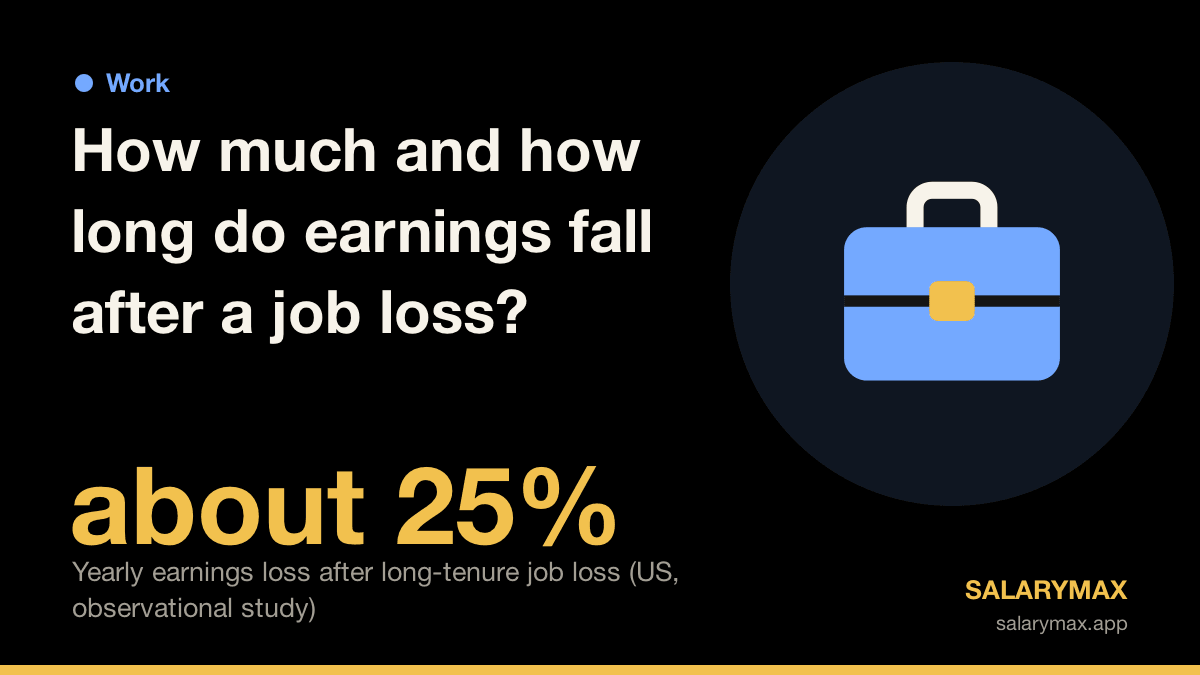
In Pennsylvania, long-tenured US workers who left struggling firms lost about 25% of prior earnings a year over time. In Japan, men's income was still lower 3 years on.
The evidence behind this article
- Adjusted observational3
Based on observational data. It shows that two things go together, not that one causes the other.
3 sources・Countries studied: United States, Japan
How to read the kinds of evidence →What to do with this
Spend 30 minutes on a skill other employers would also value, and note today's results in one line with the date and numbers.
If your employer cuts staff and you lose your job, how much does your income fall, and for how long? US studies using administrative records find large losses that last for years after leaving a long-held job. A Japanese study found income stayed lower for at least three years.
Key points
- A study of Pennsylvania administrative data (Jacobson and colleagues, 1993) found that workers with six or more years of tenure who left struggling firms in the 1980s lost, over the long run, about 25% of their pre-displacement earnings per year. Their earnings began falling before they left, and losses were large even for those who found new jobs at similar firms.
- A study of Connecticut administrative data (Couch & Placzek 2010) found that workers who lost their jobs in mass layoffs earned more than 30% less right afterwards and as much as 15% less six years later.
- A Japanese study using the Keio Household Panel Survey (Sato 2015) found that men who lost jobs for reasons outside their control still earned over ¥600,000 less than comparable men who kept working, three years after the job loss.
How much did US workers’ earnings fall after a job loss, and for how long?
Louis Jacobson, Robert LaLonde and Daniel Sullivan used administrative data from Pennsylvania that linked workers’ earnings records with information about their employers. They studied people who had worked at the same firm since 1974 and left between 1980 and 1986, so all had at least six years of tenure, and most were in their 30s or 40s. They were compared with similar workers who stayed.
For those who lost their jobs in mass layoffs, quarterly earnings were still well below their expected level six years later, by an amount equal to about 25% of their earnings before the job loss. After the third year, the losses barely shrank. Earnings had started to slip below the expected level about three years before workers actually left.
The size of the losses depended only slightly on age and sex, and more on local labour market conditions and the industry people came from. The losses were not limited to a few sectors, and they were large even for people who found new jobs at similar firms.
Later, Kenneth Couch and Dana Placzek asked the same question with administrative data from Connecticut. Workers who lost their jobs in mass layoffs earned more than 30% less at first, and as much as 15% less six years later. These losses were smaller than in Pennsylvania but similar to estimates from national surveys. They were concentrated among people who received unemployment insurance.
How did income change for people who lost jobs in Japan?
In Japan, Kazuma Sato of Meikai University used the Keio Household Panel Survey. His starting point was the “Lost Decade” slump, when many people lost jobs for reasons that were not their choice. He matched people who lost jobs with similar people who kept working, using a statistical method called propensity score matching.
For men, income stayed lower from the year of the job loss through the third year afterwards, and was still more than ¥600,000 lower at the three-year mark. The largest drops were among middle-aged and older men aged 41 and over. The author points to lower rates of finding work and to the loss of skills and experience built up in the previous job. For women, income was more than ¥300,000 lower at three years. Among women aged 40 and under, the drop lasted at least one year; among those aged 41 and over, it lasted three years.
There is also research on job loss and wages in South Korea, but we could not verify its content this time, so it is not covered here.
How to read research on job loss and earnings
All of these studies compare people who lost their jobs with similar people who kept working, using observational data. The US studies focus on mass layoffs and struggling firms, which makes it less likely that people were let go because of their own performance. Still, these are not randomized experiments.
Time and place differ too. The US findings come from two states, each in its own period, and the Japanese study uses different data and units, so the numbers are not directly comparable.
Most importantly, none of this research shows that losing a job is the worker’s fault. The size of the losses depended heavily on the local job market and on what was happening in the industry.
A small step for today
Job loss is often not your choice, which is why small, steady preparation helps.
- Use “Studied for 30 minutes” to build skills that other employers would value. Losses stayed large even at similar firms, which shows how much experience can be tied to one employer.
- Use “Wrote one line on today’s progress” to record your results with dates and numbers. It helps when you look for your next job.
- Use “Paid myself first” to build up savings for living costs, even in small amounts.
FAQ
How much does income drop after being laid off?
It varies by study and period. Long-run losses averaged about 25% of earlier earnings per year in Pennsylvania, and earnings were over 30% lower right after a layoff in Connecticut. Japanese men earned over ¥600,000 less than comparable men three years later.
How long does the drop in income last after losing a job?
In the US studies, a gap remained even six years later. In the Japanese study, men’s income stayed lower for at least three years, and women’s for at least one year at age 40 and under and for three years at age 41 and over.
Is losing your job a sign of low ability?
The research does not support that. In the US study, losses depended much more on local job markets and the industry people came from than on age or sex, and stayed large even for people rehired at similar firms.
Sources
- [X-jacobson-1993] Jacobson, LaLonde & Sullivan (1993) Earnings Losses of Displaced Workers. American Economic Review.
- [X-couch-placzek-2010] Couch & Placzek (2010) Earnings Losses of Displaced Workers Revisited. American Economic Review.
- [X-sato-2015] Sato (2015) The Impact of Job Displacement on Earnings Losses (in Japanese). Economic Analysis (ESRI, Cabinet Office of Japan).
Studies describe average tendencies. This article is not a promise that a habit will lift your income, and it is not medical or investment advice. About these articles ・ Search & sources
Updated:
← All articles