Basics ・ 7 min
Books at home as a child and adult earnings: Europe
In a study of men aged 50+ in nine European countries, extra schooling paid off more for those with many books at home at age 10. It did not study adult reading.
The evidence behind this article
- Natural experiment1
Includes studies built to test cause and effect (randomised trials or natural experiments).
1 sources・Countries studied: Several countries
How to read the kinds of evidence →What to do with this
You cannot choose the books you grew up with. Today, use Studied for 30 minutes for one block of reading, and if you have children, pick library books together.
Did people who grew up with lots of books earn more later? A study across nine European countries found that when compulsory schooling was extended, the extra lifetime income from staying in school longer was larger for those with many books at home at age 10. It does not show that books themselves raise income, and it did not study reading in adulthood.
Key points
- A study (Brunello et al. 2017) of 5,828 men born 1920 to 1956 in nine European countries, from the SHARE survey of people aged 50+, used the varying timing of compulsory schooling reforms as a natural experiment to estimate how an extra year of education changed lifetime income.
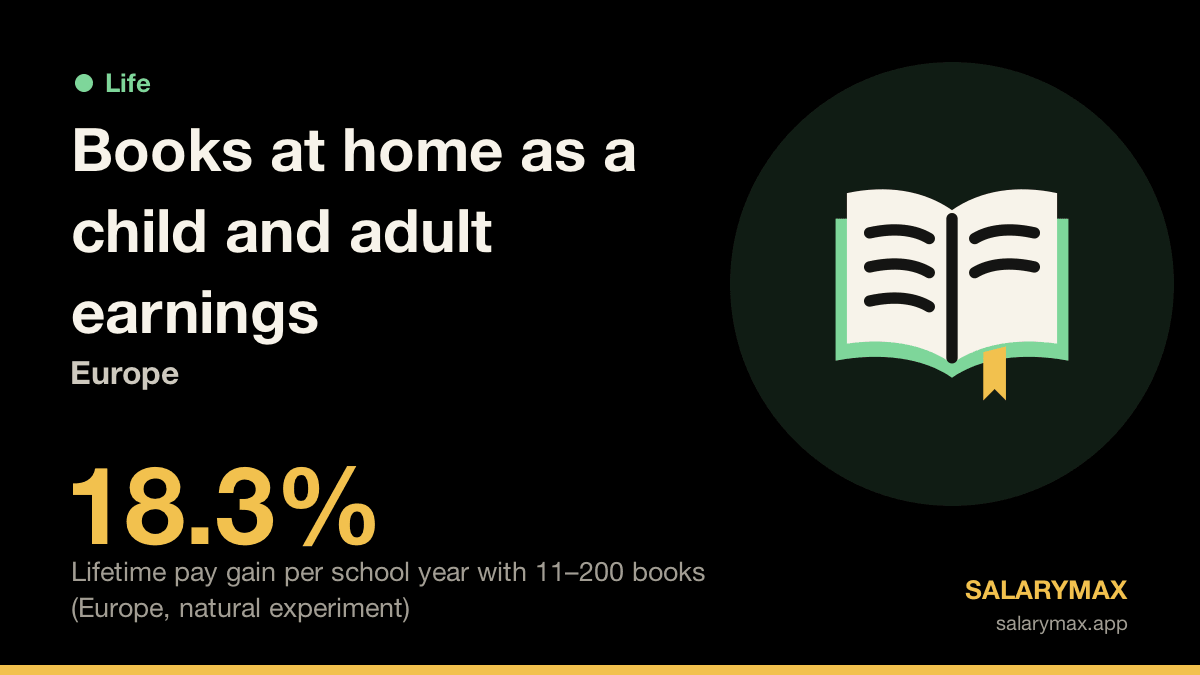
- In the pre-publication version (2012), an extra year of education raised lifetime income by about 9% on average. The return was close to zero for men who had 10 or fewer books at home at age 10 and 18.3% for those with 11 to 200 books. About 40% had almost no books at home.
- The natural experiment tests years of education, not books, which were not randomly assigned. The authors read books as a marker of the home’s cultural environment but say they cannot rule out parents’ education. We found no Japanese study on books at home and adult income.
The survey: asking people over 50 about the books in their home at age 10
The data come from SHARE, the Survey of Health, Ageing and Retirement in Europe, which covers people aged 50 and over. Its third wave asked respondents to recall their life and work history from childhood.
The study covers 5,828 men born between 1920 and 1956 in Austria, Belgium, the Czech Republic, Denmark, France, (West) Germany, Italy, the Netherlands and Sweden. Women, the self-employed and people who had worked under five years were left out.
Respondents described the number of books (not counting school books) in their home at age 10: none or very few (up to 10), one shelf (11 to 25), one bookcase (26 to 100), two bookcases (101 to 200) or more. The share with almost no books varied widely, from 20.1% in Sweden to 77.5% in Italy.
Lifetime income was built from the wages respondents recalled for each job, converted into a value at age 10 and added up.
What happened when compulsory schooling was extended?
People who stay in school longer may differ in ability or family circumstances. So the researchers used the fact that laws extending compulsory schooling took effect at different times across countries and birth years. Someone born just after a reform had to stay in school longer whatever their situation. Using a change in rules like this is called a natural experiment.
In the pre-publication version, an extra year of education raised lifetime income by about 9% on average. The people pushed into more schooling by the reforms were mainly those who grew up in rural areas.
The researchers then split the sample by books. For men with 10 or fewer books at home at age 10, the extra income from another year of school was close to zero; for men with 11 to 200 books, it was 18.3%. Their schooling also differed: 9.65 years on average with few books, 12.83 with more.
Are books just a sign of a richer family?
Books could simply mark a wealthier home. So the authors added whether the home at age 10 lacked running water or an indoor toilet, a rough sign of wealth, and the results for books did not change. Splitting by the father’s occupation changed little.
In international tests of children’s skills (PIRLS, TIMSS and PISA), children with more books at home scored higher even after accounting for parents’ education and jobs. The authors conclude that books reflect the home’s cultural environment and the growth of thinking skills more than a lack of money. Parents’ education was not recorded in their data, though, so its influence cannot be ruled out.
How far can this research on books at home go?
What this evidence supports is this: among European men born between 1920 and 1956, the extra income from schooling added by compulsory-education reforms was larger for those who had more books at home at age 10. The natural experiment tests years of education. Nobody assigned the books, so the study does not show that putting books in a home raises a child’s future income.
It also says nothing about adult reading. The data rely on decades-old memories and cover only European men, and the figures come from the pre-publication version, so the published article may differ. We found no Japanese study on books at home and adult income.
Finally, nobody chooses how many books their childhood home had. The authors argue that early support for learning may matter most for children from less privileged homes.
A small step for today
- Do not read your upbringing as a score; this study describes group averages.
- Use “Studied for 30 minutes” for one block of reading or learning. This study does not show the effect of adult learning, but you can track the days you did it.
- If you have children, try choosing library books together. The study did not test this, but the authors see early learning environments as important.
FAQ
Will having many books at home raise my child’s future income?
This study does not show that directly. It found that the extra income from longer schooling was larger for men with many books at home at age 10. Books were not randomly assigned and are seen as a marker of the home environment.
Will reading books as an adult increase my income?
We do not know, because this study did not look at adult reading. It covered European men born 1920 to 1956 who recalled the books in their home at age 10.
Aren’t books at home just a sign of a wealthy family?
The authors checked using whether the childhood home lacked running water or an indoor toilet, and the father’s occupation; the results for books changed little. Parents’ education was not recorded, so its role cannot be ruled out.
Sources
- [X-brunello-2017] Brunello, Weber & Weiss (2017) Books are Forever: Early Life Conditions, Education and Lifetime Earnings in Europe. The Economic Journal.
Studies describe average tendencies. This article is not a promise that a habit will lift your income, and it is not medical or investment advice. About these articles ・ Search & sources
Updated:
← All articles