Basics ・ 7 min
Do patient 13-year-olds earn more later? A Swedish study
In a Swedish study of about 12,000 people followed from age 13 to their late 40s, those who chose to wait for more money tended to earn more. It is observational.
The evidence behind this article
- Adjusted observational1
Based on observational data. It shows that two things go together, not that one causes the other.
1 sources・Countries studied: Sweden
How to read the kinds of evidence →What to do with this
Push tempting purchases to tomorrow with Waited a night before buying, and make saving automatic. Support waiting with systems instead of judging your character.
Do children who choose “more later” over “something now” go on to earn more as adults? A Swedish study that followed about 12,000 people born in 1953 into their late 40s found that those who chose to wait at age 13 tended to have higher incomes, and the gap grew with age. This is an observational study, though, and patience was tied to family and school environment, so it is not simply a matter of personal character.
Key points
- A study that followed children born in Stockholm, Sweden, in 1953 from a school survey at age 13 to administrative records in their late 40s (Golsteyn et al. 2014) found that those who chose to receive more money later had better school results, health, work and lifetime income on average. It is observational and does not show cause and effect.
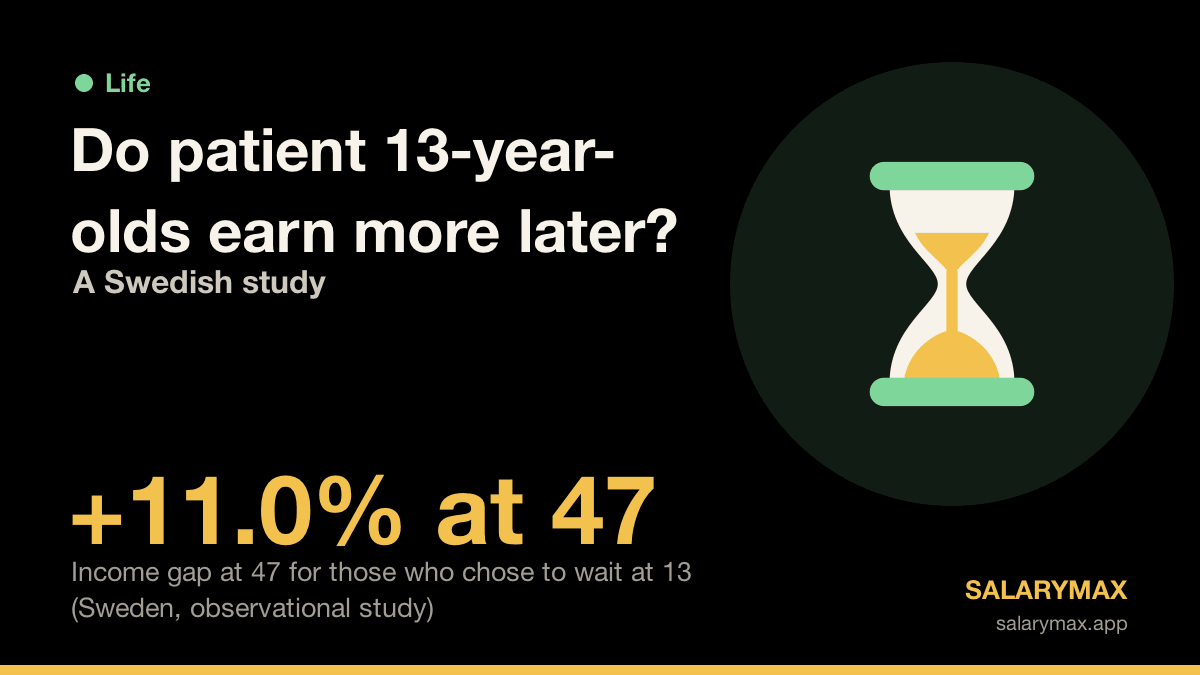
- In the pre-publication version (2013), people who firmly chose “later” earned about 6.4% more at 27, about 7.4% more at 37 and about 11.0% more at 47 than people who firmly chose “now”, after accounting for their parents’ education and income.
- The authors find that much of the link runs through early investment in education, and they note that time preferences can be shaped by environment. We found no Japanese study on childhood time preferences and adult income.
The question asked at 13: 900 kronor now, or 9,000 in five years?
The data cover every child born in 1953 who lived in the Stockholm metropolitan area in 1963. In 1966, at age 13, they filled in questionnaires at school; only the 9% absent that day did not take part.
Time preference, how much weight someone puts on the future, was measured with one question: “If you had to choose between SEK 900 (about USD 130) now and SEK 9,000 (about USD 1,300) in five years, which would you choose?” The amounts are in 2012 prices, and there were five possible answers, from “certainly 900 now” to “certainly 9,000 in five years”. Even though the later amount was ten times larger, 13% of the children chose 900 now.
The analysis covers the 11,907 children who answered. Their answers were linked to grades, a military enlistment test at 19, education, income at 27, 37 and 47, unemployment and health.
This differs from studies that rate self-control through parents and teachers. The authors argue that waiting in front of a treat mixes in-the-moment self-control with time preference.
How much more did the patient children earn, and at what age?
The comparisons account for month of birth, gender, the parents’ highest education, and each parent’s income and year of birth. The results held when cognitive ability, measured with a spatial test at 13, was also taken into account.
In the pre-publication version, people who answered “certainly in five years” earned about 6.4% more at 27 than those who answered “certainly now”, about 7.4% more at 37 and about 11.0% more at 47. The gap may grow partly because early-career income is a noisy measure of lifetime earnings, the authors suggest.
Differences appeared before work. Children who chose to wait had compulsory-school grades 0.21 standard deviations higher, similar to the gap between boys and girls then. In middle age they had 1.6 fewer days of unemployment a year, about 15% of the average.
At 27 the link was stronger for women and for people with lower test scores; later in life it was stronger for men and for people with higher scores. The authors conclude that much of the link works through early investments in education.
Should we read this as “patient children succeed”?
No. First, this is observational research. The authors write that cause and effect cannot be isolated, because not even a lab experiment could change time preference alone. The study shows a predictive link: children who weighted the future more tended to earn more later.
Second, patience is not purely a personal trait. Children of more educated parents were more likely to wait, which the authors see as a hint that time preferences are shaped by environment. A comparison of 117 twin pairs was too small for clear results, though most estimates pointed the same way as the full sample.
Third, answers to a hypothetical question may not match real choices, as the authors note. The children grew up in Sweden decades ago, and we found no Japanese study on this. The honest summary is this: among Swedes born in 1953, those who chose to wait at 13 tended to have higher adult incomes. It does not show that becoming more patient raises anyone’s income.
A small step for today
What adults can do today is avoid leaving patience to willpower alone and let simple systems help.
- Use “Waited a night before buying” to push tempting purchases to tomorrow. It is practice in not deciding in a rush.
- Set up “Paid myself first” once, so you do not have to decide again every month.
- In this study, investment in education was the key channel. Use “Studied for 30 minutes” to set aside a little time for your future self.
FAQ
If I was impatient as a child, will I earn less as an adult?
Nobody’s future can be predicted from this. The Swedish study found an average pattern: children who chose to wait at 13 tended to earn more later. Patience was also linked to family background, so it is not a matter of blame.
Can time preference change later in life?
The authors point to research suggesting that time preferences can be shaped by the environment, and they read the link with parents’ education as a hint of this. Their own study, however, did not test whether changing time preference changes income.
Is this the same as the marshmallow test?
No. The marshmallow test measured how long children around age four could wait for a treat in front of them, and the original study had 95 children. This study asked about 12,000 13-year-olds one question about money and linked the answers to records into their late 40s.
Sources
- [X-golsteyn-2014] Golsteyn, Grönqvist & Lindahl (2014) Adolescent Time Preferences Predict Lifetime Outcomes. The Economic Journal.
Studies describe average tendencies. This article is not a promise that a habit will lift your income, and it is not medical or investment advice. About these articles ・ Search & sources
Updated:
← All articles