Basics ・ 6 min
How much income do people lose after a hospital stay?
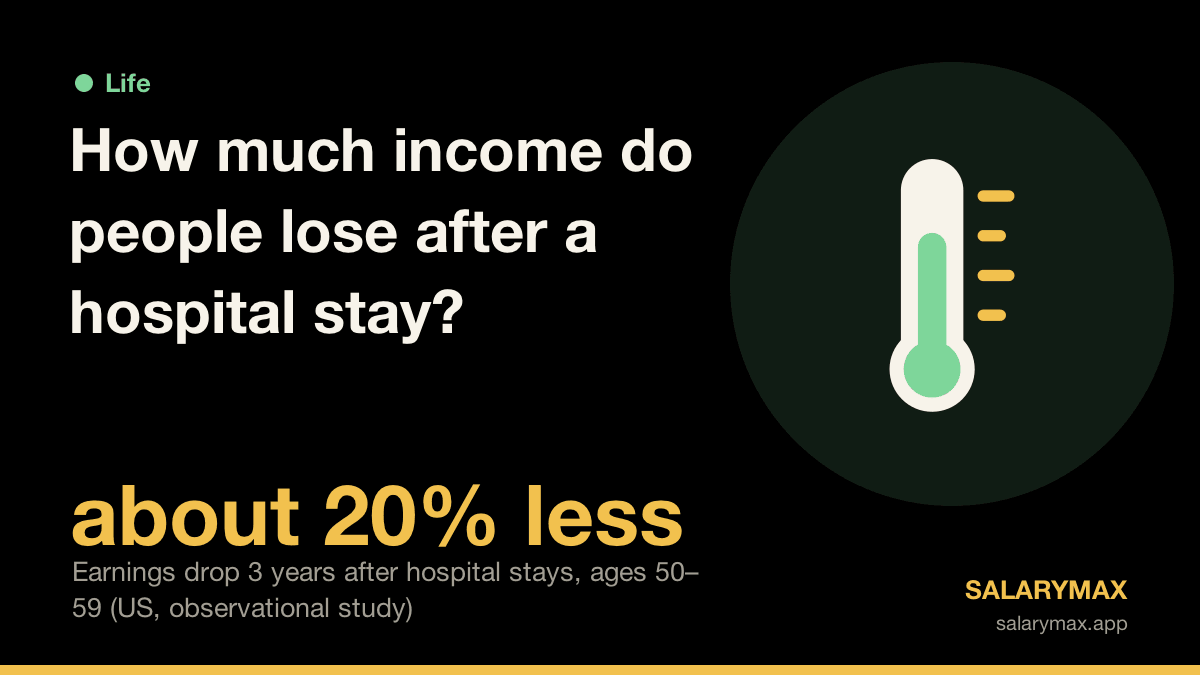
In a US study of people in their 50s, yearly earnings were about 20% lower three years after a hospital stay. In the Netherlands, income fell 5% and did not recover.
The evidence behind this article
- Natural experiment2
- Adjusted observational1
- Official guideline2
Includes studies built to test cause and effect (randomised trials or natural experiments).
5 sources・Countries studied: United States, Netherlands, South Korea, Japan
How to read the kinds of evidence →What to do with this
Check how your health insurance and workplace rules cover time off for illness, and write down the minimum you need to live on for a month.
What happens to income after a serious illness or injury and a hospital stay? Studies from the United States and the Netherlands find that after an unplanned admission, both employment and income drop, and they tend not to recover for years. How much of that loss is covered depends heavily on the country’s system.
Key points
- In US data on about 2,700 insured adults hospitalised at ages 50–59 (the Health and Retirement Study, 1992–2012), the chance of being employed was 11 percentage points lower three years after admission, and yearly earnings were about $9,000, or roughly 20%, below their pre-admission level (Dobkin and colleagues, 2018).
- In Dutch tax and hospital records (1998–2005), working adults aged 18–64 who had an acute hospital admission were 7 percentage points less likely to be employed two years later, and their personal income was about 5% lower, with no recovery up to six years (García-Gómez and colleagues, 2013).
- Among the US adults in their 50s, only about 10% of the earnings drop was covered by social insurance. The Dutch authors note that generous disability insurance limited the income loss in the Netherlands.
How much did earnings fall after a hospital stay for Americans in their 50s?
Carlos Dobkin, Amy Finkelstein and colleagues used the Health and Retirement Study (HRS) for 1992–2012. They followed about 2,700 insured people admitted to hospital at ages 50–59 and compared them before and after the admission (an event study).
Three years after admission, the probability of being employed was 11 percentage points lower, a 15% drop from the pre-admission level. Annual earnings from work fell by about $9,000 on average, around 20% of what people earned before. Out-of-pocket medical spending rose by about $1,400 a year, far less than the loss of earnings.
Only about 10% of the earnings drop was covered by social insurance. For people aged 60–64, who can claim Social Security retirement benefits, more than 60% was covered. The authors contrast this with another study from Denmark, where about half of the earnings drop was covered through sick pay and disability insurance. They found no sign that spouses worked more to make up the difference.
How did work and income change after an acute admission in the Netherlands?
Pilar García-Gómez and colleagues linked Dutch tax records, which cover one third of the population, with the national hospital discharge register for 1998–2005. Among working people aged 18–64 not admitted the year before, those with an unplanned, urgent admission were compared with similar people who were not admitted, using matching and a difference-in-differences analysis.
Two years after admission, the probability of being employed was 7 percentage points lower and personal income about €1,000 (around 5%) lower. Neither recovered in the six years after the admission. People who kept working lost about 3% of their income, while those who left work and moved onto disability insurance lost about 33%. Household income fell by about 50% more than the patient’s own income, so family members were affected too.
How to read this research, and how national systems differ
Both studies compare people before and after an unplanned admission, a sudden event, to get closer to the effect of ill health itself. A hospital stay can happen to anyone, and these figures say nothing about a person’s effort or choices.
How much lost income is replaced differs by country. Among Americans in their 50s it was about 10%. In the Netherlands, employers paid sick pay for the first period, and disability insurance supported income after that. In South Korea, a study of 4,876 workers in a national welfare panel (2009–2016) found that women in non-standard jobs and self-employed men had the largest income losses even after stays of seven days or less, and that stays longer than 14 days affected income into the following year (Sohn and colleagues, 2022). When the study was written, Korea had no public sickness benefit except for public officials. Since August 2022, the government has paid sickness benefits through a pilot programme.
In Japan, the health insurance that covers company employees includes a sickness and injury allowance. When someone cannot work because of an illness or injury not related to work, it pays two thirds of their average standard monthly pay over the previous 12 months, on a daily basis, from the fourth day off, for up to 1 year and 6 months. However, we have not found peer-reviewed research from Japan that tracks income before and after a hospital stay, so the US and Dutch figures may not apply directly.
A small step for today
- Check once how your health insurance and your workplace rules handle time off for illness.
- Keep up “Tracked spending” to learn the minimum you need to live on each month.
- Use “Paid myself first” to build a small buffer for a time when income drops.
FAQ
How much income do you lose after being hospitalised?
In a US study of people in their 50s, yearly earnings were about 20% lower three years after the admission. In the Netherlands, personal income was about 5% lower two years later and had not recovered six years on. These are averages that vary with the illness and the job.
If I am off work sick for a long time, will anything replace my pay?
In Japan, company employees’ health insurance pays a sickness and injury allowance of two thirds of standard daily pay for up to 1 year and 6 months. You can check the exact conditions with your own health insurer. Systems differ by country: among Americans in their 50s, only about 10% of the earnings drop was covered.
Does a hospital stay affect the family’s income too?
In the Dutch study, household income fell by about 50% more than the patient’s own income, so other family members were affected. In the US study of people in their 50s, there was no sign that spouses worked more to make up for it.
Sources
- [X-dobkin-2018] Dobkin, Finkelstein, Kluender & Notowidigdo (2018) The Economic Consequences of Hospital Admissions. American Economic Review.
- [X-garcia-gomez-2013] García-Gómez, van Kippersluis, O’Donnell & van Doorslaer (2013) Long-Term and Spillover Effects of Health Shocks on Employment and Income. Journal of Human Resources.
- [X-sohn-2022] Sohn, Moon, O’Campo, Muntaner & Chung (2022) Who loses more? Identifying the relationship between hospitalization and income loss. BMC Public Health.
- [X-mhlw-2020] Health Insurance Bureau, Ministry of Health, Labour and Welfare (2020) On the sickness and injury allowance (in Japanese).
- [X-mohw-2022] Ministry of Health and Welfare, Korea (2022) Notice on the sickness benefit pilot programme (in Korean).
Studies describe average tendencies. This article is not a promise that a habit will lift your income, and it is not medical or investment advice. About these articles ・ Search & sources
Updated:
← All articles