Basics ・ 6 min
Do smokers earn less? What wage studies actually show
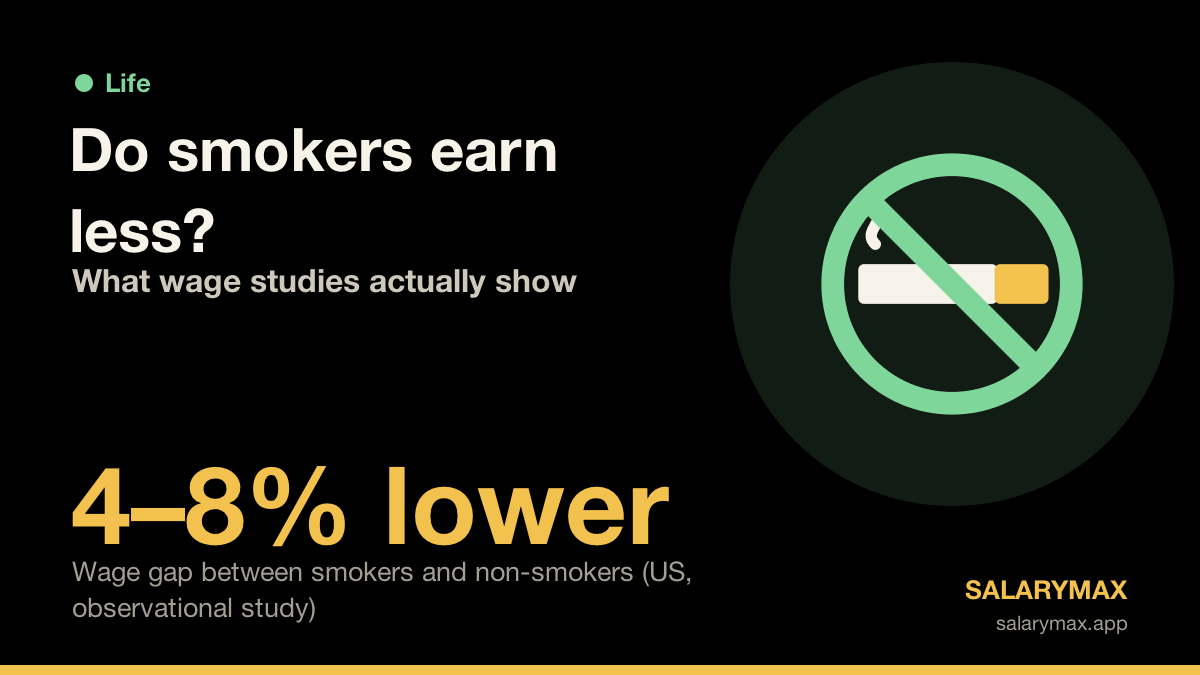
A US youth panel found smokers' wages were 4–8% lower, and Finnish twin data point the same way. A Japanese panel found no gap once personal differences were held fixed.
The evidence behind this article
- Natural experiment1
- Adjusted observational3
Includes studies built to test cause and effect (randomised trials or natural experiments).
4 sources・Countries studied: United States, Finland, Japan, South Korea
How to read the kinds of evidence →What to do with this
When you see a headline about a study, check who was compared and how. A simple comparison means something different from one within the same person.
You may have heard that people who smoke earn less. Studies from the United States and Finland do find that smokers tend to have lower wages and lower long-run income. A Japanese panel study, however, found that the gap disappeared once it compared the same people over time. The answer depends on the country and on the method.
Key points
- In the US National Longitudinal Survey of Youth (NLSY), smokers’ wages were roughly 4–8% lower, even after accounting for fixed personal and family differences (Levine and colleagues, 1997). This is an analysis of observational data.
- In Finnish data on male twins, the men who had smoked more in early adulthood had lower average income over the next 15 years, and the link held even when comparing identical twins with each other (Böckerman and colleagues, 2015).
- In a Japanese household panel (2004–2012), male smokers earned 9.4% less in a simple comparison, but the gap was no longer statistically significant when the same people were compared over time (Sun, 2015).
How much lower were smokers’ wages in the US and Finland?
The US study by Phillip Levine, Tara Gustafson and Ann Velenchik used the NLSY, which follows the same young people over many years. To deal with traits that might affect both smoking and pay, the authors compared changes within the same person and compared siblings within the same family. Across these approaches, smoking was linked to wages about 4–8% lower. The authors also tested three possible explanations for the gap, but none of the tests gave a clear answer.
The Finnish study by Petri Böckerman, Ari Hyytinen and Jaakko Kaprio used male twins born between 1945 and 1957. Twins grow up in the same home, and identical twins share almost all of their genes. The researchers measured smoking in a 1981 survey as “pack-years” (packs smoked per day multiplied by years of smoking) and took average income over 1990–2004 from tax records. Across 1,957 twin pairs, heavier smokers had lower income. The link remained among the 607 identical twin pairs alone, where a difference of five pack-years corresponded to roughly 7% lower income. The authors note that this is about the same size as the income gain from one more year of schooling.
What do studies from Japan and Korea show about smoking and wages?
In Japan, Yawen Sun analysed the Keio Household Panel Survey for 2004–2012, covering people aged 20–59, in a paper in the Japanese Journal of Labour Studies. In a simple comparison, male smokers earned 9.4% less than non-smokers. When the analysis instead followed changes within the same person (a fixed-effects model), there was no statistically significant wage gap for men or for women. An analysis that used tobacco tax increases gave the same result. The author concludes that the gap reflects unobserved differences between people rather than smoking itself.
In South Korea, Hoyong Jung and Seungwoo Chin used representative data on college graduates and used cigarette prices during their college years as a lever to separate the effect of smoking. Smokers were less likely to find a job and, if employed, tended to earn lower salaries, with stronger effects for women. The authors point to lower grades at college as one channel.
How to read research on smoking and wages
First, none of these studies randomly assigned people to smoke or not. Comparing twins or the same person over time removes many differences, but not everything that changes over time or differs in taste. The Finnish authors themselves suggest that differences in attitudes to risk may help explain why the estimates for fraternal and identical twins differ.
Second, the results differ by country and method. The negative link held in the US and Finland, but disappeared in the Japanese study. There is little Japanese research on this question, so one study cannot settle it.
Third, these are averages across groups. They do not predict the pay of any individual smoker, and they say nothing about a person’s effort or ability. Whether and how to quit is a health question, so this article does not cover it.
A small step for today
- When you see a headline about a study, check who was compared and how. A simple comparison means something different from a comparison within the same person or between siblings.
- Use “Tracked spending” for one week and look at how much goes on small treats and everyday extras. The point is to see the numbers, not to judge yourself.
- When you think about what shapes income, avoid explaining it with a single habit. Work experience and learning matter too.
FAQ
Does smoking lower your salary?
No study shows that it does for any individual. Studies from the US and Finland find that smokers tend to have lower wages or income, but a Japanese panel study found no statistically significant gap once differences between people were taken into account.
How much less do smokers earn?
In the US youth survey, smokers’ wages were about 4–8% lower. Among Finnish identical twins, a difference of five pack-years corresponded to about 7% lower income. In Japan, male smokers earned 9.4% less in a simple comparison, but the gap vanished when the same people were compared over time.
Why do smokers tend to earn less?
The reason is not clear. The US study tested three explanations and none was conclusive. The Korean study points to lower college grades as one channel, but it is not known whether that applies to other countries or age groups.
Sources
- [X-levine-1997] Levine, Gustafson & Velenchik (1997) More Bad News for Smokers? The Effects of Cigarette Smoking on Wages. ILR Review.
- [X-bockerman-2015] Böckerman, Hyytinen & Kaprio (2015) Smoking and long-term labour market outcomes. Tobacco Control.
- [X-sun-2015] Sun (2015) The relationship between smoking and wages: a panel data analysis (in Japanese). The Japanese Journal of Labour Studies.
- [X-jung-chin-2024] Jung & Chin (2024) Effects and Channels of Smoking on College Students’ Labor Market Performance. International Economic Journal.
Studies describe average tendencies. This article is not a promise that a habit will lift your income, and it is not medical or investment advice. About these articles ・ Search & sources
Updated:
← All articles