Basics ・ 6 min
Does a long commute pay off? Evidence from Germany and Japan
In a German household panel, people with longer commutes were less satisfied with life, and pay or housing did not make up for it. UK and Japanese studies are more mixed.
The evidence behind this article
- Adjusted observational3
- Observational2
Based on observational data. It shows that two things go together, not that one causes the other.
5 sources・Countries studied: Germany, United Kingdom, Japan
How to read the kinds of evidence →What to do with this
When you compare jobs or homes, write down the round-trip commute as daily hours, next to the salary and the rent.
Does a job with a long commute pay more to make up for it? Standard economics says the burden should be offset by higher wages or cheaper housing. A well-known German study found that it was not. People with longer commutes were less satisfied with their lives. A newer UK study, though, paints a more complicated picture.
Key points
- In the German Socio-Economic Panel (GSOEP, 1985–1998), people with longer commutes reported systematically lower life satisfaction, meaning that pay and housing did not fully make up for the commute. The authors called this the “commuting paradox” (Stutzer and Frey, 2008).
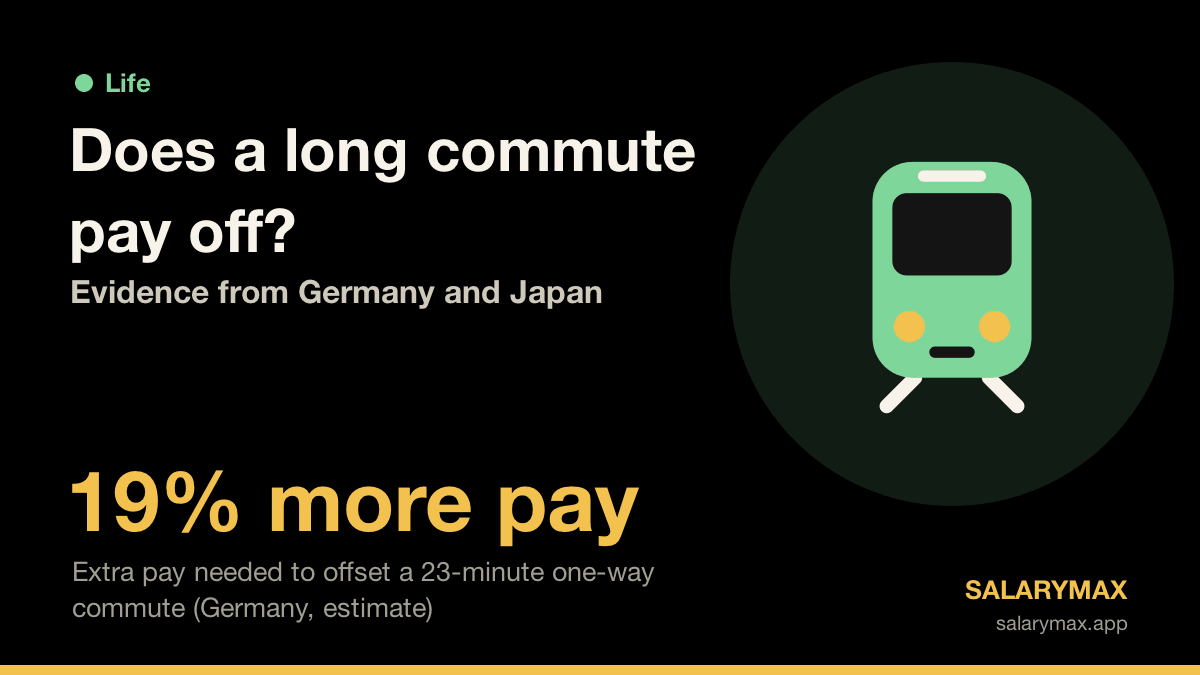
- In the working-paper version of the same study, full compensation for the average 23-minute one-way commute would have required 19% more monthly income. For a one-hour one-way commute, it would have required about 40% of the average monthly wage (Stutzer and Frey, 2004).
- In a UK panel of more than 26,000 workers (2009/10 to 2014/15), longer commutes were linked to lower job and leisure satisfaction and poorer mental health, but not to lower overall life satisfaction (Clark and colleagues, 2020).
In Germany, were people with longer commutes less satisfied with life?
Alois Stutzer and Bruno Frey used the seven waves of the German Socio-Economic Panel between 1985 and 1998 that asked about commuting time. The average one-way commute was 23 minutes (46 minutes a day), the median was 20 minutes, and 5.4% of people commuted an hour or more each way.
Respondents rated their life satisfaction from 0 to 10. People with longer commutes reported systematically lower scores. The link remained when the authors compared changes in commuting time within the same person, and it held up against a number of alternative explanations. The authors call this the commuting paradox: when people take on a long commute, the burden does not seem to be fully compensated by pay or housing.
The 2004 working paper put the shortfall in money terms. A person with the average 23-minute one-way commute would need about 19% more monthly income to be as satisfied as someone who does not commute. For a one-hour commute each way, the figure was about 40% of the average monthly wage, or roughly 515 euros.
How were commuting, pay and well-being linked in the UK and Japan?
In the UK, Ben Clark and colleagues followed more than 26,000 workers living in England across six waves of the Understanding Society survey, from 2009/10 to 2014/15. Longer commutes were associated with lower job satisfaction, lower satisfaction with leisure time, more strain and poorer mental health. The strongest link was with leisure time satisfaction. Yet longer commutes were not associated with lower overall life satisfaction, except among people who kept a long commute through all six waves. Walking to work was linked to higher leisure satisfaction and less strain, and working from home was linked to higher job and leisure satisfaction.
In Japan, Masayuki Morikawa of the Research Institute of Economy, Trade and Industry surveyed 6,856 workers in 2017. This is a discussion paper that has not been peer reviewed. Workers with twice the commuting time had wages 4.0% higher for men and 6.9% higher for women. Because the survey covers a single point in time, the author notes that this cannot be read as cause and effect. When asked to compare, 55.3% said they would dislike an extra hour of commuting a day, far more than the 25.1% who would dislike an extra hour of work.
Commutes in Japan are not short. In the government’s 2021 Survey on Time Use and Leisure Activities, people who commuted to work or school on a weekday spent an average of 1 hour 19 minutes on it that day. The longest average was in Kanagawa, at 1 hour 40 minutes, and the shortest in Yamagata and Miyazaki, at 56 minutes.
How to read research on commuting and pay
None of these studies randomly assigned commuting times. The German result holds even within the same person, but the UK study found no drop in overall life satisfaction, so the paradox may not hold everywhere. Workers may be weighing the burden of a long commute against the benefits of a better job, higher pay or a better home.
The Japanese wage result fits the idea that some of the burden of a long commute is paid back in wages, but it comes from a single survey in a paper that has not been peer reviewed. We did not find a peer-reviewed study that follows Japanese workers over time to link commuting and well-being.
A small step for today
- Reach “Walked 8,000+ steps” by walking one stop of your commute on some days. In the UK study, walking to work was linked to less strain.
- Fit “Studied for 30 minutes” into your train ride and turn part of the commute into time for yourself.
- When you compare jobs or homes, write down the round-trip commute as daily hours, next to the salary and the rent.
FAQ
Do people with longer commutes earn more?
In a 2017 Japanese survey, they did on average: workers with twice the commuting time had wages 4.0% higher for men and 6.9% higher for women. The survey covers a single point in time, so it does not show that a longer commute raises pay.
Does a long commute make you less happy?
The evidence is mixed. In Germany, people with longer commutes were less satisfied with life. In the UK, longer commutes were linked to lower job and leisure satisfaction, but not to lower overall life satisfaction.
How long is the average commute in Japan?
In the 2021 government time-use survey, people who commuted to work or school on a weekday spent an average of 1 hour 19 minutes on it that day. By prefecture, Kanagawa was the longest at 1 hour 40 minutes, and Yamagata and Miyazaki the shortest at 56 minutes.
Sources
- [X-stutzer-frey-2008] Stutzer & Frey (2008) Stress that Doesn’t Pay: The Commuting Paradox. The Scandinavian Journal of Economics.
- [X-stutzer-frey-2004] Stutzer & Frey (2004) Stress That Doesn’t Pay: The Commuting Paradox. IZA Discussion Paper No. 1278.
- [X-clark-2020] Clark, Chatterjee, Martin & Davis (2020) How commuting affects subjective wellbeing. Transportation.
- [X-morikawa-2018] Morikawa (2018) Long Commuting Time and the Benefits of Telecommuting. RIETI Discussion Paper 18-E-025.
- [X-mic-2022] Statistics Bureau of Japan (2022) 2021 Survey on Time Use and Leisure Activities: summary of results on time use (in Japanese).
Studies describe average tendencies. This article is not a promise that a habit will lift your income, and it is not medical or investment advice. About these articles ・ Search & sources
Updated:
← All articles