Basics ・ 6 min
Does paying for chores make you happier? Buying time
Surveys of 6,271 people in the US, Canada, Denmark and the Netherlands link paying to save time with higher life satisfaction. A Canadian trial of 60 found better mood.
The evidence behind this article
- Randomised trial1
Includes studies built to test cause and effect (randomised trials or natural experiments).
1 sources・Countries studied: United States, Canada, Denmark, Netherlands
How to read the kinds of evidence →What to do with this
Write down the one chore you dread most today, and, within what you can afford, try handing off or shortening just that one task.
Is paying someone to clean or shop for you an indulgence? In surveys from the US, Canada, Denmark and the Netherlands, people who spent money to free up their own time tended to be more satisfied with their lives. In a small Canadian experiment, people also felt better and less rushed on the day they bought time.
Key points
- A 2017 study of 6,271 people in the US, Canada, Denmark and the Netherlands found that people who paid others each month to do tasks such as chores tended to report higher life satisfaction (a correlation). The strength of this link did not change with income or wealth.
- In the same study, 60 working adults in Vancouver, Canada, spent $40 on each of two weekends in a row. On the weekend they bought time, their end-of-day mood was better and they felt less pressed for time than on the weekend they bought a material item.
- The experiment was small, and the surveys included few people with very low incomes. We did not find a Japanese study of the same question.
Were people who bought time more satisfied with life?
Ashley Whillans and colleagues asked the same questions in six surveys: two in the US, one each in Denmark and Canada, and two in the Netherlands (a nationally representative sample and a sample of millionaires). Each month, did people pay someone else to do things in order to increase their free time, and how much did they spend?
Across the six surveys, 28.2% of 4,469 respondents bought time each month. Those who did reported greater life satisfaction. The link held after adjusting for factors such as age and family situation, and it did not depend on how much people earned or owned. In other words, it was not just a story about the rich.
In a further US survey of 1,802 people that used a broader definition, 50% bought time in some way each month, most often by paying to avoid cooking, shopping and household maintenance. The link with life satisfaction held even after adjusting for spending on groceries, material goods and experiences. In the Canadian and Dutch surveys, the usual pattern that time stress goes with lower life satisfaction was weaker among people who bought time.
A $40 weekend: how did mood change when people bought time?
Surveys alone cannot rule out that people who were already more satisfied are the ones who buy time. So the researchers ran an experiment.
They gave 60 working adults in Vancouver $40 on each of two consecutive weekends. On one weekend, people spent it on something that would save them time; on the other, on a material purchase. The order was switched between participants. At 5 p.m. that day, a phone call asked about their mood. The results matched the hypotheses the team had registered in advance.
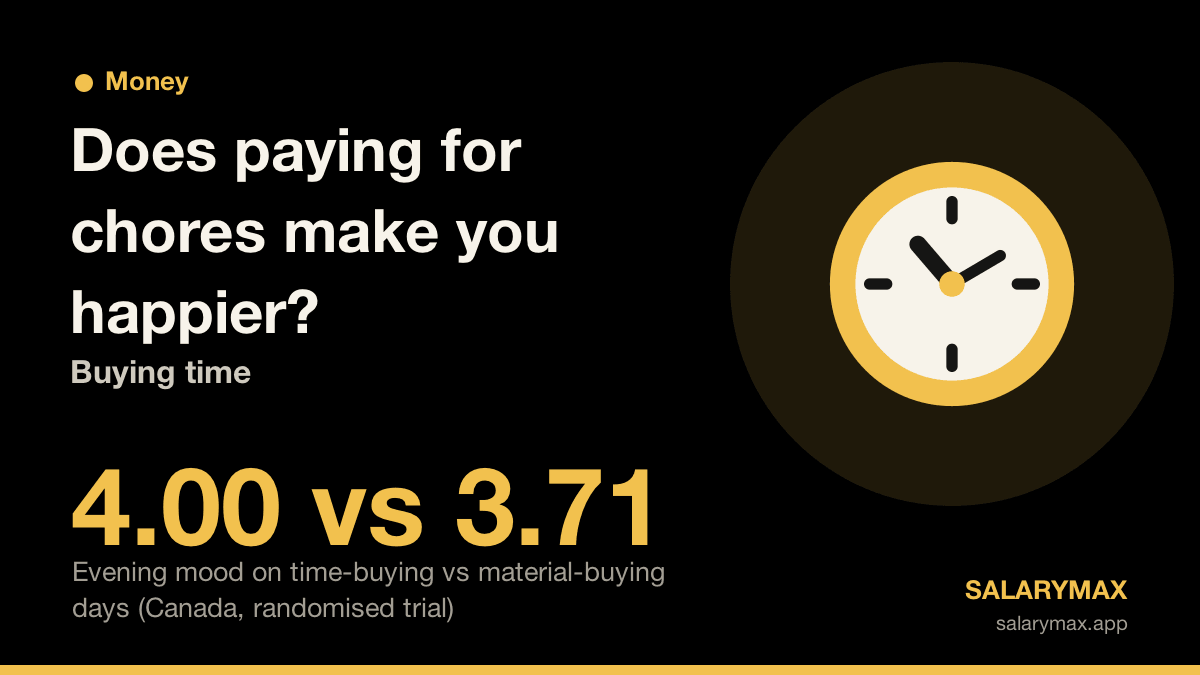
- End-of-day positive mood averaged 4.00 on the time-saving day and 3.71 on the material day.
- Feelings of time pressure were lower on the time-saving day (3.49 vs 4.22 on average).
- The better mood was explained by the drop in time pressure.
Strikingly, when another 98 working adults were asked how they would spend a $40 windfall, only 2.0% said they would buy time. It seems this use of money does not come to mind easily.
How to read the research on buying time
- The survey results are correlations. People who buy time may differ in other ways. Only the 60-person experiment speaks to cause and effect.
- The experiment measured mood on a single day. It did not test what happens to life satisfaction if people keep buying time over months or years.
- Very low incomes were rare in the data. The authors note that the benefits may not appear for people struggling to meet basic needs.
- Question wording may matter. The authors list this as a limitation and checked their result with a broader version of the question.
- We did not find a Japanese study. The paper notes that the low uptake of time-saving purchases may vary by culture and gender; in many cultures, women may feel obliged to do household tasks themselves even when they can afford help. The study does not recommend any particular service.
A small step for today
You can decide whether to buy time once you know where your time is going.
- Along with “Planned the day in the morning,” write down the one chore or errand you are dreading most today.
- With “Tracked spending,” look separately at money spent on things and money spent to free up time.
- Within what you can afford, hand off or shorten just one task, for example with a tool. Note in one line what you did with the time you got back, so you can see whether it suits you.
FAQ
Does paying for a cleaner make you happier?
In surveys from the US, Canada and other countries, people who paid others to do chores and similar tasks tended to be more satisfied with life. In a Canadian experiment with 60 people, mood at the end of the day was better on the day they bought time. The experiment was small, though, and long-term effects were not studied.
Is buying time only for the wealthy?
In this research, the link between buying time and life satisfaction did not change with income or wealth. However, the surveys included few people with very low incomes, so it is unknown whether the result holds for people struggling to meet basic needs.
Which lifts your mood more, buying things or buying time?
In the Canadian experiment, the same $40 led to higher positive mood at the end of the day, and less time pressure, when it was spent on saving time rather than on a material item. This was a comparison of one-day mood among 60 people.
Sources
- [X-whillans-2017] Whillans, Dunn, Smeets, Bekkers & Norton (2017) Buying time promotes happiness. Proceedings of the National Academy of Sciences.
Studies describe average tendencies. This article is not a promise that a habit will lift your income, and it is not medical or investment advice. About these articles ・ Search & sources
Updated:
← All articles