Practice ・ 6 min
How many people fail to refinance their mortgage?
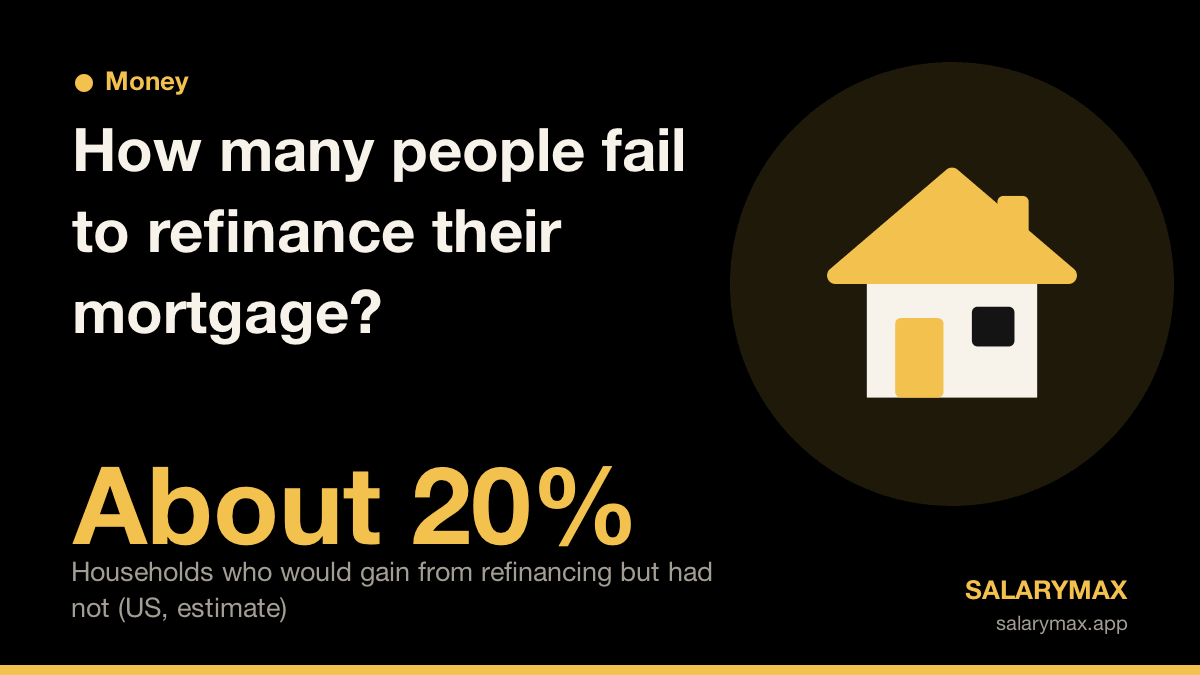
A US estimate using a random sample of mortgages (Dec 2010) found about 20% of unconstrained households who would gain from refinancing had not, losing a median $11,500.
The evidence behind this article
- Adjusted observational1
- Estimate2
Based on observational data. It shows that two things go together, not that one causes the other.
3 sources・Countries studied: United States, Denmark, Japan
How to read the kinds of evidence →What to do with this
If you have a mortgage, write down your rate and remaining term, and ask a lender once for an estimate of refinancing that includes all fees.
When interest rates fall, refinancing a mortgage can cut the monthly payment. Even so, many people leave their loan as it is. A US study estimated that about 20% of households who would gain from refinancing, and who seemed to face no obstacle, had not refinanced. This article covers that study and research from Denmark and Japan. It does not recommend any loan or lender.
Key points
- A US study using a large random sample of mortgages outstanding in December 2010 estimated that about 20% of households for whom refinancing paid off, and who appeared unconstrained, had not refinanced.
- In the same study, the median household that failed to refinance gave up $160 a month over the rest of the loan, about $11,500 in total in today’s money. These are estimates based on observational data.
- In Danish administrative data, older, poorer and less-educated households were less likely to refinance whatever the size of the gain, and so saved less. A Japanese study found that rate gaps and borrowers’ caution were linked to refinancing.
How many households failed to refinance when it would have paid?
Benjamin Keys, Devin Pope and Jaren Pope used a large random sample of US mortgages that were still outstanding in December 2010, a period when US mortgage rates had fallen sharply.
The study first identified households for whom refinancing paid off: the gap between their current rate and the rate available was large enough to make refinancing worthwhile even after its costs. It then kept only households that appeared able to refinance, for example those whose debt was not too high relative to the value of the home and who had not missed payments.
Among them, the authors estimated that about 20% had not refinanced. The median household that failed to refinance could have saved $160 a month over the remaining life of the loan, which comes to about $11,500 in today’s money. The authors call this a particularly large consumer financial mistake.
The study also looked at a mail campaign that offered refinancing to homeowners who could benefit. Many of the households who received the offer did not respond.
Why don’t people refinance? Evidence from Denmark
In Denmark, refinancing without taking cash out is unconstrained. Steffen Andersen and colleagues used Danish administrative panel data, which follow the same households over time, and built a model that splits delays in refinancing into two kinds.
The first is a “psychological cost” that keeps people from acting until the gain is big enough. The second is a low chance of acting at all, whatever the size of the gain, which may reflect the effort of gathering information.
Middle-aged and wealthy households behaved as if they had high psychological costs, waiting until the gain was large. Older, poorer and less-educated households refinanced with lower probability whatever the incentive, and so achieved smaller savings.
What can mortgage refinancing research tell us?
This evidence supports one statement: in US and Danish data, a meaningful share of households who would gain from refinancing had not done so.
- These are estimates. Whether refinancing “pays” is calculated by the researchers using assumptions about rates and costs. They cannot see every household’s circumstances.
- Systems differ by country. Loan types, refinancing fees and other costs, and how rates are set are different in the US, Denmark and Japan. The roughly 20% figure cannot be applied directly to Japan.
- The Japanese study asks a different question. A study of 4,083 mortgages from a Japanese internet survey found that the gap between fixed and variable rates, and borrowers’ risk aversion, were linked to refinancing. We did not find a Japanese study that measures what share of households who would gain from refinancing have not done so.
A small step for today
Whether to refinance depends on your own situation. These steps help you gather the facts you need.
- If you have a mortgage, write down your rate, remaining term and balance. Your monthly payment is a large fixed cost, so it counts for the app habit “Reviewed one fixed cost”.
- Ask a lender once for an estimate of whether refinancing would pay, including all fees and other costs.
- Note the result and the date in one line. As the Danish study suggests, a low chance of acting at all is itself what shrinks savings, so setting a date to check again helps.
FAQ
Does everyone who would gain from refinancing actually refinance?
No. A US study of mortgages in December 2010 estimated that about 20% of households who would gain from refinancing, and who appeared unconstrained, had not done so. We did not find a Japanese study that measures the same share.
How much do people lose by not refinancing?
The US study estimated that the median household that failed to refinance gave up $160 a month, about $11,500 in total in today’s money. The amount depends heavily on the interest rate, the balance and the costs of refinancing.
Does the same apply in Japan?
Not directly. Loan types and refinancing fees and costs in Japan differ from those in the US. A Japanese study found that the gap between fixed and variable rates and borrowers’ caution were linked to refinancing, but it did not measure how many people fail to refinance.
Sources
- [X-keys-pope-pope-2016] Keys, Pope & Pope (2016) Failure to refinance. Journal of Financial Economics.
- [X-andersen-2020] Andersen, Campbell, Nielsen & Ramadorai (2020) Sources of Inaction in Household Finance: Evidence from the Danish Mortgage Market. American Economic Review.
- [X-kutsuzawa-2007] Kutsuzawa (2007) An analysis of mortgage prepayment, refinancing and delinquency (in Japanese). Toshi Jutakugaku.
Studies describe average tendencies. This article is not a promise that a habit will lift your income, and it is not medical or investment advice. About these articles ・ Search & sources
Updated:
← All articles