Practice ・ 6 min
Do financial advisors improve investment returns?
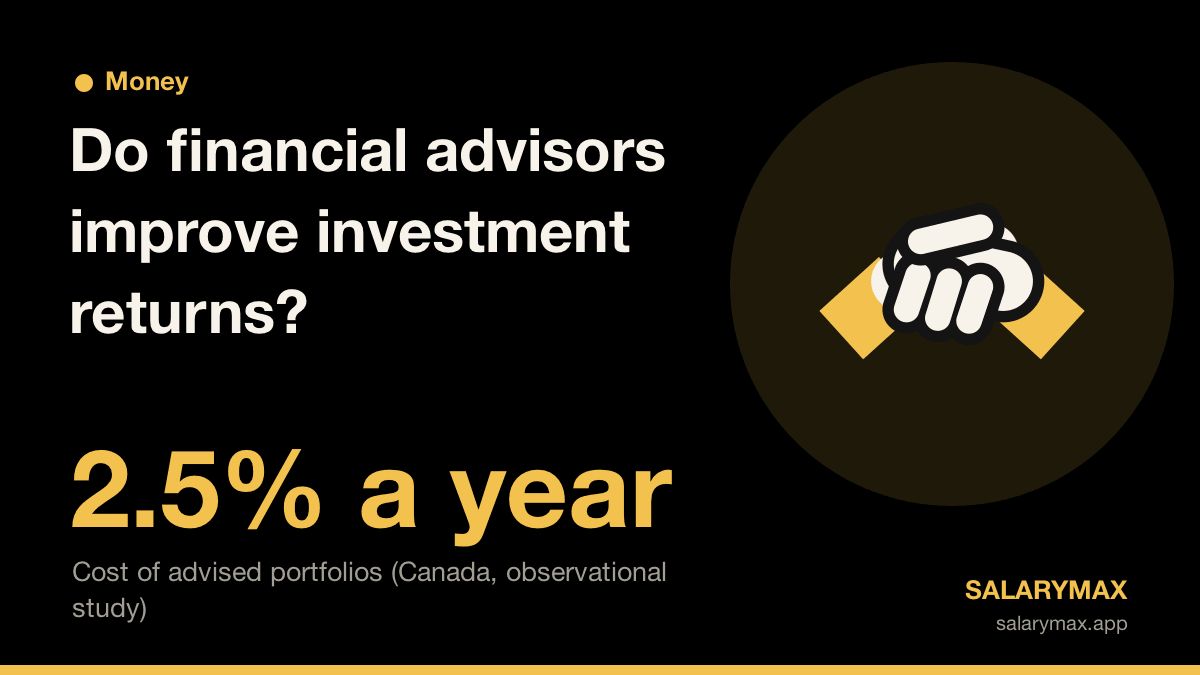
In Canadian data, advisors shaped clients' portfolios but tailored little, and advised portfolios cost 2.5% a year. Advisors' own net returns were −3% a year.
The evidence behind this article
- Adjusted observational3
Based on observational data. It shows that two things go together, not that one causes the other.
3 sources・Countries studied: Canada, Japan
How to read the kinds of evidence →What to do with this
Before meeting a financial advisor, write down questions on the total yearly cost and on why the suggested mix fits your age and goals.
Will talking to a financial advisor make your investments do better? A study using Canadian household data found that advisors had a strong influence on how clients’ money was allocated, but tailored that advice to each client only a little, and advised portfolios cost 2.5% a year. This article covers that study and research from Japan. It does not recommend any advisor or product.
Key points
- A study of Canadian household data found that which advisor a client had explained much more of the differences in portfolio risk than the client’s own risk tolerance, age, investment horizon and financial knowledge. It is an analysis of observational data.
- In the same study, advised portfolios cost 2.5% a year, 1.5% more than life-cycle funds that shift the mix with age.
- A study of Canadian advisors’ own accounts found that advisors invested their own money the way they advised clients, and their after-fee returns were −3% a year, similar to their clients’. A Japanese study found that people with more financial knowledge were more likely to use advice.
How much did advisors shape their clients’ investments?
Stephen Foerster and colleagues used unique data on Canadian households and their advisors to study what determines clients’ asset allocation, such as how much is in stocks, and how much in domestic stocks.
The advisor mattered a great deal. Which advisor a client had explained considerably more of the variation in portfolio risk and in “home bias”, the tilt towards domestic stocks, than a broad set of client traits: risk tolerance, age, investment horizon and financial sophistication. The advisor effect stayed large even with methods that compare the same client over time.
An advisor’s own asset allocation also strongly predicted the allocations chosen on clients’ behalf. The authors conclude that advisors have a strong influence over clients’ allocations but provide limited customisation.
The cost of advice, and how advisors invest their own money
This one-size-fits-all advice did not come cheap. Advised portfolios cost 2.5% a year, which was 1.5% more than life-cycle funds that automatically shift the mix as people age.
Do advisors recommend expensive products to earn higher fees? Juhani Linnainmaa and colleagues compared advisors’ personal accounts with their clients’ accounts in a large Canadian sample.
Advisors typically invested their own money just as they advised their clients. They traded often, chased returns, preferred expensive actively managed funds and did not diversify enough. Advisors’ own after-fee returns were −3% a year, similar to their clients’. They kept investing this way even after leaving the industry. The authors argue that, beyond conflicts of interest, advisors’ own misguided beliefs help explain the high cost of advice.
How is financial advice used in Japan?
In Japan, a study used Nomura Research Institute’s 2019 nationwide survey, with 11,397 valid responses. In the survey figures that the study cites, 44.6% of people wanted advice from an expert, but only 26.8% actually used advice on saving or investing.
The analysis found that people with higher financial literacy were more likely to want and to use advice. In other words, it was not the case that people with less knowledge sought more advice. We did not find a Japanese study of how advice affects investment returns.
What can research on financial advisors tell us?
This evidence supports one statement: in Canadian data, advisors strongly shaped clients’ allocations, tailored little, and charged high costs.
- It is about one kind of advisor in Canada. The data come from advisors and clients at Canadian financial firms. The results may not apply to advisors paid in other ways, or to other countries.
- It is observational. Clients were not assigned to advisors at random. The researchers used statistical methods to separate client differences from advisor differences, but this cannot be perfect.
- Some things were not measured. The studies looked at allocation, costs and returns. They did not measure other kinds of help, such as staying on track with saving or planning for retirement.
A small step for today
Whether to use an advisor, and which one, is up to you. What the research does support is checking the cost and the reasons the advice fits you.
- Before a meeting, write down your questions: the total yearly cost (as a percentage and in money), and why the suggested mix fits your age and goals. It works like the app habit “Prepared for a negotiation”.
- Ask the advisor to explain which parts of your situation the suggested mix is based on.
- Once a year, write down the yearly cost and check it, as with “Reviewed one fixed cost”.
FAQ
Will a financial advisor improve my investment returns?
The research does not show that. In the Canadian studies, advisors strongly shaped clients’ allocations but tailored them little, and advised portfolios cost 2.5% a year. Advisors’ own after-fee returns were −3% a year, similar to their clients’.
Do advisors recommend expensive products just to earn fees?
Perhaps not only for that reason. In the Canadian study, advisors invested their own money the same way, in expensive actively managed funds, and kept doing so after leaving the industry. The authors think advisors’ own beliefs play a part.
How many people in Japan use financial advice?
In the 2019 survey cited by a Japanese study, 44.6% of people wanted advice from an expert, and 26.8% actually used advice on saving or investing. People with more financial knowledge were more likely to use advice.
Sources
- [X-foerster-2017] Foerster, Linnainmaa, Melzer & Previtero (2017) Retail Financial Advice: Does One Size Fit All? The Journal of Finance.
- [X-linnainmaa-2021] Linnainmaa, Melzer & Previtero (2021) The Misguided Beliefs of Financial Advisors. The Journal of Finance.
- [X-nishide-miyamoto-2023] Nishide & Miyamoto (2023) The effect of financial literacy on the demand for advice on saving and investment (in Japanese). Seikatsu Keizaigaku Kenkyu.
Studies describe average tendencies. This article is not a promise that a habit will lift your income, and it is not medical or investment advice. About these articles ・ Search & sources
Updated:
← All articles