Basics ・ 7 min
Cross-class friendships and children's future income
A US study of 72.2 million Facebook users found that where low-income people have more high-income friends, poor children tend to earn more as adults. An area-level link.
The evidence behind this article
- Observational1
Based on observational data. It shows that two things go together, not that one causes the other.
1 sources・Countries studied: United States
How to read the kinds of evidence →What to do with this
Rather than choosing friends by income, put one conversation this week with someone from a different role or background at work or in your area into your schedule.
Do children grow up with better prospects in places where people with different incomes become friends? A US study of the friendships of 72.2 million Facebook users found that in areas where low-income people have more high-income friends, children from low-income families tend to earn more as adults. It compares averages across areas, though, and does not measure what happens when one person changes their friends.
Key points
- A study (Chetty et al. 2022) used 72.2 million US Facebook users aged 25 to 44 and 21 billion friendships to measure, for each ZIP code, how many high-status friends lower-status people have, which the authors call economic connectedness.
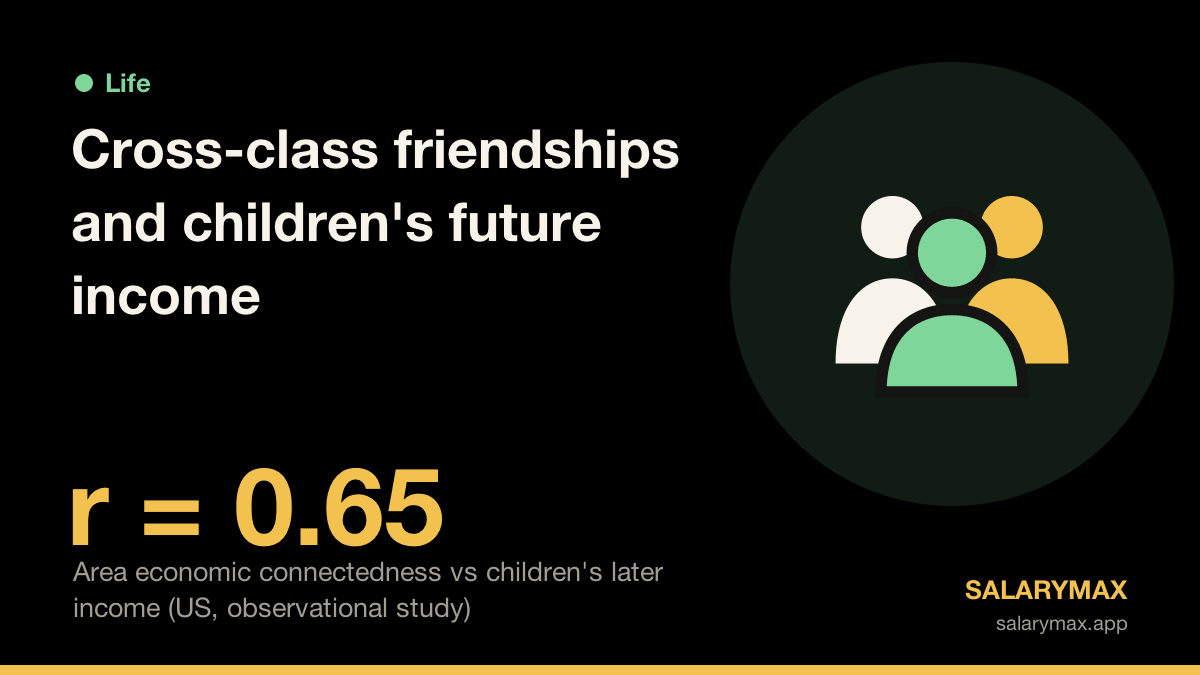
- Across US counties, the correlation between economic connectedness and the adult income rank of children from low-income families was 0.65. Measures of how tight-knit friend groups are, or of civic engagement such as volunteering, were not strongly related.
- This is an area-level observational study. The paper cannot separate whether connectedness itself matters or whether other features of well-connected places, such as schools, do. We found no Japanese study on this question.
How was “economic connectedness” measured from 72.2 million users?
The study covered Facebook users living in the US, aged 25 to 44, active in the past 30 days and with at least 100 US friends. The authors use Facebook friendships as a stand-in for real-world friendships and stress that the study is not about the effects of online networks themselves.
The researchers estimated each adult’s socioeconomic status, their standing in terms of things like income and education, from many pieces of information, and split people at the national median. Economic connectedness measures how many of the friends of people below the median are above it, counted for each ZIP code.
Areas differed widely. In the least connected tenth of counties, lower-status people had about 42% fewer higher-status friends than would be expected if people did not tend to befriend others like themselves.
How did children’s future incomes differ in well-connected areas?
Children’s prospects were measured as the average national income rank, in adulthood, of children who grew up with parents at the 25th percentile of the national income distribution.
Across counties, the correlation between economic connectedness and this rank was 0.65; across ZIP codes it was 0.69. Going from a ZIP code in the bottom tenth for connectedness to one in the top tenth was associated with an 11-point higher adult income rank for children from low-income families. That is close to the 12.6-point gap between Black and white children with low-income parents.
Other kinds of social ties, such as how closed-off friend groups are, or volunteering and membership of civic groups, were not strongly related to children’s later income. A widely used index of civic participation had a correlation of just 0.06.
Is it the friendships, or the people who live there?
A correlation can have other explanations, and the authors test three. The first is reverse causation: perhaps people who move up then make higher-status friends. When connectedness was measured from childhood friendships instead, the correlation stayed high, at 0.44 to 0.62.
The second is that better-off families might simply choose well-connected areas. The authors used estimates from another study that measured the effect of places themselves by comparing children who moved at different ages. Counties with higher connectedness had larger effects of place on children’s mobility (a correlation of 0.44).
Third, the authors write that this paper alone cannot tell whether connectedness itself matters or whether other features of well-connected places, such as better schools, do. They mention the idea that ties across class bring aspirations, information and job opportunities, but that is still being tested.
How should we read research on friendships and economic mobility?
The evidence supports this much: in the US, in areas where low-income people have more high-income friends, children from low-income families tend to earn more as adults. It compares area averages and does not test whether a person who changes their friends will earn more.
The authors calculate that if low-income children grew up in counties as connected as those of the average high-income child, their adult incomes would be 20% higher on average. That is a hypothetical calculation built on comparisons between places.
What matters also depends on the outcome: for life expectancy among low-income people, tight-knit friend groups were a better predictor. There are no data outside the US, and we found no Japanese study on this. It is also worth remembering that people often cannot choose the area or the friendships they grow up with.
A small step for today
This research does not tell individuals how to choose friends. Still, talking with people you would not usually meet is one way to widen what you know and how you see things.
- Put time to talk with someone in a different role or line of work into your plans with “Set when and where to do tomorrow’s key task.”
- Do not pick people by income. The study measured connections across whole areas, not personal gain.
- If you have children, look at whether they have places outside school to meet a wide range of people, keeping in mind that the study did not test this.
FAQ
Will making wealthy friends raise my income?
This study cannot tell you that. It found an area-level correlation: where low-income people have more high-income friends, children from low-income families tend to earn more as adults. It did not test what happens when an individual adds friends.
Why would friendships in an area be linked to children’s futures?
The authors mention the idea that ties to people of different status bring aspirations, information and job opportunities. Other features of well-connected areas, such as better schools, could also explain the link, and this paper cannot separate them.
Does the same apply in Japan?
We do not know. The study used only US data, and the authors list building similar measures outside the US as future work. We found no Japanese study on cross-income friendships and children’s later income.
Sources
- [X-chetty-2022] Chetty et al. (2022) Social capital I: measurement and associations with economic mobility. Nature.
Studies describe average tendencies. This article is not a promise that a habit will lift your income, and it is not medical or investment advice. About these articles ・ Search & sources
Updated:
← All articles