Basics ・ 6 min
Does being happier make you more productive at work?
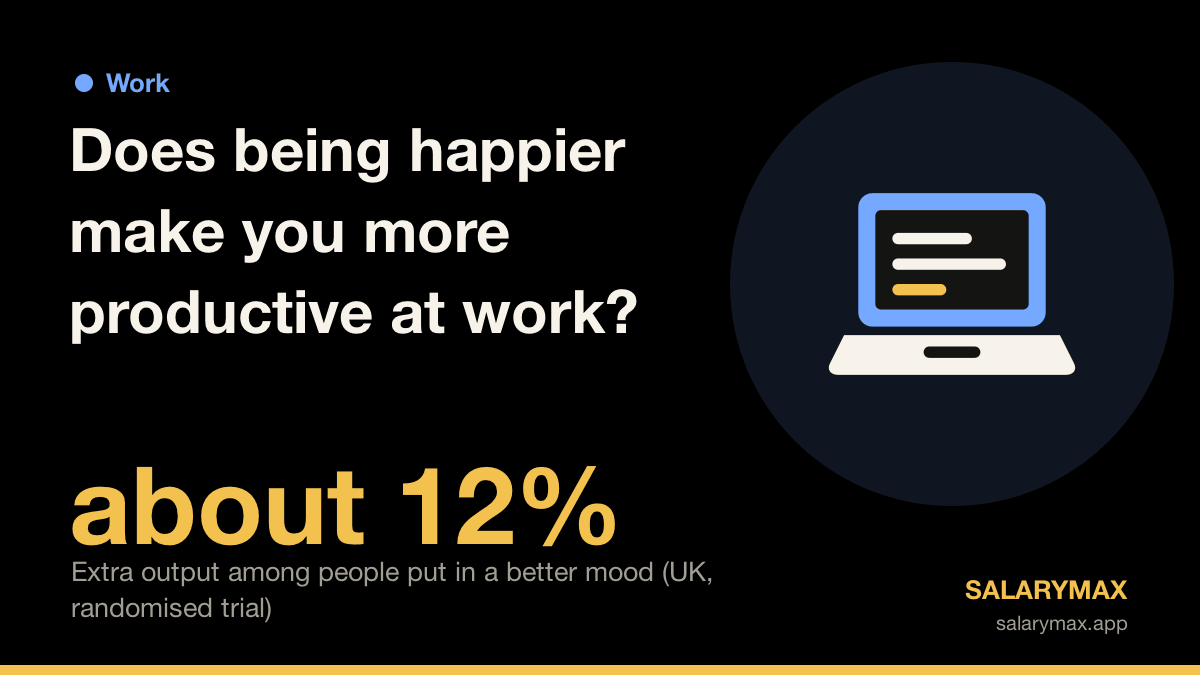
In UK experiments, people randomly put in a better mood did about 12% more piece-rate work. At UK call centres, happier weeks brought more sales, even in a weather test.
The evidence behind this article
- Randomised trial1
- Natural experiment1
Includes studies built to test cause and effect (randomised trials or natural experiments).
2 sources・Countries studied: United Kingdom
How to read the kinds of evidence →What to do with this
For one week, add your mood on a three-point scale to your one-line progress note, and look at how mood and progress line up in your own data.
Do you get more done on days when you feel good? In UK experiments, people who were randomly put in a better mood produced about 12% more work. At the call centres of a large UK telecoms company, sales were also higher in weeks when staff felt happier.
Key points
- In experiments at a UK university (Oswald and colleagues, 2015), people randomly chosen to be put in a better mood, for example by watching a short comedy clip, completed about 12% more of a paid, piece-rate arithmetic task. Accuracy did not change; the amount of work did.
- A study of 1,793 sales staff at 11 call centres of the UK telecoms company BT (Bellet and colleagues, 2024), surveyed weekly for six months from July 2017, found more sales in happier weeks. A natural experiment based on how much of the local weather staff could see pointed the same way.
- The gain came mainly from turning more calls into sales; attendance and break-taking did not change. No Japanese study testing this question as cause and effect was found.
How much more did people produce when they were randomly made happier?
Andrew Oswald, Eugenio Proto and Daniel Sgroi ran experiments with paid piece-rate work at the University of Warwick in England. In the 2010 working-paper version, 276 people took part. One group watched a 10-minute comedy clip; the other did not. Which group each person joined was decided by chance, which makes this a randomised experiment.
Participants then spent 10 minutes adding up sets of five two-digit numbers and were paid for each correct answer. The group that watched the clip felt happier and got about 12% more answers right. They did not make more mistakes; they simply got through more work.
The published version brings together three different ways of raising mood and reports that the people made happier were about 12% more productive. A fourth study looked at major real-life shocks, bereavement and family illness, and found that lower happiness went with lower productivity.
What increased at call centres in happier weeks?
Clément Bellet, Jan-Emmanuel De Neve and George Ward studied 1,793 sales workers at 11 call centres run by BT, one of the UK’s largest private employers. For six months from July 2017, staff received an email every Thursday asking how happy they had felt that week, and answered by clicking one of five faces. About 80%, or 1,438 people, answered at least once.
Sales were higher in weeks when people reported feeling happier. On its own, though, that could mean good sales made people happy. So the researchers used the weather. In buildings where staff could see more of the outside, bad local weather lowered mood. Using that weather-driven change as a natural experiment, they still found that better mood went with more sales.
The main reason was that happier workers converted more calls into sales. They also made somewhat more calls per hour and stuck more closely to their schedule. Attendance and breaks did not change. In the 2020 revised working paper, a one-step rise on the mood scale corresponded to about 4 to 6 extra sales a week, from an average of about 25. But a one-step change is large, and the estimate comes with a wide range of uncertainty.
How far does research on mood and productivity go?
This evidence supports one claim: in UK experiments and one UK workplace, people produced more or sold more when they were in a better mood. The university study is a randomised experiment, but it involved volunteers recruited at one university doing 10 minutes of arithmetic. The call centre study is a real workplace, but it covers telephone sales at one company.
It does not follow that a company adopting mood-boosting measures would see the same gains. The researchers themselves note that a one-step move on their mood scale is a big change that small workplace tweaks are unlikely to produce. No Japanese study testing this question as cause and effect was found, and Korean research was outside the scope of this review.
A small step for today
What the research supports is that mood and output are linked, and that having low-mood days is normal.
- Add your mood on a three-point scale to “Wrote one line on today’s progress.” After a week, your own data will show how mood and progress line up.
- With “Set when and where to do tomorrow’s key task,” place the work that needs focus at a time of day when your mood tends to be better.
- In the experiment, a 10-minute comedy clip was enough to raise output. A short break that lifts your mood before an important task is worth trying.
FAQ
Are happier employees more productive?
In UK experiments, people randomly put in a better mood completed about 12% more of a piece-rate task. At UK call centres, sales were also higher in weeks when staff felt happier. These results come from university experiments and one company.
Why does a good mood lead to better results?
In the call centre study, the main change was a higher share of calls turned into sales, with somewhat more calls per hour. Attendance and breaks did not change. In the university experiment, accuracy stayed the same while the amount of work increased.
Does bad weather lower work performance?
At the UK call centres, staff in buildings where more of the outdoors was visible felt worse in weeks with bad local weather. The researchers used this as a tool to study the effect of mood. It does not mean the weather decides your results; the research describes average tendencies.
Sources
- [X-oswald-2015] Oswald, Proto & Sgroi (2015) Happiness and Productivity. Journal of Labor Economics.
- [X-bellet-2024] Bellet, De Neve & Ward (2024) Does Employee Happiness Have an Impact on Productivity? Management Science.
Studies describe average tendencies. This article is not a promise that a habit will lift your income, and it is not medical or investment advice. About these articles ・ Search & sources
Updated:
← All articles