Practice ・ 7 min
Does working from home hurt performance and promotion?
Two randomized experiments at Chinese travel firms found working from home did not lower performance and cut quitting, though full-time home workers were promoted less.
The evidence behind this article
- Randomised trial2
- Adjusted observational1
- Observational1
Includes studies built to test cause and effect (randomised trials or natural experiments).
4 sources・Countries studied: China, Japan
How to read the kinds of evidence →What to do with this
Use 'Wrote one line on today's progress' to record what moved forward, so you can show it in check-ins with your manager even on days you work from home.
How does working from home change performance and promotion? Two randomized experiments at Chinese companies found that working from home did not reduce performance and that fewer people quit. But in the experiment where people worked from home every day, those with the same performance were less likely to be promoted. Each result comes from a single company and a narrow set of jobs.
Key points
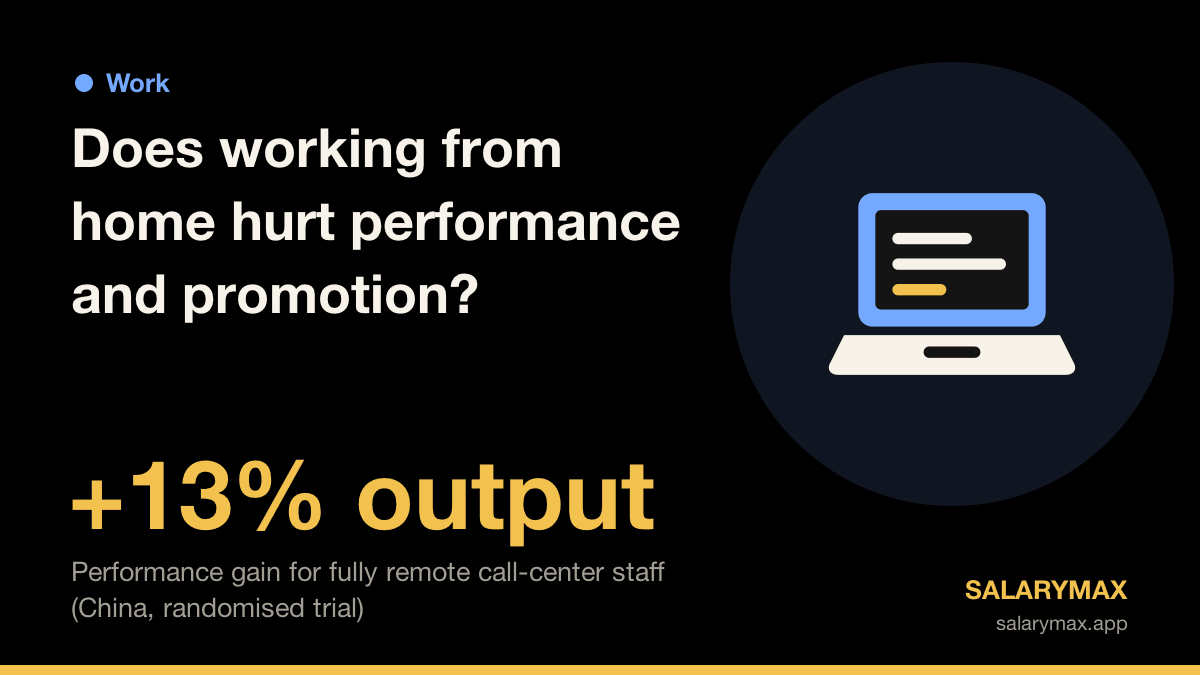
- At Ctrip, a Chinese travel agency, call center employees who volunteered to work from home were randomly assigned to home or the office for nine months. Home workers’ performance rose 13% and their attrition rate halved, but their promotion rate, given the same performance, fell.
- At Trip.com in China, 1,612 graduate employees were split by birthday, and half could work from home two days a week (Wednesday and Friday) for six months. Quitting fell by a third, and performance reviews and promotions over the next two years did not differ.
- We did not find a randomized experiment in Japan. Surveys during the COVID-19 pandemic found that home productivity averaged about 60–70% of office productivity, and that poor home setups and communication problems lowered productivity.
What full-time home working did to call center performance and promotion
The first experiment, by Nicholas Bloom and colleagues, took place at Ctrip, a NASDAQ-listed Chinese travel agency with 16,000 employees. Call center employees who volunteered to work from home were randomly assigned to work either at home or in the office for nine months.
Home workers’ performance rose 13%. About 9% came from working more minutes per shift, with fewer breaks and sick days, and 4% from handling more calls per minute, which the authors attribute to a quieter and more convenient environment. Home workers also reported higher work satisfaction, and their attrition rate halved.
There was a cost, though. Comparing employees with the same performance, home workers were less likely to be promoted.
After the experiment, the company let all employees choose whether to work from home, and allowed the experiment’s participants to choose again. More than half switched, and the performance gain from working from home almost doubled to 22%. The authors say this shows the value of learning and of letting people select the arrangement that suits them.
What two days a week at home did to quitting and reviews
The second experiment, published in Nature in 2024, ran at Trip.com from August 2021 to January 2022. It covered 1,612 graduate employees in engineering, marketing and finance in the Airfare and IT divisions, including 395 managers. Employees with odd-numbered birthdays could work from home on Wednesdays and Fridays; those with even-numbered birthdays came in all five days.
Over six months, quitting in the hybrid group fell from 7.2% to 4.8%, a drop of one-third. The reduction was significant for non-managers, women and employees with long commutes. Job satisfaction also rose.
At the same time, performance reviews over the next two years, promotions over the same period, and the lines of code written by engineers did not differ. Managers changed their minds too: before the experiment, they expected hybrid work to lower productivity by 2.6% on average; afterwards, they expected a 1.0% gain.
How to read the work from home experiments, and whether they apply to Japan
Because both studies used random assignment, they measure the effect of working from home itself. Still, each comes from a single Chinese company, and the jobs are limited to call center work and graduate office and technical roles. The results may differ for jobs built on face-to-face work or in other countries. One co-author of the Nature paper is the co-founder and chairman of Trip.com, as the paper discloses; the company did not fund the research.
We did not find any experiment in Japan that assigned working from home by lottery. Observational studies from the pandemic point to some difficulties. A survey at four Japanese manufacturing firms found that, even after accounting for stable differences between individuals, employees who worked from home saw larger productivity declines than those who did not, mainly because of poor home setups and communication difficulties; their mental health, however, was better. A separate survey of employees and firms found that home productivity averaged about 60–70% of productivity at the usual workplace, and was lower for people and firms that started only after COVID-19 spread. A sudden switch and a planned company experiment are very different conditions, which may help explain the different results. Korean research was outside the scope of this review.
A small step for today
Whether you work at home or in the office, making your output visible may help protect you from being overlooked for promotion.
- Use “Set when and where to do tomorrow’s key task” to plan what you will focus on, and where, on home days.
- Use “Wrote one line on today’s progress” to keep a record of what moved forward, which you can share in check-ins with your manager.
- On home days, list your questions for colleagues in advance to reduce communication gaps.
FAQ
Does working from home lower performance?
In two randomized experiments in China, it did not. Japanese surveys during the pandemic, however, found productivity losses when people started working from home without good setups or communication.
Does working from home make promotion less likely?
It depends on the experiment. In the full-time home call center study, home workers with the same performance were promoted less often, but in the two-days-a-week study, promotions over two years did not differ.
Does working from home reduce quitting?
In both experiments, fewer people quit. The attrition rate halved with full-time home work and fell by a third with two days at home. Both results come from a single company in China.
Sources
- [X-bloom-2015] Bloom, Liang, Roberts & Ying (2015) Does Working from Home Work? Evidence from a Chinese Experiment. The Quarterly Journal of Economics.
- [X-bloom-han-liang-2024] Bloom, Han & Liang (2024) Hybrid working from home improves retention without damaging performance. Nature.
- [X-kitagawa-2021] Kitagawa, Kuroda, Okudaira & Owan (2021) Working from home and productivity under the COVID-19 pandemic: Using survey data of four manufacturing firms. PLOS ONE.
- [X-morikawa-2022] Morikawa (2022) Work-from-home productivity during the COVID-19 pandemic: Evidence from Japan. Economic Inquiry.
Studies describe average tendencies. This article is not a promise that a habit will lift your income, and it is not medical or investment advice. About these articles ・ Search & sources
Updated:
← All articles