Basics ・ 6 min
Does a long employment gap cost you interviews?
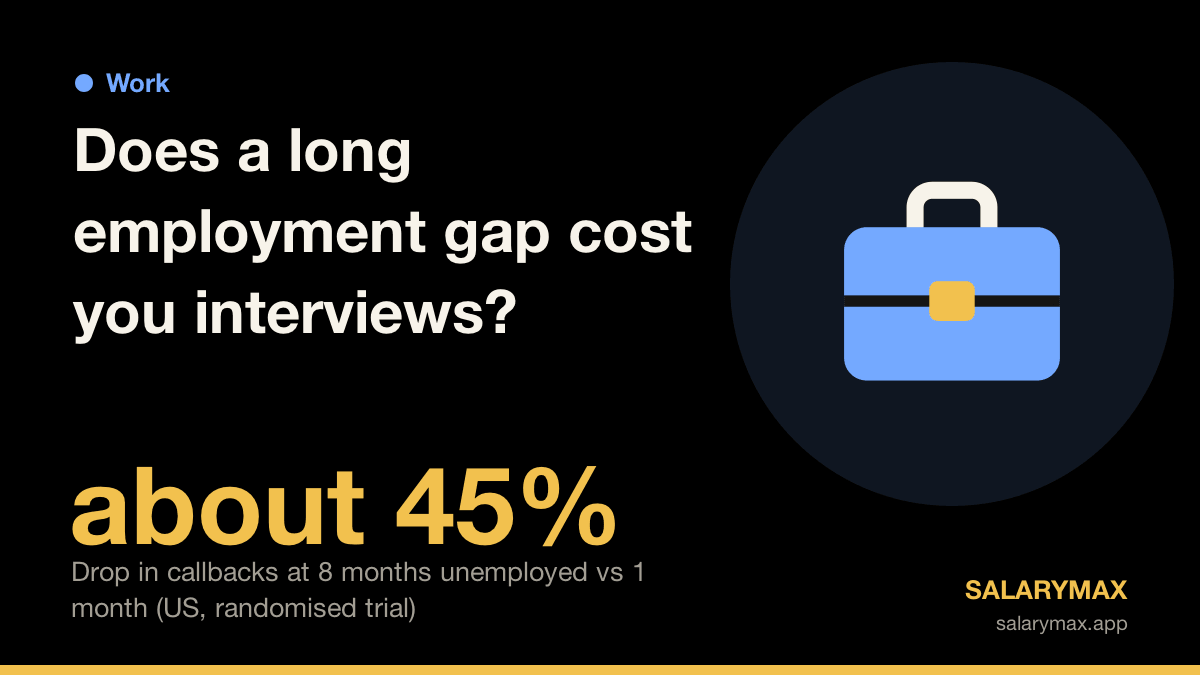
In a US experiment with about 12,000 fictitious résumés, an 8-month jobless spell drew about 45% fewer callbacks than a 1-month spell. Most of the drop came early.
The evidence behind this article
- Randomised trial3
Includes studies built to test cause and effect (randomised trials or natural experiments).
3 sources・Countries studied: United States, Sweden
How to read the kinds of evidence →What to do with this
While between jobs, set the time for your applications the night before and start early. Log one line a day on what you learned and where you applied.
Does a long gap on your résumé make it harder to get past the first screen? In a large US experiment, résumés showing a longer current spell of unemployment received fewer interview callbacks, and most of the drop happened in the first eight months. Other experiments have not all found the same thing, and researchers still debate it.
Key points
- In a US experiment that sent about 12,000 fictitious résumés to real postings in 100 cities, with the unemployment spell set by lottery (Kroft and colleagues, 2013), résumés showing 8 months out of work got about 45% fewer interview callbacks than those showing 1 month. After that, callbacks barely fell.
- In the same experiment, the gap was larger in local job markets where work was easier to find. The authors read this as employers using spell length as a sign of ability they cannot see on paper.
- A Swedish experiment (Eriksson and Rooth, 2014) found that past long-term unemployment did not matter if the person had worked since, and only a current spell of 9 months or more counted against applicants. Another US experiment (Farber and colleagues, 2019) found no difference among spells shorter than 52 weeks. No Japanese experiment was found.
How did employers treat gaps in 12,000 fictitious résumés?
Starting in July 2011, Kory Kroft, Fabian Lange and Matthew Notowidigdo applied to roughly 3,000 real online job postings in the 100 largest US metropolitan areas. The jobs were in sales, customer service and administrative or clerical work. They sent four résumés to each posting, about 12,000 in total.
The key design choice was that the résumés were otherwise comparable, while the current unemployment spell was randomly assigned, from 1 to 36 months. Because everything else was balanced, differences in callbacks reflect how employers reacted to the length of the gap.
Overall, about 4.7% of résumés led to an invitation to interview. Callbacks fell as the spell got longer: at 8 months they were about 45% lower than at 1 month, falling from roughly 7% to 4%. These percentages come from the working-paper version of the study. After 8 months, additional time out of work made almost no difference. If skills simply eroded over time, the authors note, callbacks should have kept falling, so skill loss alone does not explain the pattern.
The penalty for a long spell was also larger in local labour markets where jobs were easier to find. Their reading is that in weak markets, employers understand a long spell says less about the person.
What did other countries and other experiments find?
In Sweden, Stefan Eriksson and Dan-Olof Rooth ran a similar experiment with fictitious applications. A long spell of unemployment in the past did not affect employers’ decisions if the applicant had worked since. A short current spell was not penalised either. Only a current spell lasting at least nine months counted against applicants.
In the United States, Henry Farber and colleagues ran another résumé experiment. Applicants with 52 weeks of unemployment had a lower callback rate, but among shorter spells there was no link between spell length and callbacks. The authors say they cannot reconcile this with earlier findings.
How far does the research on employment gaps go?
This evidence supports a specific claim: for sales, service and clerical postings in the US, résumés showing a longer current spell of unemployment received fewer interview callbacks. Because the résumés were randomised, the difference in employer response is close to causal. But the studies measured only callbacks, not who was eventually hired or what they were paid.
Most importantly, the résumés were the same apart from the gap. The difference in callbacks came from how employers read the gap, not from anything about the applicant’s actual ability. About 95% of real résumés from unemployed people that the researchers collected gave no reason for the gap, so the experimental résumés gave none either. Whether explaining a gap changes the outcome was not tested.
We did not find a similar experiment in Japan, and Korean research was outside the scope of this review.
A small step for today
What the research supports is that the drop in callbacks was concentrated in the first months, and that in Sweden past unemployment stopped mattering once people had worked again.
- Use “Set when and where to do tomorrow’s key task” to fix the time for your applications the night before. Starting early fits what the research found.
- Use “Studied for 30 minutes” to build knowledge you can use in the jobs you apply for. It gives you something current to discuss in interviews.
- Use “Wrote one line on today’s progress” to log how many applications you sent and what replies came back. It helps you treat the results as a process, not a verdict on your worth.
FAQ
Does a long employment gap make it harder to get interviews?
In a US experiment, résumés showing a current 8-month spell of unemployment got about 45% fewer interview callbacks than those showing 1 month. Another US experiment, however, found no difference among spells shorter than 52 weeks. The results differ across experiments.
How many months out of work start to count against you?
It depends on the study. In the US experiment, most of the drop happened in the first 8 months and then levelled off. In the Swedish experiment, a current spell of 9 months or more counted against applicants, while shorter spells did not.
Does a long gap in the past keep hurting you?
In the Swedish experiment, past long-term unemployment did not affect employers’ decisions if the applicant had worked since. No similar experiment was found in Japan. The research describes average tendencies, not a prediction for any one person.
Sources
- [X-kroft-2013] Kroft, Lange & Notowidigdo (2013) Duration Dependence and Labor Market Conditions: Evidence from a Field Experiment. The Quarterly Journal of Economics.
- [X-eriksson-rooth-2014] Eriksson & Rooth (2014) Do Employers Use Unemployment as a Sorting Criterion When Hiring? Evidence from a Field Experiment. American Economic Review.
- [X-farber-2019] Farber, Herbst, Silverman & von Wachter (2019) Whom Do Employers Want? The Role of Recent Employment and Unemployment Status and Age. Journal of Labor Economics.
Studies describe average tendencies. This article is not a promise that a habit will lift your income, and it is not medical or investment advice. About these articles ・ Search & sources
Updated:
← All articles