Basics ・ 6 min
Do morning people earn more than night owls?
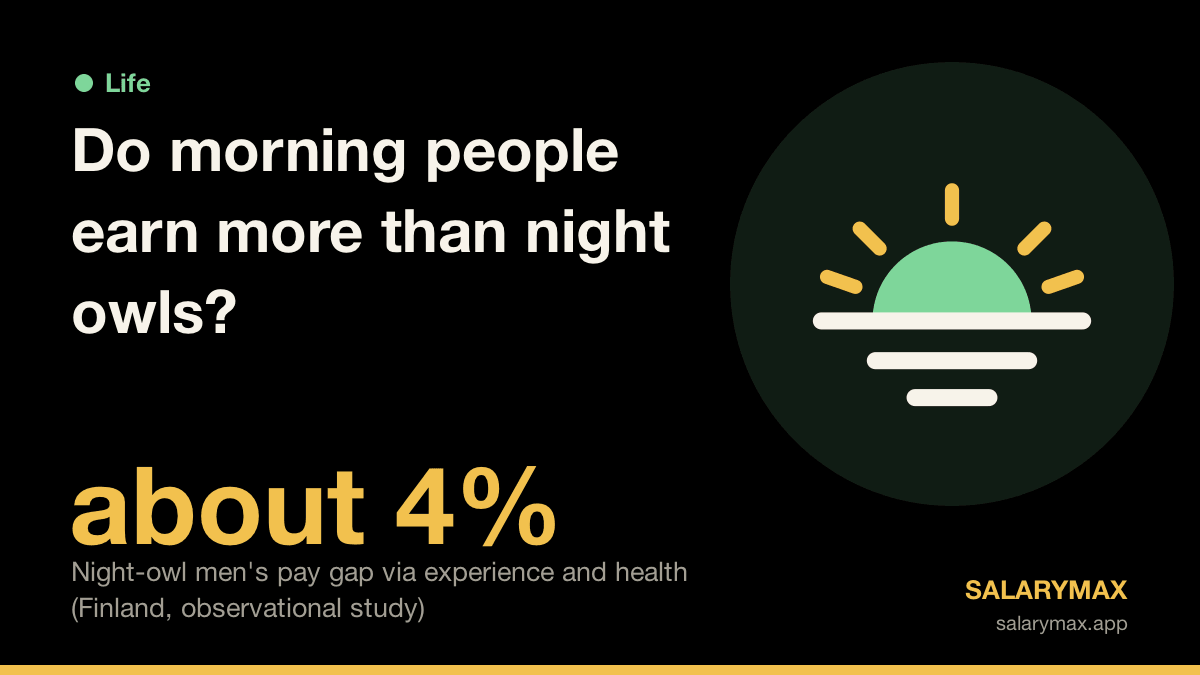
In a Finnish birth cohort, evening-type men earned about 4% less, through less work experience and poorer health. Danish data show the same tendency. Neither is causal.
The evidence behind this article
- Adjusted observational3
- Observational1
Based on observational data. It shows that two things go together, not that one causes the other.
4 sources・Countries studied: Finland, Denmark, Japan
How to read the kinds of evidence →What to do with this
Log when you went to bed and woke up along with your sleep, and see whether you can put important work in the hours your mind works best.
Is it true that early birds earn more? Studies from Denmark and Finland do find that morning types tend to have higher income and evening types lower wages. But all of them use observational data, and none shows that being a night owl in itself lowers your pay.
Key points
- In a Finnish cohort of people born in 1966, linked to tax records, evening types had lower wages through two routes: less work experience and poorer health. For men, these indirect links added up to about 4% lower average wages (Conlin and colleagues, 2023).
- In a Danish time-use survey, morning types earned significantly more than evening types, and the advantage was larger for men (Bonke, 2012). Both studies are correlational.
- In a survey of 8,155 office workers at 42 companies in Japan, evening types had larger health-related productivity losses at work, but the link ran through disturbed sleep (Shimura and colleagues, 2022).
Through what routes were night owls’ wages lower?
Your chronotype is your body clock’s preferred timing: the hours of the day when you naturally feel most active.
The Finnish study by Andrew Conlin and colleagues combined the Northern Finland Birth Cohort 1966, which has followed the same people since birth, at its age-46 follow-up, with income records from the Finnish Tax Administration. Evening types tended to accumulate less work experience and to have poorer health, and through those routes they had lower wages. The indirect link was largest for men, at about 4% of average wages. The authors also found a long-term association between chronotype and wages from age 29 to 50. Evening types made up 11% of the sample.
The authors argue that evening types fit typical working hours less well and so build up less experience and health over time. At the same time, the University of Oulu’s release on the study stresses that the results should not be read as causal.
Do morning people earn more, and do night owls find work harder?
The Danish study by Jens Bonke used a new time-use survey to sort people into morning and evening types and compare their income. The idea was that society favours early working hours, so morning types are more likely to work at the time of day when they are most productive. Morning types earned significantly more than evening types, and morningness benefited men in particular.
Another study of the same Finnish cohort, by Tapio Räihä and colleagues, looked at 5,831 people aged 46 who had not retired. Evening types made up 10% of men and 12% of women. Compared with morning types, evening types were about twice as likely to rate their work ability as poor, for both men and women. Evening-type men were also more likely to start receiving a disability pension in 2013–2016. That difference, however, was no longer statistically significant once sleep or working hours were taken into account.
How to read research on chronotype and income
None of these studies assigned people to be morning or evening types. Being a night owl overlaps with disturbed sleep, health and the hours your job requires, and the studies cannot fully separate which of these is linked to income. We also do not know whether Nordic results carry over to other countries.
We have not found a study from Japan that links chronotype directly to income. The closest is a survey by a team including Tokyo Medical University, covering 8,155 office workers at 42 companies in 2017–2019. Health-related productivity loss at work (presenteeism) averaged 5.97% and was larger for evening types. But eveningness was not linked to it directly; the link ran through disturbed sleep. On workdays, earlier bedtimes for morning types and later wake-up times for evening types were associated with better productivity.
So the research supports a modest claim: night owls tend to face more stacked-up disadvantages at work. It does not show that switching to an earlier schedule would raise anyone’s income.
A small step for today
- When you log “Slept about 7 hours,” also note when you went to bed and when you woke up. That helps you see your own rhythm and any disturbed sleep.
- Use “Planned the day in the morning” to see whether you can put your most important task in the hours when your mind works best. Those hours differ from person to person.
- If you are a night owl, avoid cutting sleep just to force an early schedule. In the Japanese survey, it was disturbed sleep, more than eveningness itself, that was linked to productivity.
FAQ
Do night owls earn less than morning people?
On average, Nordic studies find that they do. Among Finnish men, evening types had wages about 4% lower through indirect routes such as less work experience and poorer health. That is a group tendency, not a prediction for any one person.
Will becoming a morning person increase my income?
Current research cannot say that. None of the studies followed people who changed their chronotype, and the Finnish researchers caution against reading their results as causal.
How can a night owl stay productive at work?
In the Japanese office-worker survey, later wake-up times on workdays were associated with better productivity for evening types. Because the productivity loss ran through disturbed sleep, reducing sleep problems looks like one useful lever.
Sources
- [X-conlin-2023] Conlin, Nerg, Ala-Mursula, Räihä & Korhonen (2023) The association between chronotype and wages at mid-age. Economics & Human Biology.
- [X-bonke-2012] Bonke (2012) Do Morning-Type People Earn More than Evening-Type People? How Chronotypes Influence Income. Annals of Economics and Statistics.
- [X-raiha-2021] Räihä, Nerg, Jurvelin, Conlin, Korhonen & Ala-Mursula (2021) Evening chronotype is associated with poor work ability and disability pensions at midlife. Occupational and Environmental Medicine.
- [X-shimura-2022] Shimura, Yokoi, Sugiura, Higashi & Inoue (2022) On workdays, earlier sleep for morningness and later wakeup for eveningness are associated with better work productivity. Sleep Medicine.
Studies describe average tendencies. This article is not a promise that a habit will lift your income, and it is not medical or investment advice. About these articles ・ Search & sources
Updated:
← All articles