Basics ・ 6 min
Do experiences make you happier than things?
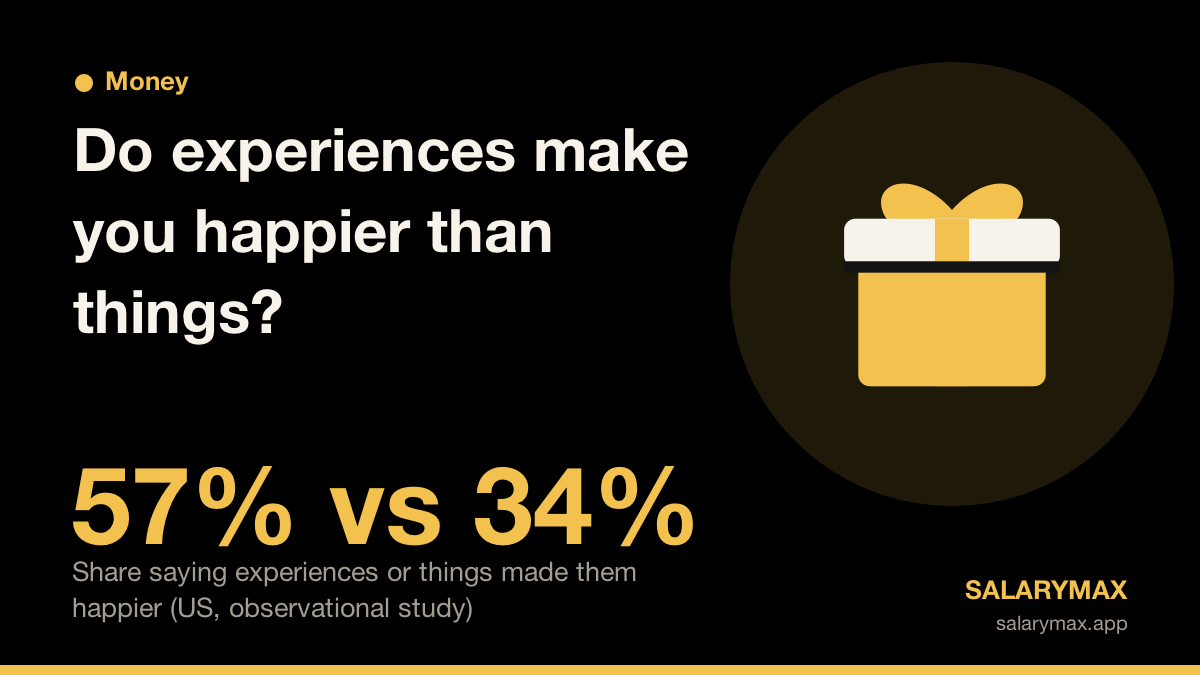
In a US phone survey of 1,263 adults, 57% said an experience made them happier than a thing; 34% said the reverse. A Canadian test found things bring joy more often.
The evidence behind this article
- Randomised trial1
- Observational2
Includes studies built to test cause and effect (randomised trials or natural experiments).
3 sources・Countries studied: United States, Canada, Hungary
How to read the kinds of evidence →What to do with this
Before your next mid-sized purchase, write down what you will do with it and how often you expect to use it. Then decide whether an experience or a thing fits better.
A trip or a new gadget: if you are spending the same money, which is more likely to make you happy? In a US survey most people said experiences. Later research shows that things have their own kind of benefit.
Key points
- In a US telephone survey of 1,263 adults in 2000, 57% said an experiential purchase had made them happier, while 34% said a material purchase had. The survey asked people to look back on their purchases; it does not show cause and effect.
- In the same survey, people in the lowest income group were about equally likely to name either kind of purchase. The authors themselves say their findings do not mean people should cut basic needs to pay for experiences.
- In a Canadian experiment that randomly assigned how people spent C$20, material purchases brought small moments of happiness more often, while experiences brought more intense happiness on single occasions. No Japanese study was found.
How many people said experiences made them happier?
The idea was popularised by a 2003 paper by US psychologists Leaf Van Boven and Thomas Gilovich.
Their first study surveyed 97 university students in Canada. Half were asked to recall their most recent experiential purchase over $100, meaning money spent mainly to live through an event or experience. The other half recalled a material purchase, an object they kept. Students who recalled an experience rated it as making them happier and as money better spent.
The second study was a national telephone survey of 1,279 Americans aged 21 to 69, carried out in late 2000. Each person recalled one experiential and one material purchase and said which had made them happier. Of the 1,263 who answered, 57% chose the experience and 34% chose the thing. Women, younger people and city dwellers leaned slightly more towards experiences, but every group chose experiences more often.
The exception was the lowest income group, where people were about equally likely to name either.
A third study, with 70 US students, randomly assigned people to think about either an experiential or a material purchase. Those who thought about an experience were in a more positive mood afterwards. The authors suggest that experiences are easier to reinterpret positively, become part of who we are, and help build relationships.
Do things bring happiness more often, and experiences more intensely?
Most earlier studies asked people to look back on purchases. In 2016, Canadian psychologists Aaron Weidman and Elizabeth Dunn tracked how people felt while actually using what they bought.
In the first study, participants were given C$20 and randomly assigned to spend it on either a material or an experiential purchase. For two weeks they recorded their feelings about it every day. In the second study, people reported several times a day, over two weeks, how they felt about a material or experiential Christmas gift.
The answer was not that one type wins. Material purchases provided moments of happiness more frequently over time, while experiential purchases provided more intense happiness on individual occasions. Things, in other words, can lift your mood again and again.
Does the experience advantage hold outside the US?
Early studies relied mostly on American samples and asked people to compare the two kinds of purchase directly. Perhaps people were simply reluctant to admit that objects made them happy?
In 2025, two researchers tested this with two samples from Hungary. They used anonymous online surveys and asked different people about experiences and things, so nobody compared the two directly. People still reported more happiness from experiential purchases. The wish to give a socially acceptable answer did affect the size of the gap somewhat, but not enough to erase it.
How far can “spend on experiences” be trusted?
A fair reading of this evidence is that people in US and Hungarian surveys tend to remember experiential purchases as making them happier. The Canadian experiment used random assignment, but with small amounts of money over two weeks.
- Most of it is recall. No study here tested, over a long period, whether getting people to spend more on experiences raises their happiness.
- The line is blurry. The original authors note that some objects, such as a piano, exist to create experiences.
- It assumes some spare money. In the lowest income group there was no difference. This is not advice to cut essential spending for the sake of experiences.
- No Japanese study was found asking the same question.
A small step for today
Rather than asking “experience or thing?”, ask what the purchase will actually do for you.
- With “Tracked spending”, tag each purchase as an experience or a thing for one week. Later, notice which ones you enjoy remembering.
- During “Waited a night before buying”, write down what you will do with the item and how often you expect to use it. Something you use every day may bring many small moments of happiness.
- If you choose an experience, think about who you will share it with. Building relationships was one of the reasons the researchers gave.
FAQ
Will spending on experiences make me happier than buying things?
In a US survey, 57% said an experiential purchase had made them happier and 34% said a material one had. That survey relied on recall, so it does not prove cause. In a Canadian experiment, things brought joy more often and experiences more intensely.
Is buying material things a waste of money?
Not according to this research. The original authors write that their results do not mean possessions fail to make people happy. In the Canadian experiment, things produced moments of happiness more often.
Should I spend on experiences even when money is tight?
The research does not say so. In the US survey, people in the lowest income group were about equally likely to name experiences or things. The authors also stress that their findings do not mean anyone should give up basic needs for experiences.
Sources
- [X-van-boven-gilovich-2003] Van Boven & Gilovich (2003) To Do or to Have? That Is the Question. Journal of Personality and Social Psychology.
- [X-weidman-dunn-2016] Weidman & Dunn (2016) The Unsung Benefits of Material Things. Social Psychological and Personality Science.
- [X-hajdu-2025] Hajdu & Hajdu (2025) The Experiential Advantage in Consumption: Evidence from Hungary. Social Indicators Research.
Studies describe average tendencies. This article is not a promise that a habit will lift your income, and it is not medical or investment advice. About these articles ・ Search & sources
Updated:
← All articles