Basics ・ 6 min
Does earning less than your neighbours lower your happiness?
In a US panel of about 10,000 people, those in higher-earning areas were less happy at the same income. In a Dutch lottery study, neighbours' wins did not reduce it.
The evidence behind this article
- Natural experiment1
- Adjusted observational1
- Observational1
Includes studies built to test cause and effect (randomised trials or natural experiments).
3 sources・Countries studied: United States, Netherlands, Japan
How to read the kinds of evidence →What to do with this
When something you saw others buy catches your eye, wait a night before buying it, and note in your spending log whether someone else prompted the urge.
Seeing how neighbours or friends live can make your own life feel lacking. A US survey found that people with richer neighbours tended to be less happy, but a Dutch natural experiment found that when neighbours suddenly came into money, people’s happiness did not fall.
Key points
- In a US survey that followed about 10,000 people twice (1987–88 and 1992–94), people living in areas with higher average earnings reported lower happiness, even after accounting for their own income. This is an observational study adjusted with statistics, not an experiment.
- In a study of a Dutch lottery that randomly picks a postcode each week, neighbours of winners were no less happy six months later. However, people living next to winners bought more cars.
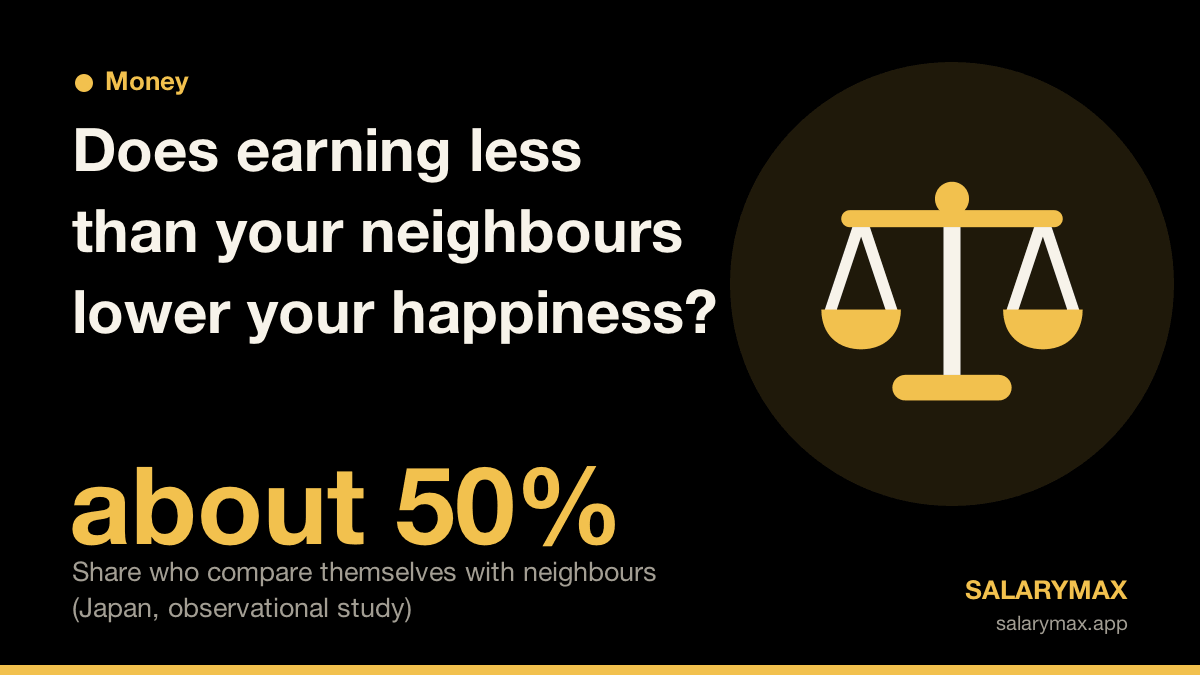
- In 2006 surveys in Japan and the US, the group people most often compared themselves with was their neighbours: about 50% (49.74%) in Japan. People who were very conscious of others’ living standards tended to be less happy in Japan but happier in the US.
Were people less happy when their neighbours earned more?
In 2005, economist Erzo Luttmer used the US National Survey of Families and Households, which interviewed the same people twice. For each person’s local area, home to about 150,000 people on average, he estimated typical earnings from the local mix of industries and jobs, and compared this with reported happiness. The main analysis covered married and cohabiting couples.
He found that:
- Even after accounting for household income and other factors, people in areas with higher average earnings reported lower happiness.
- A rise in neighbours’ earnings and a similar fall in one’s own income were linked to drops in happiness of roughly the same size.
- People in higher-earning areas also worried more often that their family income would not cover their bills.
- The link was stronger for people who socialised with neighbours, and was tied mainly to neighbours with similar education.
Because the same people were followed over time, it is less likely that unhappy people simply chose to live in richer areas. Luttmer interpreted the results as evidence that people compare themselves with those around them.
When neighbours won the lottery, did people become less happy?
In Luttmer’s study, local earnings were not assigned by chance. A Dutch study published in 2011 used chance instead.
The Dutch Postcode Lottery randomly selects one postcode each week, about 19 households on average, and gives prizes of cash and a new car to residents who bought tickets. In a typical winning postcode, about a third of households received the equivalent of roughly eight months’ income at once. Six months later, the researchers surveyed households in 419 postcodes.
Neighbours who had not won themselves were no less happy. Winners were not happier either. People living next door to winners, though, bought more cars and did more exterior home renovations. Neighbours’ luck showed up in shopping, not in feelings.
The authors themselves explained the contrast with Luttmer: neighbours’ regular earnings are long-lasting, while a lottery win happens once, and Luttmer’s neighbours’ earnings were not random.
Who do people in Japan compare themselves with?
Sun Youn Lee and Fumio Ohtake (2021) used surveys run by Osaka University in Japan and the US. According to the working-paper version, the 2006 survey had 3,763 respondents in Japan and 3,120 in the US.
In both countries, the most common comparison group was neighbours (49.74% in Japan, 51.04% in the US). People who strongly agreed that they were conscious of other people’s living standards tended to be less happy in Japan, but happier in the US. In the US, highly conscious people tended to pick lower-income comparison groups, which seemed to make them feel better off. This is an observational study, so it cannot show that comparing causes lower happiness.
How to read the research on comparing with others
A fair reading is that a link between richer neighbours and lower happiness appears in US observational data, but it was not confirmed for one-off windfalls.
- The observational study and the natural experiment disagree. Rather than one being wrong, lasting income differences and a single lottery win may simply mean different things.
- People choose whom to compare with. In the Japan–US surveys, the direction of comparison changed how it related to happiness.
- The data are fairly old. The US data are from around 1990 and the Japanese data from 2006. Today’s social media comparisons were not studied.
- The effect on spending is clearer. In the Dutch study, wins decided by lottery still led neighbours to buy more cars.
A small step for today
Comparing with others seems to show up in spending before it shows up in feelings.
- When you want something because you saw others with it, use “Waited a night before buying” and decide tomorrow.
- With “Tracked spending”, mark purchases prompted by seeing someone else. You will see how often it happens.
- Notice that you choose whom to compare yourself with; in the surveys, the direction of comparison mattered.
FAQ
Does earning less than the people around you make you less happy?
In a US panel of about 10,000 people, those in areas with higher average earnings reported lower happiness, even at the same income. In a Dutch lottery natural experiment, however, neighbours’ wins did not lower happiness. The research does not yet agree.
Do people spend more when their neighbours get richer?
In the Dutch study, people living next door to lottery winners bought more cars and did more exterior renovations. Because the wins were decided by lottery, this natural experiment shows the influence of neighbours fairly clearly.
Who do people in Japan compare their lives with?
In a 2006 Japanese survey, the most common comparison group was neighbours, named by about 50% (49.74%). People very conscious of others’ living standards tended to be less happy in Japan. It is an observational study, so it does not show cause and effect.
Sources
- [X-luttmer-2005] Luttmer (2005) Neighbors as Negatives: Relative Earnings and Well-Being. The Quarterly Journal of Economics.
- [X-kuhn-2011] Kuhn, Kooreman, Soetevent & Kapteyn (2011) The Effects of Lottery Prizes on Winners and Their Neighbors: Evidence from the Dutch Postcode Lottery. American Economic Review.
- [X-lee-ohtake-2021] Lee & Ohtake (2021) How Conscious Are You of Others? Further Evidence on Relative Income and Happiness. Journal of Happiness Studies.
Studies describe average tendencies. This article is not a promise that a habit will lift your income, and it is not medical or investment advice. About these articles ・ Search & sources
Updated:
← All articles