Deep dive ・ 7 min
Do computer and IT skills pay? A 19-country study
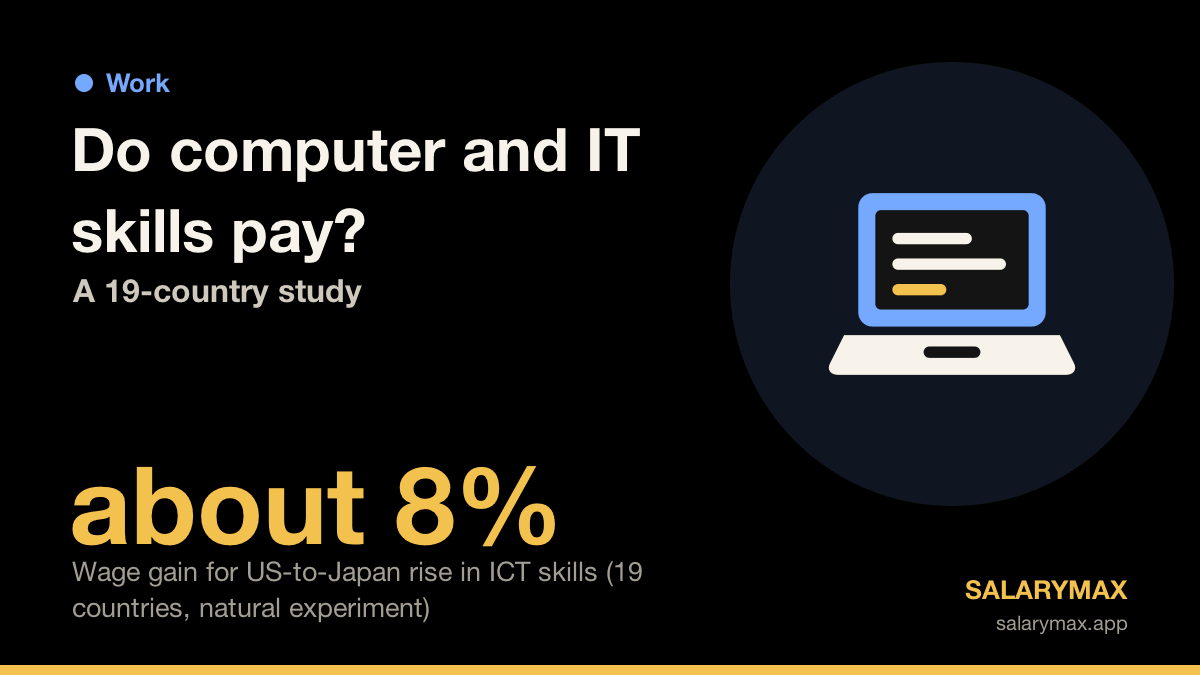
A 19-country study using OECD PIAAC data and broadband rollout estimated that raising ICT skills from the US to the Japanese average would lift wages by about 8%.
The evidence behind this article
- Natural experiment1
- Adjusted observational1
Includes studies built to test cause and effect (randomised trials or natural experiments).
2 sources・Countries studied: Japan, Several countries
How to read the kinds of evidence →What to do with this
Pick one tool you use at work, such as spreadsheets, email or online research, and practise a slightly harder way of using it for a short time each day this week.
How much do computer and internet skills matter for pay? A study using adult skills tests from 19 countries estimated that if a worker’s ICT (information and communication technology) skills rose from the US average to the Japanese average, wages would rise by about 8%. That is close to the payoff from one more year of schooling.
Key points
- Falck and colleagues (2021) analysed 53,879 employees aged 20 to 65 in 19 countries from the OECD Survey of Adult Skills (PIAAC, 2011 to 2012). Using differences in broadband availability shaped by older telephone networks, they estimated that raising ICT skills from the US average (285 points) to the Japanese average (299 points) would raise wages by about 8%.
- In the same study, ICT skills one standard deviation (41 points) higher were linked to wages about 24% higher across countries and about 31% higher across German municipalities. About two-thirds of the gain was explained by moving into occupations with more abstract, thinking-heavy tasks.
- Japan had the highest average ICT score of the 19 countries. Yet an analysis of Japan’s public IT training for the unemployed (labour ministry, 2022) found no evidence that it helped people move from other occupations into IT engineering jobs.
What does the PIAAC ICT test actually measure?
PIAAC is an OECD survey that tested adults aged 16 to 65 in literacy, numeracy and ICT skills. The ICT part, called “problem solving in technology-rich environments”, asks people to complete tasks by combining a browser, email, word processing and spreadsheets. One task was to go through several job websites and bookmark only those that did not require registration or a fee. It measures basic digital problem solving, not specialist skills such as programming.
According to Oliver Falck, Alexandra Heimisch-Roecker and Simon Wiederhold (2021), the 19-country average was 287 points, with a standard deviation of 41. Japan scored highest at 299, and Sweden, Australia and the Netherlands were also near the top. Korea had the narrowest spread of scores. Age gaps were large: 298 points for ages 20 to 34 versus 267 for ages 55 to 65. About 24% of the population lacked even very basic ICT proficiency.
Using broadband rollout, how large is the wage effect of ICT skills?
People with strong ICT skills might earn more simply because they are more able in general. So the study used differences in how easy it was to get online, which were set by factors unrelated to personal ability (an instrumental-variable method, similar to a natural experiment).
The first comparison was across countries. How fast broadband spread depended on how far older fixed-line telephone networks had spread. On top of country differences, the study used gaps between generations who were toddlers when broadband arrived and those who were already older. The second comparison was across German municipalities. In former West Germany, the telephone network was designed in the 1960s, and households too far from the main network node could not get early high-speed internet.
The results: ICT skills one standard deviation higher raised wages by about 24% across countries and about 31% in Germany. A worker moving from the US average to the Japanese average would gain about 8%, and a prime-age worker (35 to 54) reaching the level of younger workers (20 to 34) would gain a similar 8%. The instruments did not explain differences in numeracy or literacy. People with higher ICT skills were more likely to work in jobs heavy in abstract tasks, which explained about two-thirds of the wage gain.
How should Japanese readers read the ICT skills research?
What this evidence supports is that ICT skills gained through easier internet access raised wages on average across 19 countries. It is not a lottery-based experiment, and it rests on the assumption that broadband rollout affected wages only through ICT skills. The estimates are about twice as large as simple comparisons, and the authors note that the people driving the estimate may gain more than the average worker. The data are from 2011 to 2012 and measure basic skills.
Japan had the highest average score, but the study pools countries and does not report a Japan-only wage effect. In Japan, the labour ministry has analysed training for the unemployed using employment insurance records. Among people who left jobs in January to June 2020, some who took IT courses were using them in office jobs, but there was no evidence that IT training helped people move from other occupations into IT engineering. Women who took specialist IT training were still more likely to end up in office jobs.
A small step for today
The research suggests that ICT skills grow with use and shape the kinds of jobs people can take on.
- Pick one tool you use at work, such as spreadsheets, email or online research, and practise a slightly harder way of using it. Log it as “Studied for 30 minutes.”
- Practise tasks that combine several tools, like the test items. For example, put what you looked up into a table and email it.
- Use “Wrote one line on today’s progress” to note each new thing you can do.
FAQ
Do people who are good with computers earn more?
In the 19-country study, people with higher ICT skills tended to earn more. The study estimated that one standard deviation more ICT skill raised wages by about 24%. About two-thirds of that came from getting jobs with more thinking-heavy tasks.
Are Japanese adults’ IT skills low compared with other countries?
In the PIAAC test, Japan’s average was 299 points, the highest of the 19 countries. Some people could not take the computer-based test, though, and gaps by age were large.
Can IT training help me switch to an IT job?
An analysis of Japan’s public training for the unemployed found no evidence that IT courses helped people move from other occupations into IT engineering. Some trainees did use their training in office jobs.
Sources
- [X-falck-2021] Falck, Heimisch-Roecker & Wiederhold (2021) Returns to ICT skills. Research Policy.
- [X-mhlw-2022] Ministry of Health, Labour and Welfare (2022) Analysis of the effects of public vocational training (in Japanese).
Studies describe average tendencies. This article is not a promise that a habit will lift your income, and it is not medical or investment advice. About these articles ・ Search & sources
Updated:
← All articles