Deep dive ・ 6 min
Do naps improve work productivity? A sleep trial in India
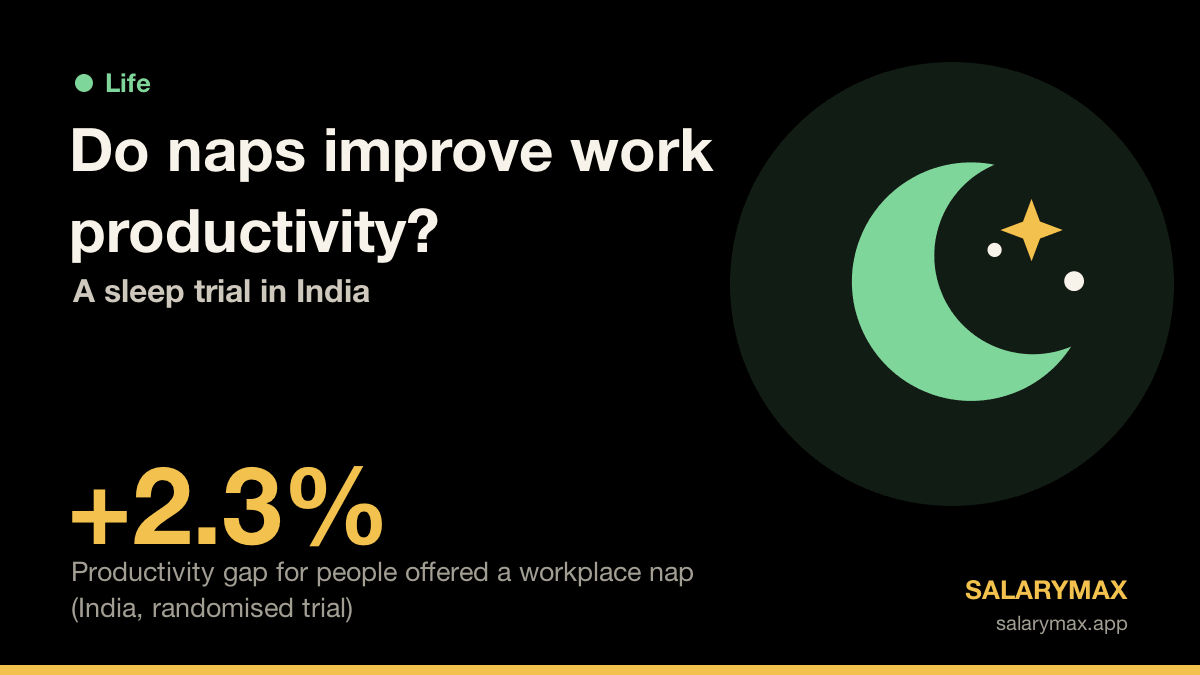
In an Indian randomised trial of 452 adults, the offer of a daily 30-minute workplace nap raised productivity 2.3% but cut work time. More night sleep did not raise output or pay.
The evidence behind this article
- Randomised trial1
- Observational1
Includes studies built to test cause and effect (randomised trials or natural experiments).
2 sources・Countries studied: India, Japan
How to read the kinds of evidence →What to do with this
Use a few minutes of your lunch break to rest with your eyes closed, and write one line on your progress on nap and no-nap days to compare.
Does more sleep make you better at your job? In an experiment in India that increased sleep through random assignment, short naps at the workplace slightly improved productivity and mood, while more sleep at night did not raise output or earnings. The naps also took time away from work.
Key points
- In a randomised trial of 452 low-income adults in Chennai, India (Bessone and colleagues, 2021), people offered a daily 30-minute nap at work were 2.3% more productive over the day and scored better on psychological well-being and cognition. But they worked less, so they earned less than people who kept working during that time.
- In the same trial, improving home sleep conditions and encouraging people to sleep more added 27 minutes of night sleep, with no significant gains in productivity, cognition or well-being. Work time fell by nine minutes a day, and earnings fell slightly, though not by a statistically clear amount.
- 119 sleep and economics experts had predicted that 30 more minutes of night sleep would raise work output by 7%, and the experiment rejected that prediction. In a small Japanese study of eight factory workers, workers felt less sleepy in the afternoon in the week with a 15-minute nap, but reaction times did not change.
What happened to work when night sleep was increased?
The study was run in Chennai in southern India by a team of US-based economists (Pedro Bessone, Gautam Rao, Frank Schilbach, Heather Schofield and Mattie Toma) and published in 2021. The participants were 452 low-income adults, typically about 35 years old, and two-thirds were women.
When sleep was measured with wrist-worn devices, participants spent 8 hours in bed but slept only 5.5 hours on average. They woke about 31 times a night, and their sleep efficiency, the share of time in bed spent asleep, was 70%, similar to people with sleep disorders.
The researchers hired participants for a one-month data-entry job with flexible hours. Pay depended on time spent typing and on the amount and accuracy of the data entered, so productivity, work time and earnings could be measured precisely. A lottery then assigned these interventions:
- Night sleep: items to improve home sleep conditions, plus information and encouragement. Some people also received money for sleeping more.
- Naps: the chance to sleep for up to 30 minutes each afternoon at a nap station at the workplace.
The night sleep interventions added 27 minutes of sleep a night. The gain came from more time in bed (38 minutes more), not better sleep. Yet there was no significant improvement in data-entry productivity, in cognition such as attention and memory, in mood or physical health, or in preferences about time and risk. Instead, work time fell by nine minutes a day, and earnings dipped slightly, though the difference was not statistically clear.
How did a 30-minute workplace nap change productivity and earnings?
People offered naps slept about 14 minutes more during the day. They were 2.3% more productive over the day and did better on psychological well-being, cognitive tests and attention at work. On an overall index combining many outcomes, naps had a clear positive effect.
But nap time is time not spent working. Looking at earnings, the study’s summary measure of work, people who napped earned more than people who spent the same time on a simple break, but less than people who kept working through it. Naps raised output per hour, but not by enough to make up for the time lost.
In Japan, a small study looked at eight factory workers (Takahashi and colleagues, 2004). It compared a week with a 15-minute nap in a reclining chair at 12:30 with a week without one, switching the order between people. By the end of the nap week, workers felt less sleepy in the afternoon, but reaction-time tests and night sleep did not differ.
How far does this evidence go on naps and sleep at work?
The Indian study was a randomised experiment, so its results can be read as cause and effect. But the participants were low-income adults in Chennai, in a setting with many obstacles to good sleep, and the study lasted one month. The authors themselves note that the benefits of more sleep could be larger in richer countries. Night sleep may have had no effect because sleep quality stayed low, but the reason is not yet known.
The Japanese study had only eight people and was not randomised. What we can say is that a short nap at work may help with sleepiness and focus, but not that it raises output or earnings.
A small step for today
- Use a few minutes of your lunch break to rest with your eyes closed. The Japanese study used a 15-minute nap, and the Indian study allowed up to 30 minutes.
- On nap and no-nap days, compare your “Wrote one line on today’s progress” entries. Check whether your working time is shrinking too.
- At night, log “Slept about 7 hours,” and remove one thing that disturbs your sleep, such as heat, noise or light, rather than only adding time in bed. If poor sleep goes on for weeks, talk to a doctor.
FAQ
Does napping improve productivity at work?
In a randomised trial of 452 adults in India, people offered a 30-minute nap at work were 2.3% more productive over the day. But they worked less, so they earned less than people who kept working during that time.
Does more sleep at night increase earnings?
In the Indian trial, 27 more minutes of night sleep did not raise productivity or earnings. Work time fell by nine minutes a day and earnings dipped slightly, though the difference was not statistically clear.
Do workplace naps help in Japan too?
In a Japanese study of eight factory workers, workers felt less sleepy in the afternoon in the week with a 15-minute nap, but reaction times did not change. The study was small and did not measure work output or earnings.
Sources
- [X-bessone-2021] Bessone, Rao, Schilbach, Schofield & Toma (2021) The Economic Consequences of Increasing Sleep Among the Urban Poor. The Quarterly Journal of Economics.
- [X-takahashi-2004] Takahashi, Nakata, Haratani, Ogawa & Arito (2004) Post-lunch nap as a worksite intervention to promote alertness on the job. Ergonomics.
Studies describe average tendencies. This article is not a promise that a habit will lift your income, and it is not medical or investment advice. About these articles ・ Search & sources
Updated:
← All articles