Basics ・ 6 min
Do people who shop around pay less for the same goods?
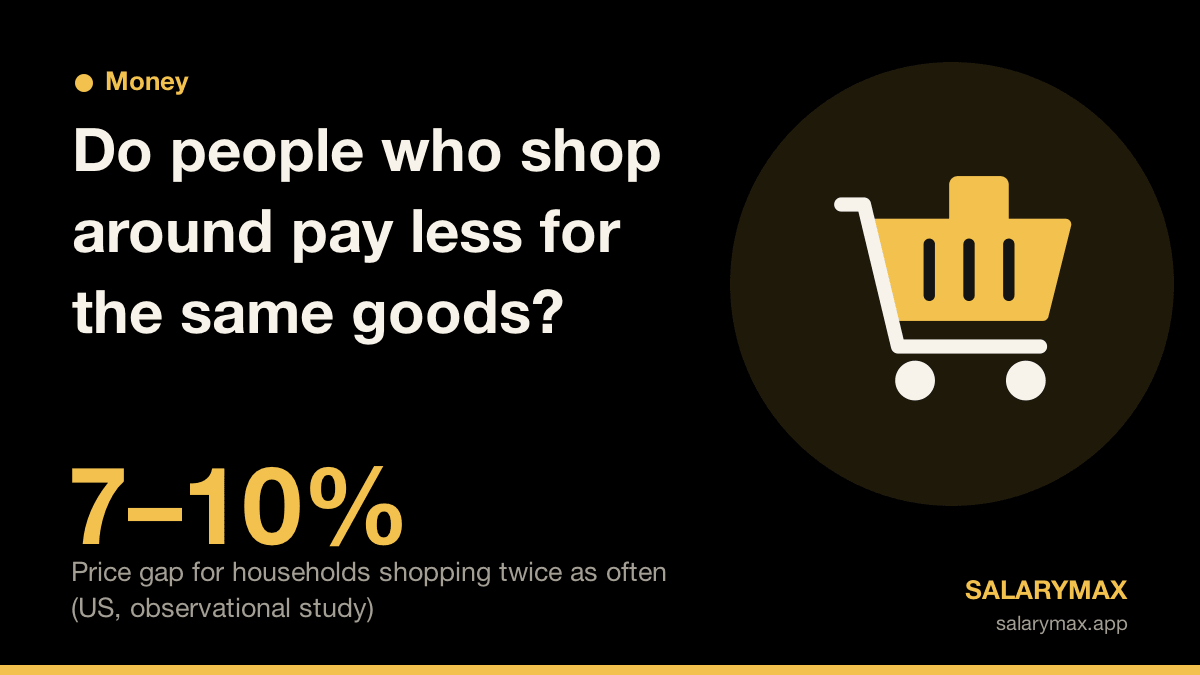
In US household scanner data, shopping twice as often went with 7–10% lower prices for the same goods, and older households paid least. In Japan, sales use mattered more.
The evidence behind this article
- Adjusted observational2
Based on observational data. It shows that two things go together, not that one causes the other.
2 sources・Countries studied: United States, Japan
How to read the kinds of evidence →What to do with this
Pick three everyday items you buy often and note your usual price and the sale price. Rather than shopping more often, try timing those purchases to sales.
Do people who make more trips to the shops end up paying less for the same things? In US household purchase records, households that shopped more often tended to pay lower prices for identical goods. In Japanese records, though, how much people bought on sale was more closely tied to the prices they paid than how often they shopped.
Key points
- In purchase records from about 2,100 households in Denver, US (Aguiar and Hurst, 2007), prices paid for the same good in the same area and period varied widely. Shopping twice as often went with prices 7–10% lower, and older households, who shopped the most, paid the lowest prices.
- In the working-paper version of the same study, households in their early 40s paid 6–8% more for identical goods than households in their early 20s or late 60s. Prices paid tended to be highest at the life stage when time was most valuable.
- In 2004–2006 purchase records from about 12,000 households across Japan (Abe and Shiotani, 2014), price differences by age and income were small, and older households actually paid more. The strongest link was with buying on sale, while shopping frequency had only a limited effect.
How did shopping trips relate to prices paid in US purchase records?
Mark Aguiar and Erik Hurst used home-scanner data, in which households scan the barcodes of everything they buy, from the Denver metropolitan area in Colorado. The data ran from January 1993 to March 1995 and covered about 2,100 households and more than 950,000 transactions. For each barcode, they compared what different households paid.
Even for the same good, in the same area and at the same time, households paid very different prices. Shopping twice as often went with prices 7–10% lower. By age, older households shopped the most and paid the lowest prices.
The earlier working-paper version gives more detail. Households earning more than $70,000 a year paid on average 5% more for an identical good than households earning less than $30,000. Households in their early 40s paid 6–8% more than households in their early 20s or late 60s. Households with more children also tended to pay more.
The authors read this as a trade between time and money. People whose time is worth more, because of work or children, spend less time hunting for lower prices and pay more as a result. Combining the purchase data with the American Time Use Survey, they estimate that the shopper’s value of time peaks in middle age at about 40% above that of retirees (working paper).
Who paid higher prices in Japanese purchase records?
In Japan, Naohito Abe and Kyosuke Shiotani used nationwide household purchase records from the research company Intage. The data covered about 12,000 randomly selected households over three years, 2004 to 2006, limited to married couples in which the wife was under 70.
As in the US, the same goods sold at very different prices to different households. But differences by age and income were small, and older households faced higher prices than younger ones, the opposite of the US finding.
The strongest link with the price level was the share of purchases made on sale. Doubling purchases made on sale was linked to a price level about 2% lower. Shopping frequency was statistically related to prices, but the size of the effect was limited.
Reading it as a trade between time and money: how far can we go?
This evidence supports a specific claim: in the US, households that spent more time shopping tended to pay less for the same goods, while in Japan the use of sales was more closely tied to price differences. Both are observational studies of household records; nobody was assigned to shop more often by lottery.
The data are also old: one US city in the early 1990s and Japan in the mid-2000s. Online shopping and price comparison have since changed how people spend time on shopping. The price gaps are a few percent, and searching takes time that has value too. It helps to see this as the mirror image of paying money to free up time. Korean research was outside the scope of this review.
A small step for today
What the research supports is that, at least in the Japanese data, knowing the usual price of what you buy and choosing when to buy fits better than simply making more trips.
- When you log “Tracked spending,” also note the price of three everyday items you buy often. You will start to see the gap between the usual price and the sale price.
- Use “Waited a night before buying” to ask whether a non-urgent purchase can wait until the next sale.
- If searching costs you a lot of time, do not force extra trips. As the US study shows, time has a price too.
FAQ
Does shopping more often save money?
In US purchase records, households that shopped twice as often tended to pay 7–10% less for the same goods. In Japanese records, however, shopping frequency had only a limited effect, and the share bought on sale was more closely tied to prices. Both are observational studies, so they do not show that shopping more often lowers what you pay.
Do older people pay less for groceries?
In the US data, older households shopped the most and paid the lowest prices. In Japanese records from 2004 to 2006 it was the opposite: older households faced higher prices. The results differ by country and period.
Why do busy people end up paying more?
The US authors argue that people whose time is worth more spend less time looking for cheaper shops or better timing. Households in their early 40s paid 6–8% more than those in their early 20s or late 60s (working paper). The research describes average tendencies, not a prediction for any one person.
Sources
- [X-aguiar-hurst-2007] Aguiar & Hurst (2007) Life-Cycle Prices and Production. American Economic Review.
- [X-abe-shiotani-2014] Abe & Shiotani (2014) Who Faces Higher Prices? An Empirical Analysis Based on Japanese Homescan Data. Asian Economic Policy Review.
Studies describe average tendencies. This article is not a promise that a habit will lift your income, and it is not medical or investment advice. About these articles ・ Search & sources
Updated:
← All articles