Practice ・ 6 min
Do side jobs build skills and careers? UK and Japan research
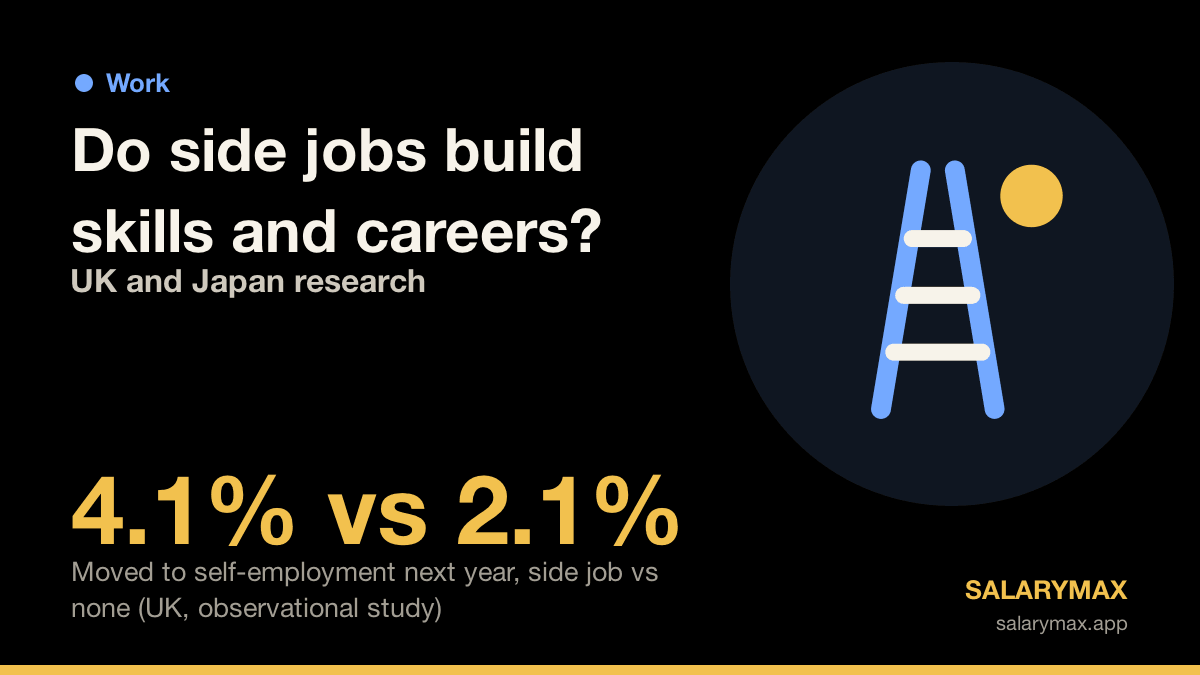
In UK working-paper data on men, 4.1% with a second job became self-employed the next year, versus 2.1% without one. A Japanese panel study found benefits for only some.
The evidence behind this article
- Adjusted observational2
- Observational1
Based on observational data. It shows that two things go together, not that one causes the other.
3 sources・Countries studied: United Kingdom, Japan
How to read the kinds of evidence →What to do with this
If you are considering a side job, write down two things: whether it builds skills your main job does not, and whether it would eat too far into your time and energy.
Can a side job do more than top up your income and actually feed your career? In long-run UK data, people with a second job were more likely to change employers or become self-employed the following year. In Japan, however, a second job was linked to higher pay in the main job only for some types of workers, and to lower pay for others.
Key points
- In the British Household Panel Survey (1991 to 2005), among male employees aged 18 to 60, 4.1% of those with a second job switched to self-employment as their main job the next year, compared with 2.1% of those without one. The shares moving to a new employer were 14.2% and 11.5%. This is observational data, and the figures come from the working-paper version.
- In the same study, men whose second job was in a different occupation from their main job were more likely to switch their main job to a different occupation the next year. The authors suggest side jobs can be a route to new skills.
- A study using the Keio Household Panel Survey in Japan found a positive link between second jobs and main-job wages for some full-time workers in intellectual tasks, but lower main-job wages for part-time workers in physical tasks. In 2022, 3.05 million people in Japan had a side job, 4.8% of non-farm workers.
In the UK, were people with side jobs more likely to switch jobs or go it alone?
Georgios Panos, Konstantinos Pouliakas and Alexandros Zangelidis (2014) used the British Household Panel Survey (BHPS). They followed male employees aged 18 to 60 who stayed in the survey for at least three years between 1991 and 2005. In the working-paper version, the sample was 5,590 men.
In the working-paper figures, 8.5% of the men held a second job, and 67.3% of those did a different occupation in it.
In a simple comparison (working-paper figures), 4.1% of men with a second job made self-employment their main job the next year, compared with 2.1% of men without one. Moving to a new employer was also more common, at 14.2% versus 11.5%, while moves into unemployment or out of the labour force did not differ.
In models that account for differences between individuals, a second job was still linked to a higher chance of becoming self-employed or getting a new job, and a lower chance of becoming unemployed or inactive. Men whose second job was in a different occupation were more likely to move to a different main occupation the next year, while those doing the same occupation in both jobs were less likely to. The authors suggest that side jobs may be a channel for gaining new skills and a stepping stone to new careers, especially self-employment.
In Japan, how were side jobs linked to main-job pay?
Atsushi Kawakami (2019) used the Keio Household Panel Survey, which follows the same people each year, to study how holding a second job relates to the wage rate in the main job. He used a method (difference GMM) that removes the influence of fixed personal traits.
The results depended on the type of work. Full-time workers doing intellectual tasks, and workers who had not changed jobs, showed a training effect from their second jobs, but only when compared with workers whose employers allowed side jobs. Part-time workers doing physical tasks, by contrast, had lower main-job wage rates, which the author attributes to being worn out by their second jobs.
Japan’s 2022 Employment Status Survey counted 3.05 million people with a side job, up 600,000 from five years earlier. That was 4.8% of non-farm workers: 2.5% of regular employees and 7.2% of non-regular employees.
How far does the side-job research carry over?
This evidence shows only that among UK men, those with second jobs tended to change jobs or become self-employed more often the next year. In Japan, the link between side jobs and main-job pay was positive for some kinds of work and negative for others. Both are observational studies, not experiments in which side jobs were assigned at random. People who start a side job may already have been planning to move or go independent.
The UK study also shows that people take side jobs for different reasons. Men with more financial security were more likely to try a different field, while those under financial pressure tended to do the same occupation to earn more. The UK data cover men from 1991 to 2005, before today’s online side work.
A small step for today
Think separately about what a side job teaches you and what it costs your main job.
- If you are weighing a side job, write down whether it builds skills your main job does not. In the UK, a side job in a different occupation was linked to later career changes.
- Physically demanding side jobs were linked to lower main-job wages in one Japanese group. Use “Wrote one line on today’s progress” to track how your main work and your energy hold up.
- Before taking one on, you can start with “Studied for 30 minutes” and check your employer’s side-job rules.
FAQ
Does a side job improve the skills I use in my main job?
It depends on the person and the work. In a Japanese panel study, side jobs were positively linked to main-job wages for some full-time workers in intellectual tasks, but negatively for part-time workers in physical tasks.
Can a side job help me prepare to go freelance or switch jobs?
In long-run UK data on men, 4.1% of those with a second job became self-employed the next year, compared with 2.1% of those without (working-paper version). Because the data are observational, this does not show that the side job itself made the move possible.
How many people in Japan have a side job?
Japan’s 2022 Employment Status Survey counted 3.05 million people with a side job, or 4.8% of non-farm workers. The share was 2.5% among regular employees and 7.2% among non-regular employees.
Sources
- [X-panos-pouliakas-zangelidis-2014] Panos, Pouliakas & Zangelidis (2014) Multiple Job Holding, Skill Diversification, and Mobility. Industrial Relations.
- [X-kawakami-2019] Kawakami (2019) Multiple job holding as a strategy for skills development. Japan and the World Economy.
- [X-mic-2023] Statistics Bureau of Japan (2023) 2022 Employment Status Survey: Summary of Results (in Japanese).
Studies describe average tendencies. This article is not a promise that a habit will lift your income, and it is not medical or investment advice. About these articles ・ Search & sources
Updated:
← All articles