Deep dive ・ 7 min
Literacy, Numeracy and Wages: PIAAC Data From 23 Countries
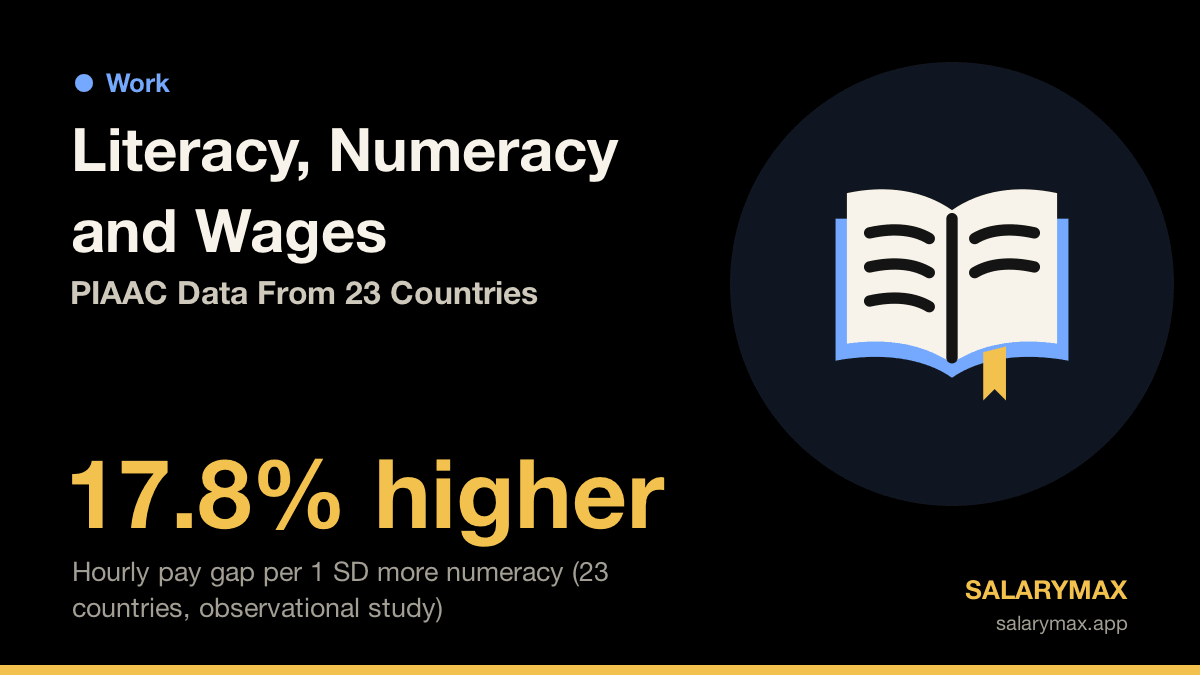
A 23-country study of the OECD PIAAC survey found 1 SD more numeracy went with 17.8% higher hourly pay on average, 18.4% in Japan and about 28% in the US. A correlation.
The evidence behind this article
- Adjusted observational1
Based on observational data. It shows that two things go together, not that one causes the other.
1 sources・Countries studied: Several countries
How to read the kinds of evidence →What to do with this
Spend 10 minutes of your study time reading a table or chart from your work, and write one sentence in your own words on what the numbers mean.
How closely are adult literacy and numeracy linked to pay? A 23-country study using the OECD’s Survey of Adult Skills (PIAAC) found that people with stronger numeracy earned more in every country. But the size of the link varied more than twofold, and it should mostly be read as a correlation.
Key points
- Using the OECD’s Survey of Adult Skills (PIAAC, 2011 to 2012), Hanushek and co-authors (2015) found across 23 countries that among full-time employees aged 35 to 54, one standard deviation more numeracy within a country went with 17.8% higher hourly wages on average.
- The gap varied widely: about 28% in the US, 24% in Ireland and Germany, 21.7% in Korea, 18.4% in Japan and 12% to 15% in the four Nordic countries.
- Literacy on its own showed almost the same link, 17.1% on average. Among workers aged 25 to 34 the figure was smaller, about 14%, so looking only at early-career pay tends to understate the link between skills and wages.
What do PIAAC’s literacy and numeracy tests measure?
PIAAC is an international OECD survey in which adults aged 16 to 65 solve test questions at home. This study used data collected from August 2011 to March 2012 in 24 countries, and analyzed 23 of them, leaving out Russia, whose data were still preliminary.
The survey measures three skills. Literacy is understanding, evaluating and using written texts. Numeracy is reading, using and communicating mathematical information. Problem solving in technology-rich environments is using digital tools to find information and complete tasks. Sample tasks include keeping a driver’s logbook and booking a meeting room online.
The main analysis focuses on 35,854 employees aged 35 to 54 who worked at least 30 hours a week, because pay at those ages is a good stand-in for lifetime earnings. Japan had 1,322 people in the sample and Korea 1,441. In this group, Japan had the highest average numeracy score of all 23 countries.
How much more did people with stronger numeracy earn?
Scores were standardized within each country to a mean of 0 and a standard deviation of 1. Comparing people of the same sex and years of work experience, one standard deviation more numeracy (one typical step up within the country) went with 17.8% higher pre-tax hourly wages on average across the 23 countries.
It was about 28% in the US, 24% in Ireland and Germany, and above 21% in Spain, the UK and Korea (21.7%). Japan, at 18.4%, was close to the average. In the four Nordic countries, Denmark, Finland, Norway and Sweden, it was 12% to 15%. Countries with higher union membership, stricter employment protection and larger public sectors tended to show smaller gaps.
Japan and Korea have relatively narrow spreads of scores within the country. When scores were standardized across all 23 countries instead, the estimate was 3.8 percentage points higher for Japan and 3.1 points higher for Korea.
Age mattered too. In a wider sample of workers aged 25 to 65, the figure was about 14% for those aged 25 to 34, and about 4 points higher for those aged 35 to 54.
How to read the PIAAC research: correlation or cause?
The core of this study is a comparison of observational data. People with stronger numeracy may differ in family background, health or personality in ways that were not measured. The link can also run the other way: people in better jobs may use their skills more at work, which keeps their scores up.
To probe this, the authors also ran analyses using variation in skills linked to years of schooling, parents’ education and changes in compulsory schooling laws, and got even larger estimates. But they note that none of these approaches deals with every possible problem on its own.
How does this differ from our other articles? “Reading the Research on Education and Earnings” looked at years of schooling. PIAAC measures current skills directly rather than years spent in school. Meanwhile, studies of adult learning in Japan and the UK often find that the link with pay shrinks once personal differences are taken into account (see “Self-Study and Pay in Japan” and “Adult Qualifications and Pay: Evidence from the UK”). Even if current skills are linked to pay, that does not mean studying lifts wages by the same amount.
A small step for today
- Spend 10 minutes of your “Studied for 30 minutes” reading a table or chart from your work, and write one sentence in your own words on what the numbers mean.
- Pick one calculation common in your job, such as a percentage or a year-on-year change, and work it through by hand.
- In “Wrote one line on today’s progress,” write down something you learned from a document, including a number. That practices reading, calculating and explaining in one go.
FAQ
Do people who are good at math earn more?
In a 23-country study using the OECD’s PIAAC, people with stronger numeracy tended to earn more: one standard deviation more numeracy went with 17.8% higher hourly wages on average. Because this is observational, it does not mean that improving your numeracy would lift your pay by the same amount.
How strong is the link between numeracy and pay in Japan?
In an analysis of 1,322 full-time employees aged 35 to 54 in Japan, one standard deviation more numeracy within the country went with 18.4% higher hourly wages. That is close to the 23-country average of 17.8% and smaller than in the US, at about 28%.
Which matters more for pay, literacy or numeracy?
On their own, the two were almost the same, at 17.1% and 17.8% on average. When both were included together, numeracy came out stronger, but the authors note that the two scores are highly correlated (0.87), so such results should be read with caution.
Sources
- [X-hanushek-2015] Hanushek, Schwerdt, Wiederhold & Woessmann (2015) Returns to skills around the world: Evidence from PIAAC. European Economic Review.
Studies describe average tendencies. This article is not a promise that a habit will lift your income, and it is not medical or investment advice. About these articles ・ Search & sources
Updated:
← All articles