Practice ・ 7 min
Does self-employment pay more than a job? US research
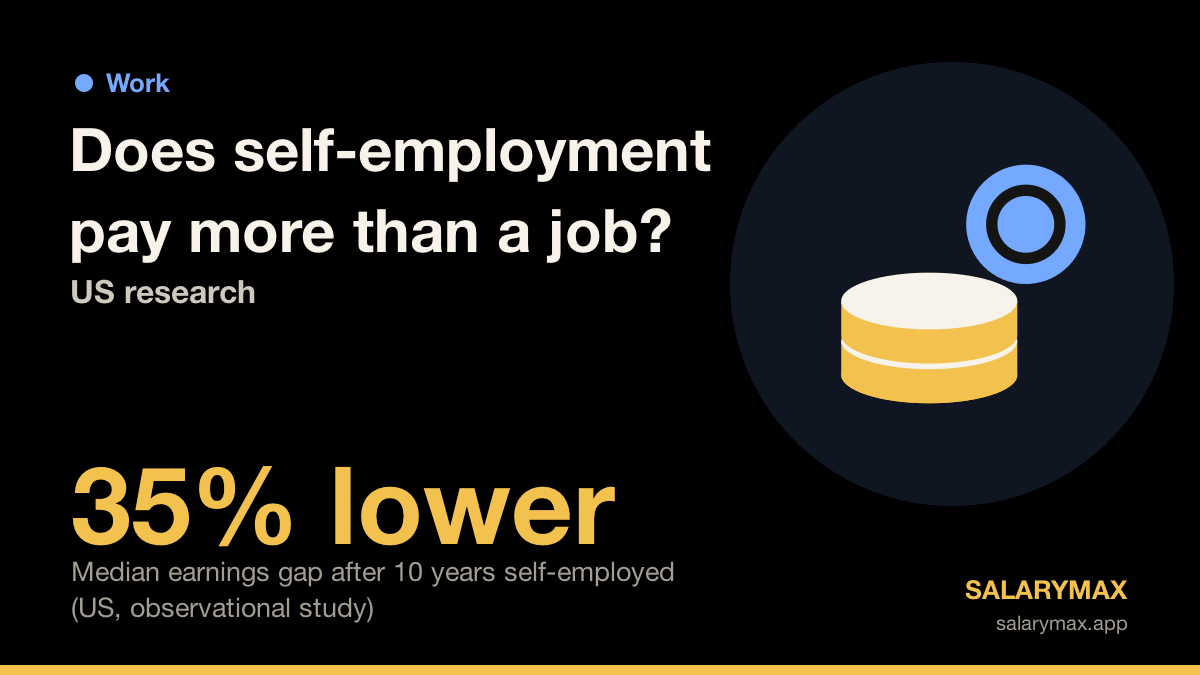
A classic US study found median earnings after 10 years of self-employment about 35% below paid work. Incorporated owners tended to earn more. The data are observational.
The evidence behind this article
- Adjusted observational3
Based on observational data. It shows that two things go together, not that one causes the other.
3 sources・Countries studied: United States, Japan
How to read the kinds of evidence →What to do with this
If you are thinking of going independent, list your pay plus the insurance and benefits your employer provides, and compare them with your expected income in one table.
Do people earn more when they leave a job and work for themselves? A classic US study found the opposite for the typical self-employed person: lower earnings than in paid work, with a median gap of about 35% after 10 years in business. Later research, however, shows that once the self-employed are split into groups, owners of incorporated businesses tend to earn more.
Key points
- Using US data, Hamilton (2000) found that most self-employed people had both lower starting earnings and slower earnings growth than in paid employment, implying a median earnings gap of about 35% for those in business for 10 years. The gap could not be explained by less able employees moving into self-employment.
- Levine and Rubinstein (2017) split the US self-employed into incorporated and unincorporated business owners. In the working-paper version, the median incorporated owner earned about 50% more per hour and worked about 25% more hours than the median salaried worker, while the median unincorporated owner earned about 15% less per hour.
- A Japanese study using household panel data from 2009 to 2019 (a discussion paper, not peer reviewed) found that self-employed households may underreport their disposable income by about 33.0 to 36.4%. Self-employment income is hard to compare using survey or tax figures alone.
How much less did the typical self-employed person earn?
Barton Hamilton (2000) used US data to compare what people with similar characteristics earned in self-employment and in paid work.
Most self-employed people started out earning less than they would have as employees, and their earnings grew more slowly. For people in business for 10 years, the median earnings gap was estimated at about 35%. The median is the middle person when everyone is lined up by income.
The gap could not be explained by low-ability employees moving into self-employment. It was similar across three different ways of measuring self-employment earnings and across industries. And because employee benefits such as health insurance were not counted, the true difference in total pay may be even larger. Since many people still started and stayed in business, Hamilton concluded that the non-financial benefits of self-employment must be substantial.
The study also found that self-employment earnings are more widely spread out than employee earnings.
Do incorporated business owners earn differently from sole traders?
Ross Levine and Yona Rubinstein (2017) used the Current Population Survey (CPS) and the National Longitudinal Survey of Youth 1979 (NLSY79), which follows the same people from their youth. They split the self-employed into those who run incorporated businesses and those who run unincorporated ones.
In the working-paper figures, using CPS data for 1995 to 2012, the median incorporated owner earned about 50% more per hour than the median salaried worker and worked about 25% more hours. The median unincorporated owner, in contrast, earned about 15% less per hour.
People who incorporated had distinctive traits. They tended to be more educated, and as teenagers they scored higher on learning aptitude tests, had higher self-esteem and engaged in more rule-breaking behaviour. The authors call this combination “smart and illicit.” The published abstract reports that people tend to see a material increase in earnings when they become incorporated business owners, at every decile of the earnings distribution. But those who incorporated were already high earners as salaried workers.
What self-employment research can and cannot tell you
What this evidence supports is a split picture. In the US, the typical self-employed person tends to earn less than in paid work, while a subset who run incorporated businesses tend to earn more. Both studies are observational. Nobody was randomly assigned to start a business, and differences in who chooses to do so show up in the results.
How income is measured matters too. In Japan, Niizeki and Hamaaki (2021, a Cabinet Office ESRI discussion paper, not peer reviewed) used a household panel from 2009 to 2019 and compared the spending of self-employed and salaried households after accounting for income, wealth and household traits. They found that self-employed households may underreport their disposable income by about 33.0 to 36.4%. Similar concerns have been raised in the US, so survey figures alone may make self-employment look worse than it is.
The US studies reflect US institutions and markets, which differ from Japan’s tax, social insurance and work patterns. This article does not cover a Japanese study that follows the same people before and after going independent and compares them with employees.
A small step for today
The research supports one modest idea: do not compare going independent with staying employed on salary alone.
- Write down your current pay plus the insurance and benefits your employer provides. In the US study, counting such benefits could make the gap even larger.
- If you are considering independence, write down what form it would take (an incorporated business or a small sole proprietorship) and what you would sell. In the US, earnings patterns differed sharply by form.
- If you already have side or freelance work, use “Tracked spending” and “Wrote one line on today’s progress” to keep a record of income and costs.
FAQ
Do self-employed people earn more than employees?
On average, not necessarily. In the US study, the typical self-employed person had lower starting earnings and slower growth than in paid work, with a median gap of about 35% after 10 years. Owners of incorporated businesses, however, tended to earn about 50% more per hour than salaried workers (working-paper version).
If earnings are lower, why do so many people go independent?
Hamilton concluded that the non-financial benefits of self-employment must be large. The earnings gap could not be explained by less able employees choosing self-employment.
Are statistics on self-employment income accurate?
They are hard to compare directly. A Japanese household panel study (a discussion paper, not peer reviewed) found that self-employed households may underreport their disposable income by about 33.0 to 36.4%. Survey figures alone should not be taken as proof that self-employment pays less.
Sources
- [X-hamilton-2000] Hamilton (2000) Does Entrepreneurship Pay? An Empirical Analysis of the Returns to Self-Employment. Journal of Political Economy.
- [X-levine-rubinstein-2017] Levine & Rubinstein (2017) Smart and Illicit: Who Becomes an Entrepreneur and Do They Earn More? The Quarterly Journal of Economics.
- [X-niizeki-hamaaki-2021] Niizeki & Hamaaki (2021) Do the Self-Employed Underreport Their Income? Evidence from Japanese Panel Data. ESRI Discussion Paper Series No.366.
Studies describe average tendencies. This article is not a promise that a habit will lift your income, and it is not medical or investment advice. About these articles ・ Search & sources
Updated:
← All articles