Basics ・ 6 min
Do licensed workers earn more? US and Japanese evidence
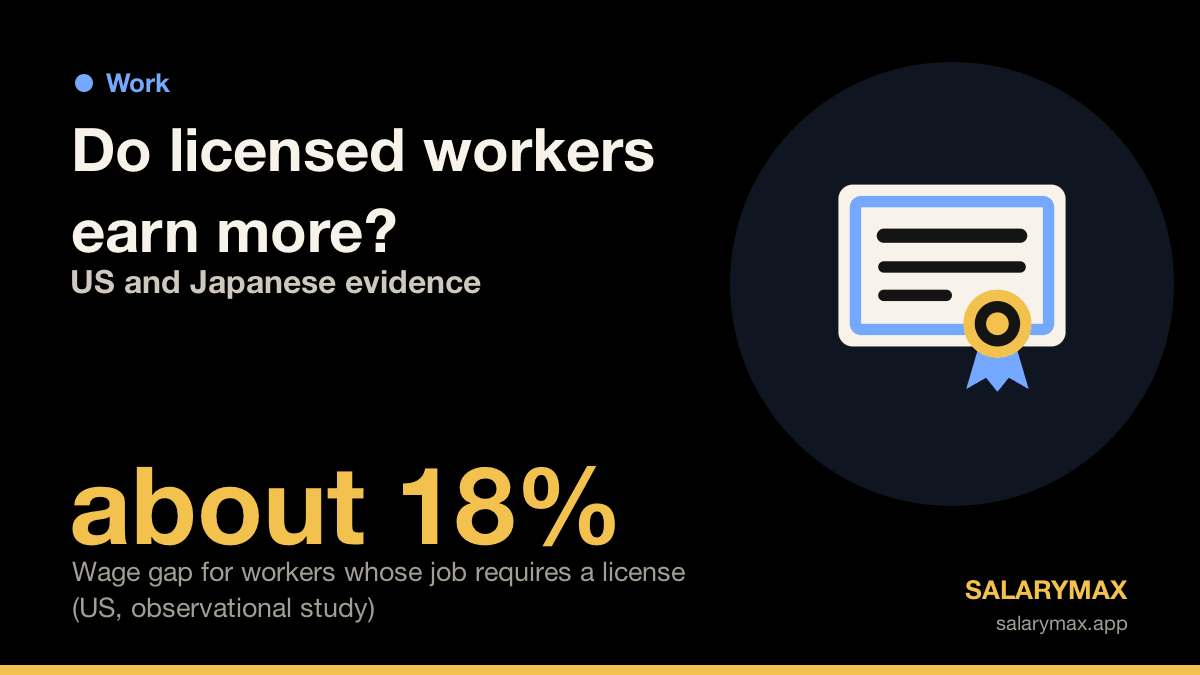
In a 2008 US survey, workers in jobs requiring a license earned about 18% more. A Japanese survey found a similar link for licenses used at work. Both are observational.
The evidence behind this article
- Adjusted observational3
Based on observational data. It shows that two things go together, not that one causes the other.
3 sources・Countries studied: United States, Japan
How to read the kinds of evidence →What to do with this
Check whether a credential you hold or want is a legal license or a voluntary certification, and write down whether your current job would actually use it.
How much more do people with a license or certification earn? In a US survey, workers in jobs that legally require a license earned about 18% more. But much of that gap reflects which occupations people work in, and a Japanese survey found that credentials were linked to higher pay mainly when people actually used them at work.
Key points
- In a 2008 US national phone survey of about 2,500 people, Kleiner and Krueger found that 29% of employees needed a government license for their job, and licensing was associated with about 18% higher wages. Government certification had a much smaller link with pay.
- Using a large US government survey (SIPP, 2012), another study found that people with a license or certification earned 23.6% more before any adjustment, but only 6.5% more once detailed occupation was taken into account. Both studies are observational, so they do not show that getting a credential raised anyone’s pay.
- In a discussion paper (not peer reviewed) using a 2016 Japanese internet survey of 10,000 people, workers who used an exclusive license at work had annual earnings 17.3 log points higher for men and 11.7 for women, even after accounting for occupation. People who held a credential but did not use it at work showed little clear difference.
How much more did US workers in licensed jobs earn?
First, two terms. A license is required to do the job legally, as for doctors or lawyers. A certification is not required, but it lets you use a title or signals your skills.
Morris Kleiner and Alan Krueger (2013) used a national phone survey carried out in the United States in June and July 2008. About 2,500 people were asked whether someone without a license or certificate would be legally allowed to do their job, which let the researchers separate licenses from certifications. They found that 35% of employees were either licensed or certified by the government, and 29% were licensed. Licensing was associated with about 18% higher wages, while the link between government certification and pay was much smaller.
How much of the credential gap is really about occupation?
Maury Gittleman, Mark Klee and Morris Kleiner (2018) used new questions about credentials in the Survey of Income and Program Participation (SIPP), a large US government survey. In fall 2012, 28.0% of working adults aged 18 to 64 held a license or certification.
In the working-paper version, people with a license or certification earned 23.6% more with no adjustment. When the authors compared people within the same detailed occupation, the gap fell to 6.5%. Credential holders are more common in well-paid occupations. Splitting by who issued the credential, holders of government-issued licenses earned 6.2% more and holders of privately issued certifications 7.3% more than people with neither, so the two gaps were similar.
In Japan, Masayuki Morikawa (2017) used an internet survey of 10,000 people run by the Research Institute of Economy, Trade and Industry. The paper is a discussion paper that has not been peer reviewed. In this sample, 55.9% held some occupational credential and 31.2% held an exclusive one, meaning a license required to do the work or a credential a business is legally required to have on staff. After accounting for age, education, industry, occupation and type of employment, the gap for ordinary credentials was 7.0 log points for men and close to zero for women. For exclusive licenses, gaps of 17.3 points for men and 11.7 points for women remained. Log points are roughly comparable to percentages at this size.
What credential research can and cannot tell you
What this evidence supports is a tendency: in US and Japanese observational data, people who use licenses or certifications at work tend to earn more. Nobody was randomly assigned to get a credential, and Kleiner and Krueger themselves describe their estimates as mainly descriptive.
The gap also needs careful reading. Morikawa points out that the premium for exclusive licenses probably includes a substantial monopoly rent, extra pay that arises because only license holders may do the work. In the Japanese survey, people who held a credential but did not use it in their current job showed no clear earnings difference, except men with exclusive licenses. A credential seems to matter when it is matched with work that needs it.
The Japanese survey did not ask about individual credentials such as nursing or tax accounting, and as an internet survey its respondents may not be fully representative. US licensing rules also differ by state and from Japan’s.
A small step for today
The research supports a simple idea: check what kind of credential it is, and how you would use it, before investing time.
- Find out whether the credential you are considering is a legal license or a voluntary certification. The size of the pay link differed between the two.
- Look at one job posting to see whether your current or target job actually asks for it. Use “Wrote one line on today’s progress” to note what you found.
- If you decide to go for it, log “Studied for 30 minutes” and move forward a little each day.
FAQ
Will getting a certification raise my salary?
There is no promise that it will. In US and Japanese surveys, people who use licenses or certifications at work tended to earn more, but the data are observational. In one US study, the gap shrank from 23.6% to 6.5% once detailed occupation was taken into account.
Do government licenses pay more than private certifications?
The studies disagree. In the 2008 US survey, government certification had a much smaller link with pay than licensing, but in the larger 2012 survey, government-issued licenses (6.2%) and private certifications (7.3%) showed similar gaps. In Japan, exclusive licenses showed a larger gap than ordinary credentials.
Is a credential worth anything if I do not use it at work?
In a discussion paper using the Japanese survey of 10,000 people, holding a credential without using it in the current job showed no clear link with earnings, except for men with exclusive licenses.
Sources
- [X-kleiner-krueger-2013] Kleiner & Krueger (2013) Analyzing the Extent and Influence of Occupational Licensing on the Labor Market. Journal of Labor Economics.
- [X-gittleman-klee-kleiner-2018] Gittleman, Klee & Kleiner (2018) Analyzing the Labor Market Outcomes of Occupational Licensing. Industrial Relations.
- [X-morikawa-2017] Morikawa (2017) Occupational Licensing and Labor Market Outcomes (in Japanese). RIETI Discussion Paper Series 17-J-009.
Studies describe average tendencies. This article is not a promise that a habit will lift your income, and it is not medical or investment advice. About these articles ・ Search & sources
Updated:
← All articles